The Bottleneck Theory of a Good Life
Most self-improvement fails because it treats life like a grocery list. But your life isn't fifty problems. It's one constraint. Find it, fix it, and everything else moves.
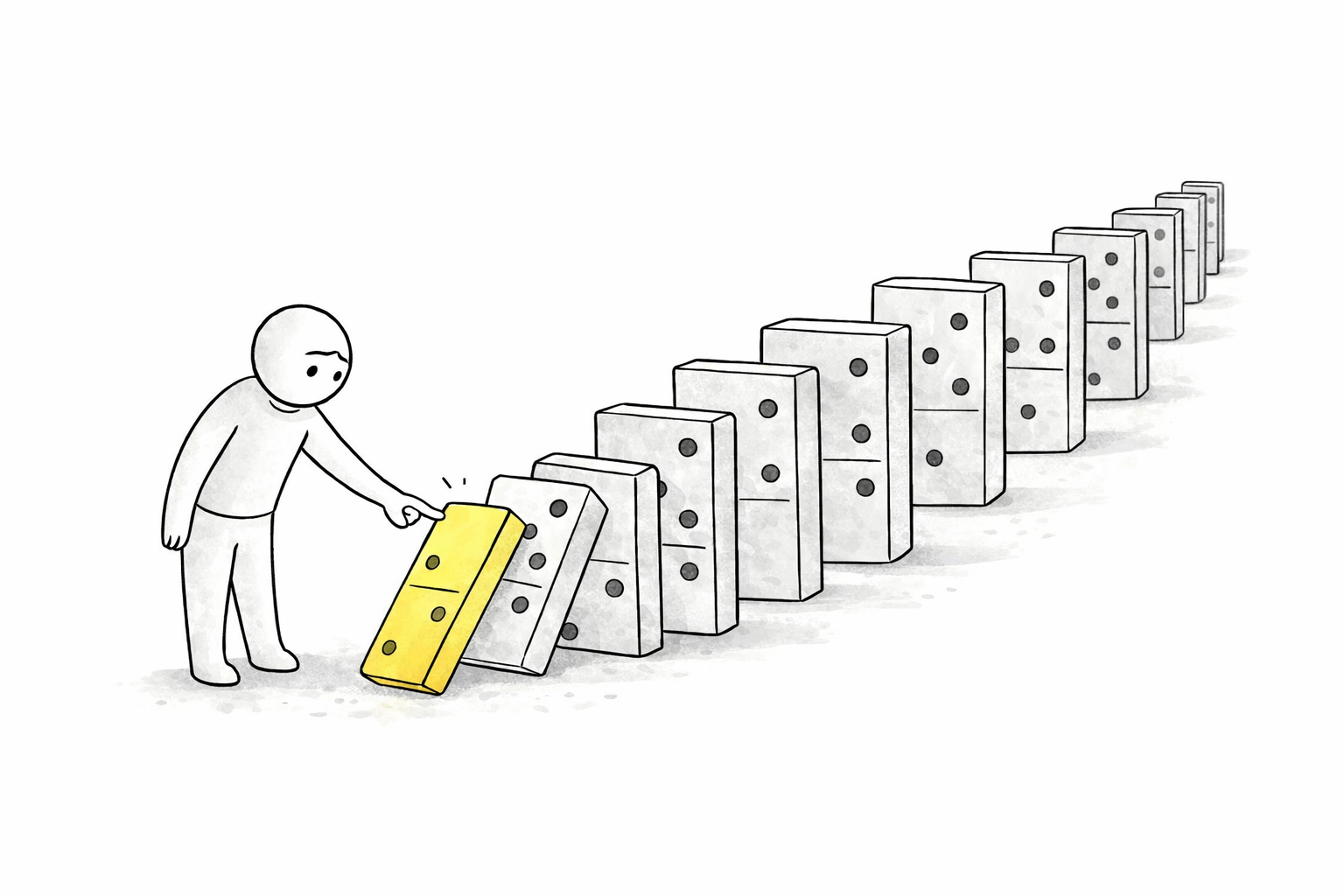
You don't have fifty problems
Here's something most people never figure out: you don't have fifty problems. You have one. You just experience it as fifty.
The busy mom who feels behind on everything (the kids, the career, the house, the relationship) doesn't need a better system for managing all of it. She needs to sleep. Fix sleep, and her patience returns. Patience makes her more present with her kids. Presence makes her less reactive at work. Less reactivity means fewer fires to put out at home.
One thing changed. Everything moved.
The founder who's working eighty hours a week, saying yes to every meeting, starting three projects before finishing one? His bottleneck isn't time management. It's the inability to say no. Fix that, and the calendar opens up. The calendar opens up, and deep work becomes possible. Deep work means the projects actually ship.
Again: one thing.
This isn't motivational thinking. It's a theory. And once I understood it, I couldn't unsee it.
The factory floor insight
In 1984, a physicist named Eliyahu Goldratt published a business novel called The Goal. It was about a failing manufacturing plant, and it contained an idea so powerful that it changed how entire industries think about performance.
The idea: every system, no matter how complex, is constrained by exactly one bottleneck at any given time. The capacity of the entire system equals the capacity of that single constraint. Not the average of all its parts. Not the sum. The weakest point.
An hour lost at the bottleneck is an hour lost for the entire system. An hour saved anywhere else is a mirage.
Goldratt called this the Theory of Constraints. Manufacturing companies used it to double output without buying new equipment. They just found the one machine that was slowing everything down and fixed that. The resistance was always the same: "But what about these other twelve things that also need improvement?" Goldratt's answer was simple. Those twelve things don't matter. Not yet. Only the bottleneck matters.
Here's what's interesting: Goldratt's five steps for fixing a constraint aren't complicated. Identify the bottleneck. Get everything you can out of it. Make sure nothing else is making it worse. If it's still a problem, invest in fixing it. Then find the new bottleneck and repeat.
So why doesn't anyone do this with their life?
The grocery list problem
Instead, people treat self-improvement like a grocery list. Wake up earlier. Meditate. Exercise. Read more. Journal. Eat better. Call your parents. Learn a language. Network. Side hustle.
The list is long. It feels productive. But does any of it actually move the needle? Here's what the research shows: not really.
A Harvard Business School working paper examined the side effects of goal-setting and found something that the self-help industry doesn't like to talk about. Goals narrow attention so aggressively that other important things get missed. And in multi-goal situations, people default to whichever goal is easiest to measure, not whichever one matters most. The researchers went so far as to describe goal-setting as "a prescription-strength medication that requires careful dosing, consideration of harmful side effects, and close supervision."
Prescription-strength medication. Not a grocery list you tape to your bathroom mirror.
The pattern is clear. One specific goal dramatically outperforms a scattered handful. Not because the other goals don't matter, but because attention is finite and dilution is real.
The thinkers who got this right
What's striking is how many of the most effective people in modern history arrived at this same idea independently.
When Steve Jobs returned to Apple in 1997, the company was ninety days from bankruptcy and selling dozens of mediocre products. Jobs cut 70% of the product line. Not trimmed. Cut. The tech press said he was destroying Apple. He was finding the bottleneck. Within two years, the iMac launched and the company posted its first profit in over a decade.
"People think focus means saying yes to the thing you've got to focus on," Jobs said. "But that's not what it means at all. It means saying no to the hundred other good ideas."
Peter Drucker reached the same conclusion from a different starting point entirely. "If there is any one secret of effectiveness," he wrote in The Effective Executive, "it is concentration. Effective executives do first things first and they do one thing at a time."
Not two things. Not their top five priorities. One thing at a time.
Gary Keller built an entire real estate empire on this principle and then wrote a book about it. His key insight was the domino effect: a single domino can knock over another domino 50% larger than itself. Line them up sequentially and a two-inch domino eventually topples something the size of the Leaning Tower of Pisa. But only if you line them up. Knock them over simultaneously and you just have a mess on the floor.
"Extraordinary success is sequential, not simultaneous," Keller wrote. You do the right thing, then you do the next right thing.
Why this works (the science)
Why does sequential focus work so much better than the parallel approach we all default to? It's not philosophical. It's mechanical. Your brain has real constraints.
Working memory holds about four items at once. When you're pursuing eight goals simultaneously, you're not making parallel progress on eight fronts. You're rapidly switching between them, paying a cognitive tax every time you shift context. Sophie Leroy at the University of Minnesota calls this "attention residue." After you switch tasks, part of your attention stays stuck on the previous one. The more you switch, the more residue accumulates. Eventually you're not really focused on anything.
Vilfredo Pareto noticed something similar in 1896, though he was looking at Italian land ownership, not personal growth. Twenty percent of the population owned eighty percent of the land. The principle turned out to be everywhere: 20% of your efforts produce 80% of your results. But here's what I find most interesting about the Pareto principle. It's fractal. Apply it again to the top 20%, and you find that 4% of your efforts produce 64% of your results. Keep going. What do you get? Something very close to Goldratt's conclusion: there's one thing that matters more than everything else combined.
The hard part
So why don't people do this? Why does everyone default to the grocery list?
Because finding your bottleneck requires honesty. Real honesty.
The grocery list is comfortable. It lets you stay busy without confronting the thing you're actually avoiding. You can meditate every morning and still not have the conversation you need to have. You can optimize your morning routine to the minute and still not quit the job that's draining you. The list gives you the feeling of progress without the vulnerability of change.
The bottleneck is almost always something you already know about. It's the thing you think about at 2am. The thing you change the subject from. The thing that, when a friend brings it up, makes your chest tighten.
You don't need a productivity system to find it. You need five minutes of honesty.
Your bottleneck is not a mystery. It's the thing you've been avoiding.
The domino, not the list
Here's what the bottleneck theory means in practice. At any moment in your life, there's one constraint that, if you resolved it, would unlock everything else. Not eventually. Not theoretically. Directly.
What does yours look like? Maybe it's a relationship that's poisoning your energy. Maybe it's a health issue you keep postponing. Maybe it's a career move you've been "thinking about" for two years. Maybe it's something as simple and hard as sleep.
Whatever it is, it's not item number thirty-seven on your self-improvement list. It's item number one. And everything else on the list is either downstream of it or a distraction from it.
Identify
What is the single thing that, if you fixed it, would make everything else easier? You probably already know the answer.
Commit
Stop spreading your attention across a dozen goals. Put everything behind this one constraint until it breaks.
Repeat
Once the bottleneck breaks, a new one emerges. Find it. This is not a one-time exercise. It's a way of operating.
Goldratt's five steps. Jobs cutting 70% of the product line. Drucker's one thing at a time. Keller's sequential dominoes. They're all describing the same mechanism: find the constraint, subordinate everything else to it, break it, then find the next one.
The grocery list feels productive. The bottleneck actually is.
A quiet bet
We built Clarido around this belief. It's the reason our company exists.
Not as a task manager. Not as a place to organize your grocery list of goals. As a place to talk through the noise, find the one thing that actually matters right now, commit to it, and do it. Then find the next one.
I think most people don't need more tools for managing their lives. They need fewer goals and more focus. They need something patient enough to help them cut through the clutter and find the domino.
Your grocery lists still have a place. Somebody has to remember to buy milk.
But the thing that would actually change your life? That's not on any list. You already know what it is. You just haven't committed to it yet.
Get the next essay
One article per week on the psychology of thinking clearly. No spam, unsubscribe anytime.
References
- Goldratt, E.M. & Cox, J. (1984). The Goal: A Process of Ongoing Improvement. North River Press.
- Locke, E.A. & Latham, G.P. (1990). A Theory of Goal Setting and Task Performance. Prentice Hall.
- Locke, E.A. & Latham, G.P. (2002). "Building a Practically Useful Theory of Goal Setting and Task Motivation." American Psychologist, 57(9), 705-717.
- Ordóñez, L.D., Schweitzer, M.E., Galinsky, A.D., & Bazerman, M.H. (2009). "Goals Gone Wild: The Systematic Side Effects of Over-Prescribing Goal Setting." Harvard Business School Working Paper, 09-083.
- Leroy, S. (2009). "Why Is It So Hard to Do My Work? The Challenge of Attention Residue When Switching Between Work Tasks." Organizational Behavior and Human Decision Processes, 109(2), 168-181.
- Keller, G. & Papasan, J. (2013). The ONE Thing: The Surprisingly Simple Truth Behind Extraordinary Results. Bard Press.
- Drucker, P.F. (1967). The Effective Executive. Harper & Row.
Clarido is a quiet log for a loud mind. Speak or type what's on your mind. Clarido holds it for you so you can return when you have space. Join the beta