The Science of Brain Dumping: Why Writing Things Down Frees Mental Space
Your brain can hold about four things at once. Everything beyond that is making you worse at thinking. Here's what the research says about why writing things down helps.
The strange thing about writing everything down
There's a strange thing that happens when you write down everything on your mind. After five or ten minutes, you feel noticeably calmer. Nothing in your life has changed. But something in your head has.
Most people who try this describe the same feeling: relief. Like setting down something heavy you didn't realize you were carrying. Which raises an interesting question: what were you carrying?
The answer involves two things: a fundamental constraint of the human brain that most people don't know about, and a psychological effect discovered almost a hundred years ago that explains why unfinished tasks keep looping in your mind even when you desperately want them to stop.
The bottleneck
Your brain has a workspace for active thinking. Psychologists call it working memory. It's where you hold whatever you're processing right now: the thing someone just said to you, the number you're trying to add, the idea you're developing.
How many things can it hold at once? Far fewer than you'd guess.
George Miller's famous 1956 paper in Psychological Review put the limit at "seven, plus or minus two." Subsequent research has revised that downward. But the exact number matters less than the implication: your brain's active workspace is tiny, and you're overloading it.
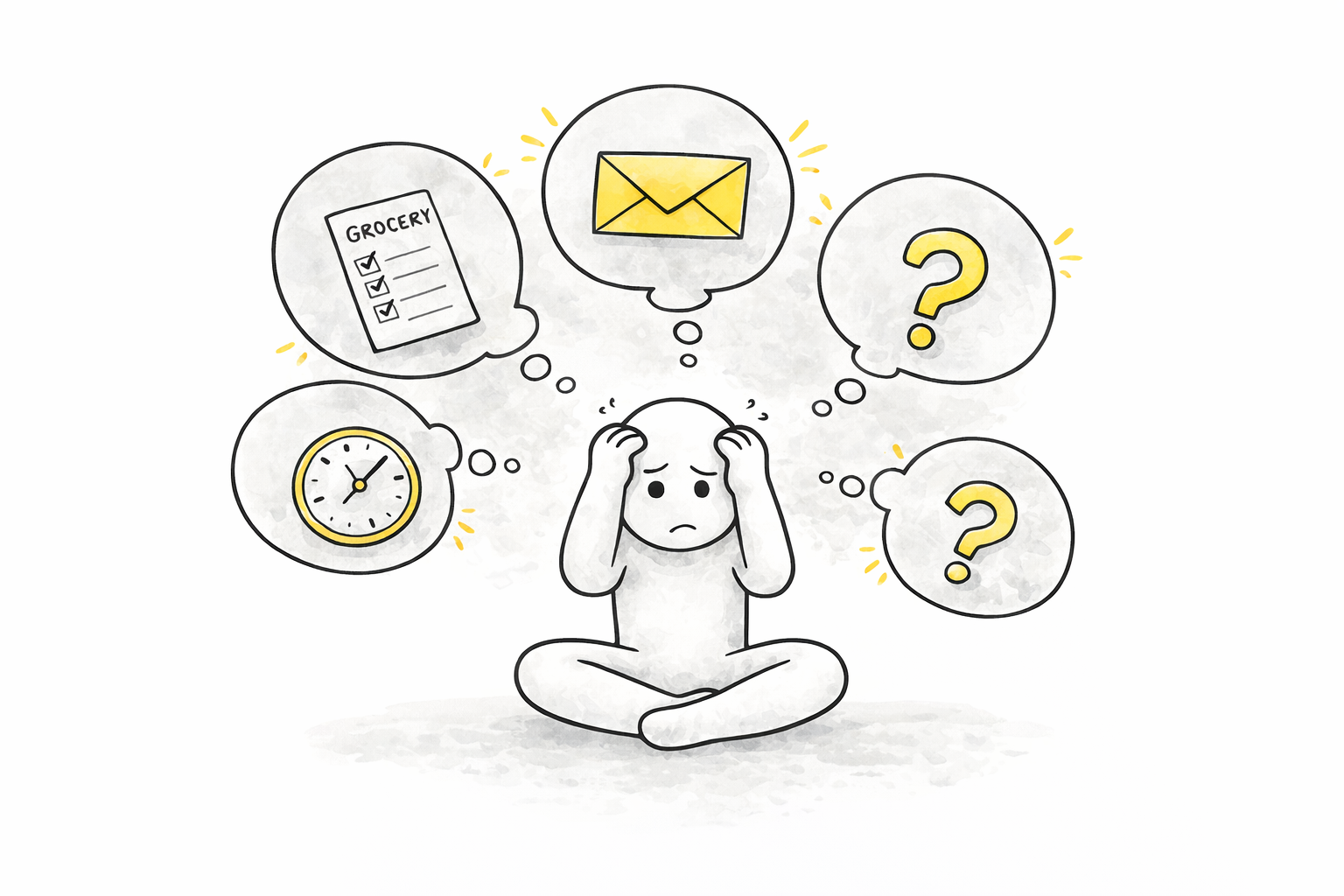
Think of it as a desk with room for four things. When you try to keep twenty things on that desk simultaneously (the email you need to send, the errand you keep forgetting, the conversation you're dreading, the idea you had in the shower), everything gets cluttered and nothing gets proper attention. The problem isn't that you're bad at focusing. It's that you're asking your brain to do something it cannot do.
Why unfinished tasks haunt you
In the 1920s, a psychologist named Bluma Zeigarnik noticed something interesting: people remember incomplete tasks far better than completed ones. Your brain doesn't passively store your to-do list. It keeps unfinished items running in the foreground of your mind, nagging you about them.
This makes evolutionary sense. If you needed to find water before nightfall, you wouldn't want your brain to file that away and move on. But in modern life, where you might have thirty unfinished tasks at any given moment, the Zeigarnik effect becomes a problem. Your brain is running thirty background processes, all consuming resources, all competing for those four working memory slots.
So what happens when the demand exceeds capacity?
A kind of mental fog where you can't focus on anything, because you're vaguely thinking about everything.
Psychologists call this "cognitive load." When it spikes, the consequences cascade:
Focus drops
You can't concentrate on complex tasks because your mental bandwidth is consumed by open loops.
Creativity stalls
Novel ideas require free working memory. When it's full of tasks and worries, creative thinking shuts down.
Problem-solving slows
You can't hold the problem and all its context when slots are occupied by unrelated clutter.
Energy drains
Mental fatigue sets in. Not from doing too much, but from carrying too much.
Ramirez and Beilock demonstrated this in a 2011 study published in Science: students who wrote down their worries before an exam performed better than those who didn't. Same students, same exam. The only difference was that one group offloaded their mental clutter first.
Why writing helps
But what if you didn't have to finish a task to stop thinking about it?
That's the surprising part. A 2011 study by Masicampo and Baumeister in the Journal of Personality and Social Psychology found that writing down a specific plan for an unfinished task was enough to stop it from intruding on your thoughts. You didn't have to execute the plan. Just making one was sufficient.
This makes intuitive sense once you think about it. Your brain nags you about unfinished tasks because it's worried you'll forget them. When you write something down in a place you trust, you're sending a signal: this is handled. You can let it go now. And it does.
Your brain evolved to think, analyze, and solve problems. Not to be a filing cabinet. When you use it to store things instead, you're wasting its most valuable capability.
The analogy that works best for me is RAM versus disk. Your working memory is like RAM: fast but limited in capacity. When you try to store long-term information in it, you're not just wasting space. You're degrading your brain's ability to do what it does best: think through hard problems. Writing things down moves data to disk. It frees up RAM for the work that matters.
And that's why people feel so much better afterward. Not because anything external has changed, but because they've restored their brain to its intended mode of operation.
How to brain dump
The practice itself is simple, which is part of why it works. Set aside five to fifteen minutes and write down everything on your mind.
The key word is everything. Not just tasks. Worries too. Random thoughts. Ideas. Things people said that are bothering you. Questions you don't have answers to. The messier it is, the better. You're emptying a cache, not building a filing system.
What do you do with it all once it's on paper? It helps to do a loose sort. Most things fall into one of three buckets:
Action items
Things you need to do
"Buy birthday gift for Mom"
Thoughts to process
Worries, feelings, or ideas that need reflection
"Idea for side project"
Reference info
Things you just need to remember
That third bucket (things you just needed to get out of your head) is larger than you'd expect.
For action items, the most important thing is to make them specific. "Work on presentation" lingers in your mind as an open loop. "Create slides 1–5 for Tuesday's client meeting" doesn't. The more concrete the task, the easier it is for your brain to let go of it.
Then, and this matters, assign it a time or put it on a calendar. Unscheduled tasks tend to float back into working memory, recreating the clutter you just cleared.
What about worries? Writing serves a different function here. It forces you to articulate what you're worried about, which often turns out to be more fixable than the vague anxiety you've been carrying. The worry that's been looping in the background for days sometimes resolves itself the moment you pin it down on paper.
The deeper mechanism
There's something going on here that's more interesting than mere productivity. Why would writing be different from just thinking about it?
James Pennebaker, the psychologist who pioneered research on expressive writing, found that writing about stressful experiences measurably improved immune function and reduced blood pressure. His research, spanning decades and published across journals including Psychosomatic Medicine and Advances in Experimental Social Psychology, points to a consistent mechanism: writing forces you to organize fragmented thoughts into coherent narratives. You can't write about something without thinking about it more carefully than you otherwise would.
This is why brain dumping often produces a feeling that goes beyond relief. When you look at everything written down in front of you, you sometimes see connections you missed. The worry that's been bothering you turns out to be about something actionable. The decision you've been agonizing over turns out to be obvious once you can see all the factors at once.
A 2018 study by Scullin et al. at Baylor University, published in the Journal of Experimental Psychology, adds another dimension: writing about unfinished tasks before bed improves sleep quality. The Zeigarnik effect, it turns out, is most active at night. Your brain will keep you awake to worry about things it thinks you might forget. Writing them down tells it to stand down.
The practice
The people who benefit most from brain dumping are the ones who make it a habit rather than a one-time experiment.
What does that look like? It doesn't require much. Five minutes in the morning to clear overnight mental accumulation. Five minutes before bed to offload the day's clutter. Or doing it whenever you notice that familiar feeling of mental overload, when your brain feels foggy and nothing is getting your proper attention.
The point is not to build an elaborate system. It's to give your brain regular permission to stop carrying things. Most people who try this consistently for a week report the same thing: they feel lighter. More present. More able to focus on the thing in front of them rather than the twenty things behind it.
Which makes sense. You're not doing anything magical. You're just working with your brain instead of against it, respecting the constraint that it can only hold a few things at once, and giving it a way to let go of the rest.
Get the next essay
One article per week on the psychology of thinking clearly. No spam, unsubscribe anytime.
References
- Miller, G.A. (1956). "The Magical Number Seven, Plus or Minus Two: Some Limits on Our Capacity for Processing Information." Psychological Review, 63(2), 81–97.
- Zeigarnik, B. (1927). "On Finished and Unfinished Tasks." Psychologische Forschung, 9, 1–85.
- Ramirez, G. & Beilock, S.L. (2011). "Writing About Testing Worries Boosts Exam Performance in the Classroom." Science, 331(6014), 211–213.
- Masicampo, E.J. & Baumeister, R.F. (2011). "Consider It Done! Plan Making Can Eliminate the Cognitive Effects of Outstanding Goals." Journal of Personality and Social Psychology, 101(4), 667–683.
- Pennebaker, J.W. & Beall, S.K. (1986). "Confronting a Traumatic Event: Toward an Understanding of Inhibition and Disease." Journal of Abnormal Psychology, 95(3), 274–281.
- Scullin, M.K., Krueger, M.L., Ballard, H.K., Pruett, N., & Bliwise, D.L. (2018). "The Effects of Bedtime Writing on Difficulty Falling Asleep." Journal of Experimental Psychology: General, 147(1), 139–146.
Clarido is a quiet log for a loud mind. Speak or type what's on your mind. Clarido holds it for you so you can return when you have space. Join the beta →