Why You Can't Decide Anything by 8PM
Every decision costs something. Your brain doesn't care if it's a career move or what to have for dinner. By evening, you're not indecisive. You're depleted.
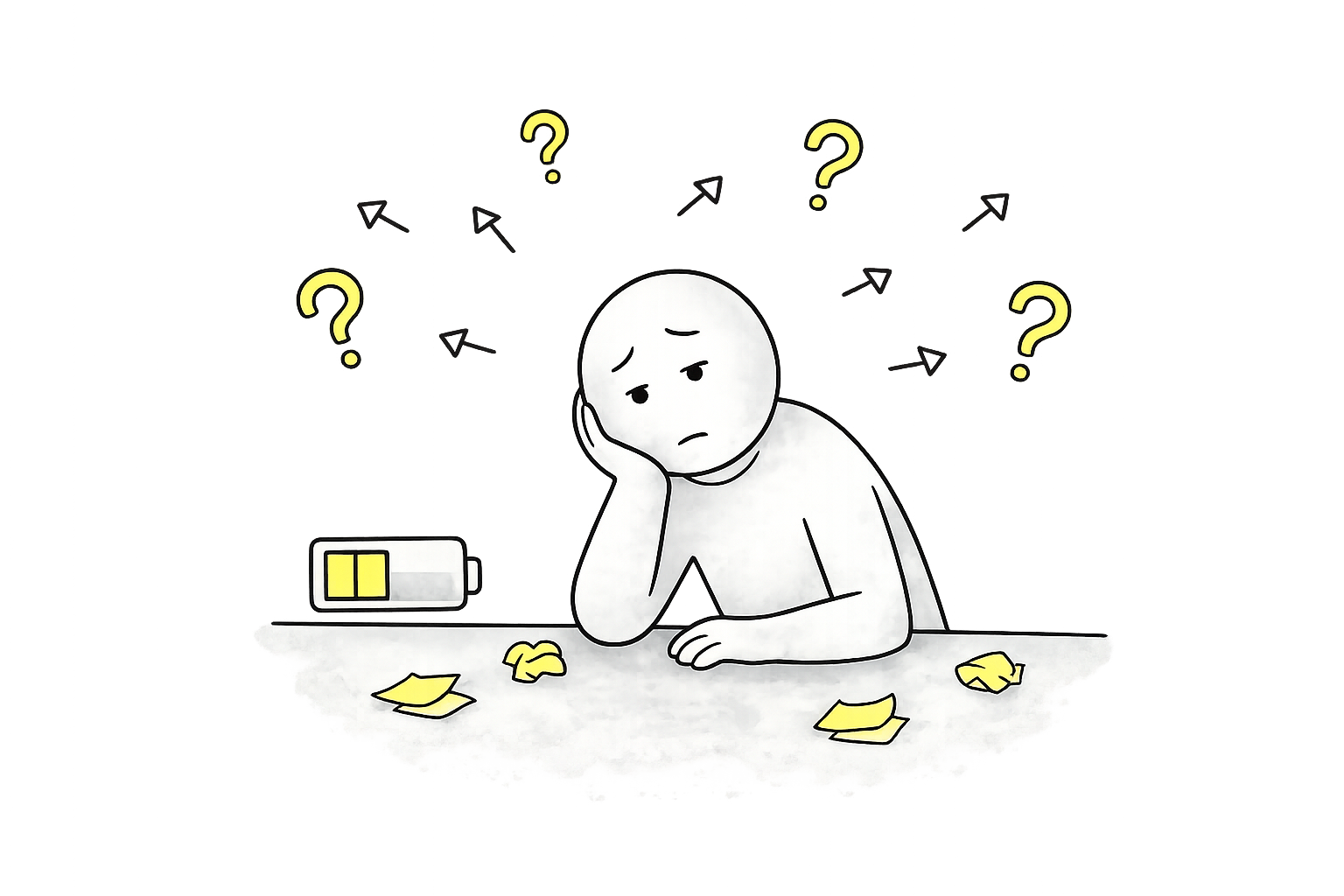
The nightly collapse
It's 8PM. You've had a full day. Nothing catastrophic happened. But now someone asks where you want to eat, and you genuinely cannot answer. The question sits there and your brain just... stalls. You scroll Netflix for twenty minutes and pick nothing. You open the fridge, close the fridge, open it again. You default to whatever requires the least thought.
This isn't laziness. It's not indecisiveness. And it's not a character flaw.
So what happened? Something shifted in your brain over the course of the day, and it happened so gradually you didn't notice until you hit the wall.
The cost of choosing
Here's something most people don't realize: every decision you make has a cost. Not a metaphorical cost. A real, measurable reduction in your brain's ability to make the next one well.
In 2008, Kathleen Vohs and a team of researchers ran a series of experiments that demonstrated this with uncomfortable clarity. Across four lab studies and a field study, they found that the act of choosing between options depleted the same mental resource used for self-control. People who had spent time making decisions showed less physical stamina, gave up on difficult tasks sooner, procrastinated more, and performed worse on basic arithmetic.
The depleting factor wasn't stress. It wasn't physical effort. It was the act of choosing itself.
This is what psychologists call decision fatigue. And once you see it, you start noticing it everywhere.
The judges who stopped thinking
The most striking demonstration of decision fatigue comes from a study that has nothing to do with sandwiches.
In 2011, Shai Danziger and colleagues analyzed more than 1,100 parole decisions made by eight Israeli judges over fifty days. What they found was startling. At the beginning of each session, judges granted parole in roughly 65% of cases. By the end of each session, that number dropped to nearly zero. After a food break, it reset to 65% and began declining again.
Same judges. Same types of cases. The only variable that predicted the ruling was when in the session it occurred.
The judges weren't being malicious. They were being human. When your capacity for careful evaluation runs dry, you default to the safest, easiest option. For judges, that means denying parole. For you, it means scrolling past everything on Netflix and rewatching The Office.
The pattern is the same: depleted brains stop choosing and start defaulting.
Too many options, worse outcomes
Decision fatigue is one half of the problem. The other half is what happens when the decisions themselves are too complex.
Sheena Iyengar and Mark Lepper ran a now-famous field experiment at an upscale grocery store in 2000. On some days, they set out a display with 24 varieties of jam. On other days, just 6. The large display attracted more shoppers to stop and look. But when it came to actually buying? Shoppers who saw 6 options were roughly ten times more likely to purchase than those who saw 24.
So did more options help people choose? The opposite. More options made them freeze.
This shows up in bigger decisions too. Jonathan Levav and colleagues studied people configuring custom cars and suits (published in the Journal of Political Economy in 2010). Early in the configuration process, people made active, deliberate choices. But as the number of sequential decisions mounted, they increasingly accepted whatever the default option was. Not because they preferred the default. Because they'd run out of capacity to evaluate.
Your brain has a finite number of good decisions in it per day. Spend them on trivia, and you won't have them when they matter.
The controversy (and what survived it)
If this sounds familiar, you might be thinking of "ego depletion," the broader theory that willpower is a limited resource. Roy Baumeister's famous 1998 cookie-and-radish experiment launched an entire subfield: participants who resisted eating chocolate cookies gave up on a subsequent puzzle twice as fast as those who didn't have to resist.
It was elegant. It was intuitive. And it ran into a wall.
In 2016, twenty-three laboratories across multiple countries tried to replicate the ego depletion effect using a standardized protocol. The result: essentially zero effect. Twenty-two of the twenty-three labs had predicted they would replicate it successfully. None did convincingly.
Does this mean decision fatigue isn't real?
Not exactly. What the replication failure challenged was the specific mechanism Baumeister proposed: that self-control runs on a single, depletable resource (he even suggested it might be blood glucose). That model is likely too simple. But the behavioral phenomenon, the observable pattern of decisions degrading in quality over time and volume, has replicated consistently in real-world settings. The judges study holds up. The choice overload research holds up. The car configuration study holds up.
The mechanism is debated. The phenomenon is not. Your hundredth decision of the day is worse than your tenth, regardless of why.
Something happens in the brain after sustained decision-making. We don't fully understand the mechanism yet. But we can see the results clearly enough to act on them.
What depleted decision-making looks like
You don't always realize when you've crossed the threshold. Decision fatigue doesn't announce itself. It just quietly changes your behavior.
You default
Instead of evaluating options, you pick whatever requires the least effort. The same lunch. The same route. The same show.
You avoid
You put off decisions entirely. The email sits unanswered. The form goes unfiled. You tell yourself you'll deal with it tomorrow.
You impulse
Depleted brains stop weighing tradeoffs. You buy the thing. You say the thing. You skip the gym. Short-term reward wins by default.
You snap
Emotional regulation runs on the same depleted resource. The small irritation that wouldn't have bothered you at 10AM becomes a fight at 8PM.
Sound familiar? Most people interpret these as personal failings. I'm lazy. I'm indecisive. I have no willpower. But what if the problem isn't you? What if the problem is that nobody told you decisions have a cost, and you've been spending recklessly all day?
Working with the constraint
So what do you do about this? You can't eliminate decision fatigue. Your brain has limits. But you can stop wasting decisions on things that don't deserve them.
The people who seem endlessly decisive aren't working with a bigger tank. They're making fewer withdrawals. Steve Jobs wore the same outfit every day. Barack Obama only wore blue or gray suits. This sounds trivial, and it is, on purpose. Every trivial decision you eliminate is one more good decision available for something that matters.
But wardrobe isn't where most of your decisions go. They go to the dozens of micro-choices that accumulate throughout the day: what to work on next, how to respond to that message, whether to address the thing that's bugging you or let it slide.
The most effective strategy isn't eliminating clothing choices. It's making your hardest decisions first, before the tank runs low. That report you're dreading? Do it at 9AM, not after six hours of email triage. The conversation you need to have? Have it in the morning, when you still have the capacity to be thoughtful.
And for everything else: plan ahead or write it down.
When you decide tomorrow's priorities tonight, you wake up with a plan instead of a blank slate that demands evaluation. When you write down the thing that's circling in your head, you stop spending decision resources on "should I deal with this now or later?" every time it resurfaces. You made the decision once. Your brain can stop re-making it.
The 8PM question
So back to 8PM. Someone asks where you want to eat, and your brain returns a blank screen.
Now you know what happened. You spent the day making hundreds of decisions, most of them so small you didn't register them as decisions at all. Each one cost something. By evening, the account is empty. You're not failing at a simple question. You're asking a depleted brain to do one more thing it doesn't have capacity for.
What's the fix? Not trying harder. Spending less.
Protect your mornings for work that requires real thought. Automate or eliminate the decisions that don't matter. And when something is circling in your head, pulling at your attention, demanding that you decide something about it, write it down. Get it out. Give your brain permission to stop carrying it.
You'll be surprised how much capacity you get back when you stop asking your brain to hold and evaluate everything at once. The question was never whether you're good at decisions. The question is how many you've already made today.
Get the next essay
One article per week on the psychology of thinking clearly. No spam, unsubscribe anytime.
References
- Baumeister, R.F., Bratslavsky, E., Muraven, M., & Tice, D.M. (1998). "Ego Depletion: Is the Active Self a Limited Resource?" Journal of Personality and Social Psychology, 74(5), 1252-1265.
- Vohs, K.D., Baumeister, R.F., Schmeichel, B.J., Twenge, J.M., Nelson, N.M., & Tice, D.M. (2008). "Making Choices Impairs Subsequent Self-Control: A Limited-Resource Account of Decision Making, Self-Regulation, and Active Initiative." Journal of Personality and Social Psychology, 94(5), 883-898.
- Danziger, S., Levav, J., & Avnaim-Pesso, L. (2011). "Extraneous Factors in Judicial Decisions." Proceedings of the National Academy of Sciences, 108(17), 6889-6892.
- Iyengar, S.S. & Lepper, M.R. (2000). "When Choice Is Demotivating: Can One Desire Too Much of a Good Thing?" Journal of Personality and Social Psychology, 79(6), 995-1006.
- Levav, J., Heitmann, M., Herrmann, A., & Iyengar, S.S. (2010). "Order in Product Customization Decisions: Evidence from Field Experiments." Journal of Political Economy, 118(2), 274-299.
- Hagger, M.S., Chatzisarantis, N.L.D., Alberts, H., et al. (2016). "A Multilab Preregistered Replication of the Ego-Depletion Effect." Perspectives on Psychological Science, 11(4), 546-573.
Clarido is a quiet log for a loud mind. Speak or type what's on your mind. Clarido holds it for you so you can return when you have space. Join the beta