Your Brain's Background App: The Default Mode Network and Why Your Mind Won't Stay Still
You spend nearly half your waking life thinking about something other than what you're doing. That's not a flaw. It's a feature called the default mode network, and it's doing more important work than you realize.
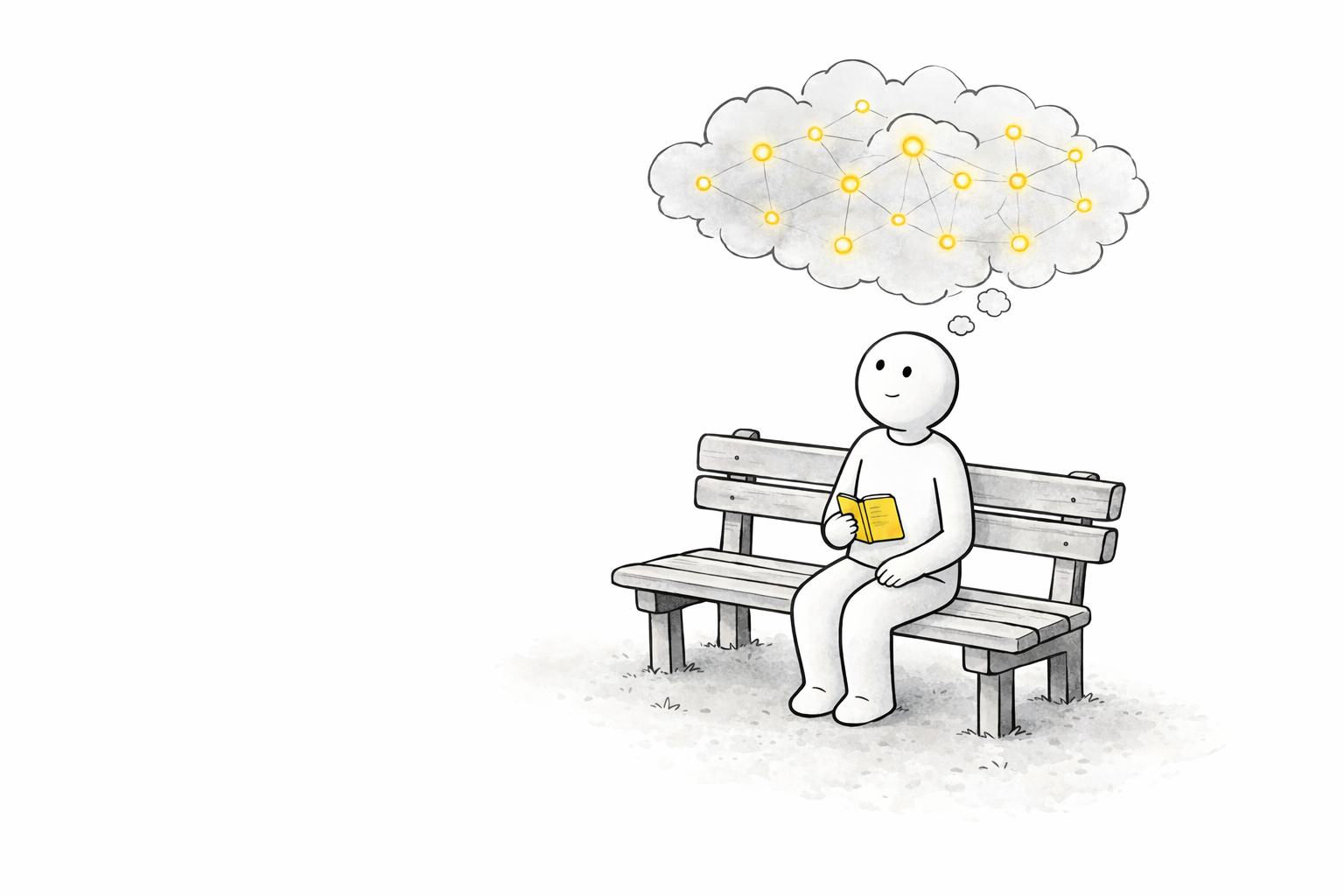
You're not paying attention right now
Not fully. Even as you read this sentence, part of your brain is somewhere else. Maybe it's replaying a conversation from this morning. Maybe it's rehearsing what you're going to say in tomorrow's meeting. Maybe it drifted to something you forgot to do last week, and you just caught yourself.
Don't worry. This happens to everyone, roughly half the time.
In 2010, Harvard psychologists Matthew Killingsworth and Daniel Gilbert built a smartphone app that pinged 2,250 people at random moments throughout their day, asking three simple questions: What are you doing? What are you thinking about? How are you feeling?
The results, published in Science, were striking.
Your mind wanders when you're commuting. It wanders during conversations. It wanders while you're eating, exercising, working. The only activity where people stayed mostly present was sex, and even then, 30% of the time their minds were elsewhere.
So what's going on? Is your brain broken? Are you bad at paying attention?
No. Your brain is doing exactly what it evolved to do. And the system responsible has a name.
The network that never shuts up
In 2001, a neuroscientist named Marcus Raichle at Washington University noticed something odd in brain imaging data. When researchers put people in an fMRI scanner and asked them to do nothing (just lie still and stare at a fixation point), their brains didn't go quiet. Specific regions lit up. The same ones, consistently, across subjects.
This was strange. Neuroscience had always focused on what the brain does during tasks. Nobody had paid much attention to what it does during the gaps between tasks. Raichle and his colleagues published a paper in Proceedings of the National Academy of Sciences that proposed these regions weren't just idling. They were doing something. He called it the brain's "default mode of function."
The name stuck. Today we call it the default mode network, or DMN.
It includes the medial prefrontal cortex (involved in thinking about yourself), the posterior cingulate cortex (involved in memory retrieval), and the angular gyrus (involved in integrating different types of information). These regions activate together, like a circuit, whenever your attention turns inward.
Here's the pattern: when you focus on an external task, the DMN quiets down. When you stop focusing, it fires back up. Like a background app on your phone that springs to life the moment you close whatever you were using.
But calling it a "background app" undersells what it's doing. The DMN isn't wasting your brain's resources. It's running some of the most important cognitive processes you have.
What the wandering mind is actually doing
Your default mode network handles three things that matter enormously.
Autobiographical memory
Sifting through your past, pulling up experiences, connecting them to the present
Future simulation
Projecting yourself forward in time, imagining scenarios, rehearsing possibilities
Social cognition
Modeling other people's minds, figuring out what they think and feel
Notice the thread? All three involve your sense of self. The DMN is your brain's storytelling engine. It weaves together who you were, who you are, and who you might become. It's the system that creates what neuroscientists call your "internal narrative," the running story of your life that gives your experiences coherence.
This is why mind wandering feels so personal. Your brain isn't randomly firing. It's doing identity work.
The creativity connection
Here's where it gets interesting.
In 2012, Benjamin Baird and his colleagues at the University of California, Santa Barbara, ran an experiment. They gave participants a creativity test (the Unusual Uses Task, where you come up with creative uses for everyday objects), then gave them a break. Some participants spent the break doing a demanding task. Others did something simple and mindless. A third group just rested. A fourth group got no break at all.
When they retook the creativity test, one group dramatically outperformed the others. Not the ones who rested. Not the ones who concentrated. The ones who did the mindless task.
Why? Because the mindless task let their minds wander. And mind wandering, it turns out, is where creative incubation happens. The participants who let their default mode networks run showed a 41% improvement on problems they'd already been exposed to. The connection between the problem and the solution had been forming below conscious awareness, in the background, while their attention was somewhere else entirely.
The best ideas don't arrive when you're staring at the problem. They arrive when you've walked away from it and your brain keeps working without you.
Further research has revealed the mechanism. Highly creative people show stronger functional connectivity between the default mode network and the executive control network (the system responsible for focused, goal-directed thinking). These two networks typically work in opposition. When one is active, the other quiets down. But in creative thinkers, they cooperate. The DMN generates raw material (memories, associations, possibilities) and the executive network evaluates it.
Your best thinking happens when these two systems talk to each other. And the DMN can only contribute if you give it room to run.
The cost of never being idle
So your brain has this powerful system for connecting past to future, generating creative insights, and maintaining your sense of self. But here's the problem: modern life rarely lets it do its job well.
What happens during those 46.9% of waking hours when your mind wanders? Killingsworth and Gilbert found something uncomfortable. Mind wandering made people less happy, regardless of what they were doing. A wandering mind wasn't the consequence of unhappiness. It was the cause.
How can the same system be both essential and harmful?
The answer is that not all mind wandering is equal.
Jonathan Smallwood and Jonathan Schooler, who synthesized decades of mind-wandering research in the Annual Review of Psychology, describe this tension well. Mind wandering involves "perceptual decoupling," where your brain disconnects from the present moment to explore internal content. This is valuable when the internal content is useful: planning, connecting, creating. It becomes costly when you get stuck in loops: ruminating about the past, worrying about the future, replaying the same anxious scenario for the fifteenth time today.
The DMN doesn't distinguish between these modes on its own. It just runs. And without any system for capturing what it produces, the useful thoughts get lost in the noise while the anxious ones keep looping.
The capture problem
Think about what actually happens when your mind wanders productively. You're in the shower and you realize you should call your sister. You're on a walk and an idea for a work project surfaces. You're falling asleep and suddenly remember something important you forgot.
What do you do with those moments? Usually, nothing. The thought arrives, you acknowledge it vaguely, and then it dissolves. By the time you're in a position to act on it, it's gone. Or worse, it keeps resurfacing, consuming DMN cycles because your brain knows you haven't dealt with it yet (the Zeigarnik effect at work again).
This is the paradox at the heart of modern distraction. We blame ourselves for not being present. We download meditation apps. We try to force our minds to stay still. But the default mode network exists for a reason. Trying to suppress it is like trying to stop breathing. You can do it for a while, but it always comes back, and the effort itself is exhausting.
The more practical question isn't "how do I stop my mind from wandering?" It's "what do I do with what my mind produces when it wanders?"
Working with the wandering, not against it
The research points toward a straightforward principle: give your default mode network both the space to run and a place to deposit what it finds.
The space part means protecting moments of low-demand activity. Walks without podcasts. Showers without mental rehearsal. Commutes without scrolling. These aren't wasted time. They're when your DMN does its best connecting and planning. Baird's research showed that a mindless task beat both rest and focused work for creative problem-solving. Your brain needs unstructured time, but not total disengagement. A little bit of idle activity is the sweet spot.
The deposit part means having a trusted capture system. Something you can speak or type a thought into the moment it arrives, without friction, without needing to organize it. The goal isn't to build a perfect archive. It's to tell your brain: I got this. You can let it go.
This is what Masicampo and Baumeister found in their 2011 research (the same study that inspired the brain-dumping approach): just making a plan for an unfinished thought was enough to stop it from consuming mental resources. You don't have to act on every thought your DMN produces. You just have to acknowledge it and put it somewhere.
Your default mode network is the most creative, connective system in your brain. It just needs somewhere to put what it finds.
The people who seem effortlessly present aren't the ones who've learned to suppress mind wandering. They're the ones who've learned to process it quickly. The thought arrives, they capture it or release it, and they return to the moment. The loop closes. The DMN moves on to the next connection instead of recycling the last one.
The quiet engine
Your brain spends nearly half your waking life in default mode. That's not a failure of attention. It's your mind doing the work that makes you, you: connecting your past to your future, modeling other people's minds, generating the ideas that arrive when you least expect them.
The question isn't whether your mind will wander. It will. The question is whether the wandering produces something useful or just more noise.
And the difference, more often than not, comes down to something simple. Not willpower. Not discipline. Not another productivity system. Just a quiet place to catch what your mind finds before it slips away.
Get the next essay
One article per week on the psychology of thinking clearly. No spam, unsubscribe anytime.
References
- Raichle, M.E., MacLeod, A.M., Snyder, A.Z., Powers, W.J., Gusnard, D.A., & Shulman, G.L. (2001). "A Default Mode of Brain Function." Proceedings of the National Academy of Sciences, 98(2), 676–682.
- Killingsworth, M.A. & Gilbert, D.T. (2010). "A Wandering Mind Is an Unhappy Mind." Science, 330(6006), 932.
- Baird, B., Smallwood, J., Mrazek, M.D., Kam, J.W.Y., Franklin, M.S., & Schooler, J.W. (2012). "Inspired by Distraction: Mind Wandering Facilitates Creative Incubation." Psychological Science, 23(10), 1117–1122.
- Smallwood, J. & Schooler, J.W. (2015). "The Science of Mind Wandering: Empirically Navigating the Stream of Consciousness." Annual Review of Psychology, 66, 487–518.
- Andrews-Hanna, J.R., Smallwood, J., & Spreng, R.N. (2014). "The Default Network and Self-Generated Thought: Component Processes, Dynamic Control, and Clinical Relevance." Annals of the New York Academy of Sciences, 1316(1), 29–52.
- Masicampo, E.J. & Baumeister, R.F. (2011). "Consider It Done! Plan Making Can Eliminate the Cognitive Effects of Outstanding Goals." Journal of Personality and Social Psychology, 101(4), 667–683.
Clarido is a quiet log for a loud mind. Speak or type what's on your mind. Clarido holds it for you so you can return when you have space. Join the beta →