The Willpower Myth That Won't Die: What the Ego Depletion Debate Actually Tells Us
For two decades, psychology told us willpower is a finite resource that runs out like gas in a tank. Then the science collapsed. The real story is more interesting, and more useful.
The radish experiment
In 1998, a psychologist named Roy Baumeister brought hungry college students into a room that smelled like freshly baked chocolate chip cookies. On the table: a plate of warm cookies and a bowl of radishes.
Some students were told to eat the cookies. Lucky them. Others were told to eat only the radishes and resist the cookies. Then both groups were given a set of geometric puzzles to solve. The puzzles were, secretly, impossible.
Here's what happened. The cookie eaters worked on the puzzles for about 19 minutes before giving up. The radish eaters? Eight minutes.
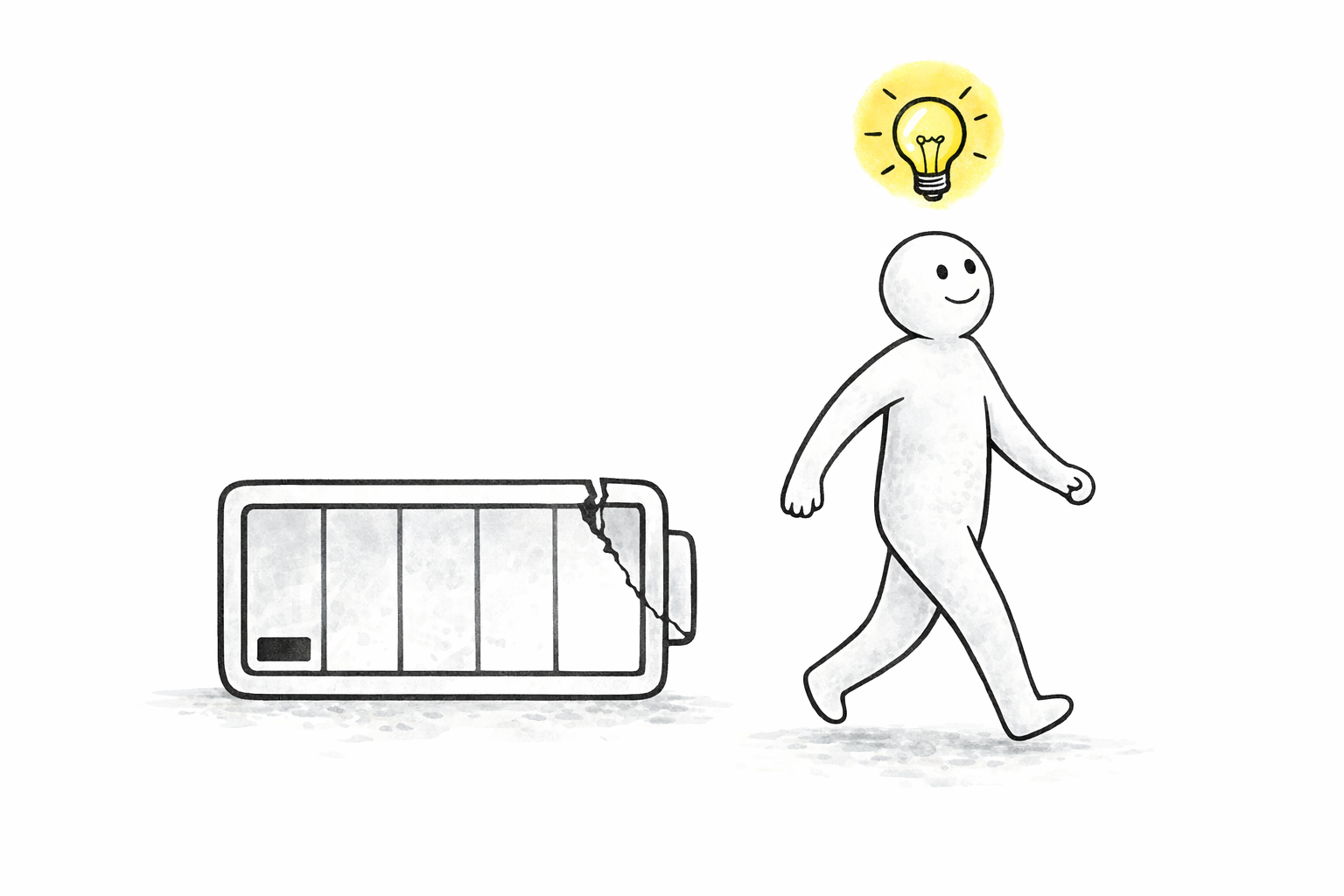
Baumeister's explanation was elegant: resisting the cookies had used up something. Some internal resource that the radish eaters needed for the puzzles was already spent. He called this "ego depletion," and the theory behind it was simple. Willpower is like a battery. Every act of self-control drains it. When it's low, you're more likely to give in, give up, or make bad decisions.
The idea felt true. It explained why you eat junk food after a stressful day. Why you snap at your partner after a long meeting. Why the thing you were disciplined about at 8am falls apart by 8pm. And for the next two decades, it became one of the most influential ideas in all of psychology.
Then it fell apart.
Two hundred studies that might be wrong
The ego depletion theory didn't just catch on. It became foundational. By 2010, over 200 published studies had tested and confirmed variations of the effect. Meta-analyses pooled the data and found a strong, consistent effect size. Textbooks taught it. TED talks explained it. Self-help books built entire frameworks around it.
The theory even got a biological mechanism. In 2007, Matthew Gailliot and Baumeister published a paper arguing that self-control literally runs on glucose. Your brain burns blood sugar when you exert willpower, they claimed, and when glucose drops, so does your self-control. Drink some lemonade (with real sugar, not diet) and your willpower rebounds.
It was a satisfying story. Willpower as a physical resource, measurable in your bloodstream, replenishable with a snack. But satisfying stories should make you nervous.
The first crack came from an unexpected angle. In 2010, Veronika Job and Carol Dweck (of growth mindset fame) ran a series of studies asking a pointed question: what if ego depletion only happens to people who believe in it?
Their findings were striking. People who viewed willpower as a limited resource showed the classic depletion effect. People who believed willpower was not limited? They didn't deplete at all. In a longitudinal study during finals week, students who bought into the limited-resource theory ate junk food 24 percent more often and procrastinated 35 percent more than students who didn't.
That's a strange result if willpower is a physical resource like glucose. Your beliefs about gasoline don't change how fast your car burns through a tank.
The replication crisis arrives
Then, in 2016, the hammer dropped.
Martin Hagger coordinated a massive preregistered replication attempt across 23 laboratories with 2,141 participants. Every lab followed the same protocol. Every hypothesis was registered in advance (so researchers couldn't cherry-pick results). The study was designed to answer one question definitively: does ego depletion replicate?
The effect size they found: d = 0.04. Essentially zero. Not a small effect. Not a weakened effect. Zero.
Twenty-three laboratories, two thousand participants, and the effect that had been confirmed over two hundred times simply wasn't there.
Baumeister and his allies pushed back hard. The replication used the wrong task, they argued. The "e-crossing" task (where participants cross out certain letters in a text) wasn't depleting enough. The original studies used more potent manipulations.
So Kathleen Vohs, Baumeister's longtime collaborator, organized her own massive test. Published in Psychological Science in 2021, this one spanned 36 laboratories with 3,531 participants. Each lab chose from paradigms that the original researchers considered valid.
The result: d = 0.06. Again, not significantly different from zero. Bayesian analysis showed the data were four times more likely under the null hypothesis than under the theory.
Two enormous, carefully designed studies. Nearly 6,000 participants across 59 laboratories. And the signature finding of ego depletion research, the thing that 200+ studies had confirmed, wasn't there.
How is that possible?
How a field fools itself
The ego depletion story is, in some ways, a case study in how science goes wrong. Not through fraud (nobody is accusing anyone of making up data), but through a series of small, understandable choices that compound into a big problem.
Publication bias
Studies that found the effect got published. Studies that didn't were filed away. Over time, the published literature looked overwhelmingly positive because negative results were invisible.
Small samples
Most original studies had 30 to 60 participants. With samples that small, random noise can look like a real effect. And if you run enough small studies, some will "work" by chance.
Flexible analysis
Researchers had many choices: which participants to exclude, which outcome to highlight, when to stop collecting data. These "researcher degrees of freedom" make it easy to find patterns that aren't real.
Confirmation momentum
Once a finding is established, researchers design studies expecting to find it. Subtle choices in experimental design and analysis tilt toward confirming what everyone already believes.
None of these problems are unique to ego depletion. They're endemic to psychology, and really to all of science. Ego depletion just happened to be the poster child: famous enough to attract replication attempts, and fragile enough to crumble under scrutiny.
The glucose theory collapsed even faster. Later analyses showed that the brain's energy consumption during self-control tasks is trivially small. Your brain uses about 0.1 calories more during a hard cognitive task than during an easy one. The idea that a sip of lemonade could meaningfully restore willpower was, in hindsight, biologically implausible.
What's actually going on
So if willpower isn't a battery that drains, what is it?
The most compelling alternative comes from Michael Inzlicht and Brandon Schmeichel, who proposed what they call the "process model" in 2012. Their argument: what looks like depletion is actually a shift in motivation.
After you've been doing something effortful and unrewarding for a while, your brain doesn't run out of fuel. It changes priorities. Your motivation shifts away from "should" tasks (the things that require self-control) and toward "want" tasks (the things that feel good). Your attention follows. You start noticing temptations more. Resisting them feels harder, not because you can't, but because part of you has decided you've done enough.
This distinction matters enormously. If willpower is a battery, you're helpless when it's drained. You have to wait for it to recharge. But if it's a motivational shift, you have more agency than you think. The tank isn't empty. You've just mentally checked out.
Think about it this way. You've had a grueling day at work. You're "depleted." You have zero willpower left to go to the gym. Then your phone rings: someone is offering you courtside tickets to a playoff game, but you have to get across town in 20 minutes. Suddenly you have energy. You have drive. You're out the door.
That's not a battery recharging. That's motivation reshuffling.
Why this matters for real life
But wait. Even if the ego depletion effect is essentially zero in controlled experiments, something real is happening when you feel "spent" at the end of a hard day. You're not imagining that. The question is what to do about it.
The old advice (based on the battery model) was to conserve willpower. Don't waste it on small decisions. Build habits so you don't need self-control. Eat the frog first thing in the morning when your willpower tank is full.
Some of that advice is fine, but for the wrong reasons. Doing hard things first is good because you're more alert in the morning (for most people). Building habits is good because it reduces friction. But the framing of "conserving a limited resource" can actually backfire.
Remember Job and Dweck's finding? Believing willpower is limited makes you more likely to give in. The belief itself becomes a self-fulfilling prophecy. You have a tough conversation at work, and then you think: "Well, my willpower is shot for the day." So you skip the gym, order takeout, and scroll your phone for three hours. Not because you literally can't do otherwise, but because you've given yourself permission to quit.
The motivation model suggests a different approach. When you feel "depleted," the useful question isn't "how do I recharge?" It's "what would make the next thing feel worth doing?"
Sometimes that means changing the task. Sometimes it means changing the context. Sometimes it means acknowledging that you've been grinding on something unrewarding and your brain is correctly signaling that it wants something different. That signal isn't weakness. It's information.
The deeper lesson
The ego depletion saga is really a story about how eager we are for clean explanations of messy human experience.
"Willpower is a battery" is a beautiful theory. It's intuitive, it's actionable, it maps onto how things feel. But human motivation is not a simple resource to be managed like a bank account. It's a constantly shifting mix of priorities, beliefs, emotions, and context. The same person who "can't" resist a cookie after a hard task will find reserves of discipline they didn't know they had if the stakes change.
Does that mean self-control is unlimited? No. Fatigue is real. Stress is real. Sleep deprivation genuinely impairs executive function (that's well-replicated neuroscience, not a debunked theory). But the mechanism isn't a willpower tank running dry. It's more like a committee in your head renegotiating what's worth the effort.
Which, honestly, is better news. A battery is something that happens to you. Motivation is something you can work with.
The people who sustain effort over long periods aren't the ones with bigger willpower tanks. They're the ones who've gotten good at three things: noticing when their motivation shifts, understanding why, and adjusting course instead of pushing through with brute force or collapsing into "I'm depleted, I can't."
That's not willpower management. It's self-awareness. And unlike a mythical mental battery, self-awareness actually improves with practice.
Get the next essay
One article per week on the psychology of thinking clearly. No spam, unsubscribe anytime.
References
- Baumeister, R.F., Bratslavsky, E., Muraven, M., & Tice, D.M. (1998). "Ego Depletion: Is the Active Self a Limited Resource?" Journal of Personality and Social Psychology, 74(5), 1252-1265.
- Gailliot, M.T. & Baumeister, R.F. (2007). "The Physiology of Willpower: Linking Blood Glucose to Self-Control." Personality and Social Psychology Review, 11(4), 303-327.
- Job, V., Dweck, C.S., & Walton, G.M. (2010). "Ego Depletion: Is It All in Your Head? Implicit Theories About Willpower Affect Self-Regulation." Psychological Science, 21(11), 1686-1693.
- Inzlicht, M. & Schmeichel, B.J. (2012). "What Is Ego Depletion? Toward a Mechanistic Revision of the Resource Model of Self-Control." Perspectives on Psychological Science, 7(5), 450-463.
- Hagger, M.S. et al. (2016). "A Multilab Preregistered Replication of the Ego-Depletion Effect." Perspectives on Psychological Science, 11(4), 546-573.
- Vohs, K.D. et al. (2021). "A Multisite Preregistered Paradigmatic Test of the Ego-Depletion Effect." Psychological Science, 32(10), 1566-1581.
Clarido is a quiet log for a loud mind. Speak or type what's on your mind. Clarido holds it for you so you can return when you have space. Join the beta →