emotional-intelligencejournalingmental-healthneuroscienceself-awareness

"Fine" Is Not a Feeling (And Your Brain Knows It)

Most people move through life with a vocabulary of about three emotional states. Research shows that the precision with which you can name what you're feeling determines how well you can handle it.

Clarido Team··8 min read
"Fine" Is Not a Feeling (And Your Brain Knows It)

The word that does too much work

"How are you doing?"

"Fine."

It's the most common answer to the most common question in human interaction. And almost everyone knows, in some private way, that it isn't true. Fine doesn't mean fine. It means: I have something going on but I either can't identify it, don't want to explain it, or both.

But here's the part that's more interesting than the social awkwardness of "fine": your brain is worse off for using it.

Not worse off in some vague, motivational-poster sense. Worse off in specific, measurable ways that affect your decisions, your relationships, and your ability to get through hard days without doing something you'll regret. The precision with which you can name what you're feeling turns out to matter enormously. And most people, it turns out, are moving through their emotional lives with a vocabulary about as useful as a map with no street names.


What emotional granularity actually is

In the 1990s, psychologist Lisa Feldman Barrett noticed something that should have been obvious but wasn't: people differ wildly in how finely they can distinguish between their own emotional states.

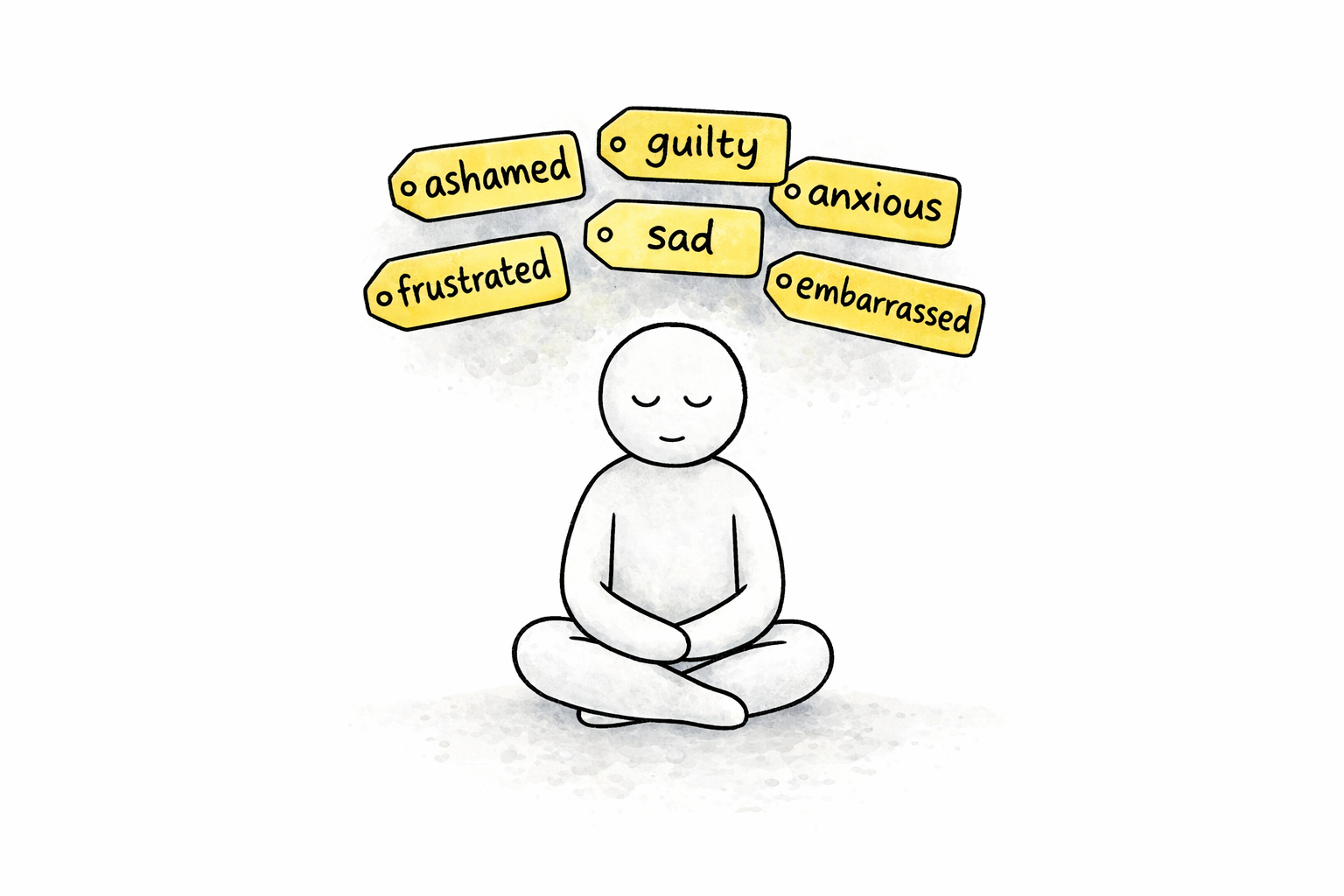
Some people, when they feel bad, can tell you exactly which flavor of bad it is. Anxious. Guilty. Ashamed. Embarrassed. Disappointed. Bereft. Each one points to something different. Each one suggests a different response.

Other people feel bad and just... feel bad. Everything negative blurs together into one undifferentiated cloud. Stressed, sad, angry, frustrated: all the same, just "not good."

Barrett named this difference emotion differentiation, now more commonly called emotional granularity. High granularity means you're able to experience emotions in a nuanced, precise way. Low granularity means you're experiencing them as a broad wash of positive or negative feeling, without much resolution.

30+ distinct negative emotional states in the full English emotional vocabulary. Most people regularly use three or four of them.

The question Barrett started asking wasn't just descriptive. It was: does this difference matter? Does it actually change anything about your life whether you can tell ashamed from embarrassed, or whether both just feel like "bad"?

The answer turned out to be: yes. Quite a lot, actually.


Why vocabulary shapes experience

Before getting to the outcomes, there's a more fundamental question. Why would the words you have for emotions change the emotions themselves? Shouldn't feeling be feeling, whatever you call it?

Barrett's 2006 paper in Personality and Social Psychology Review makes an argument that takes a minute to sink in. She proposes that experiencing an emotion isn't a passive event. It's an act of categorization. Your brain is constantly receiving raw input from your body: elevated heart rate, tension in your shoulders, a hollowness in your chest. And it reaches into your existing concepts to make sense of what's happening.

If you have a rich concept of "guilt" (something you did wrong, a specific person affected, a wish you'd acted differently), your brain can map that bodily experience onto that concept and generate a discrete feeling. If you don't have that concept, or if it's blurry, the experience stays undifferentiated. Just "not good." Just "stressed."

You don't feel an emotion and then find a word for it. You feel it through the concept you already have. And if the concept is vague, the feeling is too.

This is why children's emotional vocabularies and emotional regulation develop together. Teaching a kid the difference between disappointed and jealous doesn't just give them words. It gives them new emotional experiences. New categories to feel with.

Adults are the same way. Only most of us stopped expanding our emotional vocabulary sometime in middle school.


What happens when you can't tell them apart

Barrett's 2001 study in Cognition & Emotion, coauthored with James Gross and others, established the baseline finding: people who differentiate their emotions more precisely engage in emotion regulation more frequently when distress is high. They don't just feel more clearly; they do something with what they feel. They have handles.

When everything is just "bad," there's nothing to grab onto. You know you feel awful, but you don't know what to do with it. So you wait for it to pass. Or you distract yourself. Or, as later research showed, you drink.

In 2010, Todd Kashdan and colleagues published a three-week ecological momentary assessment study in Psychological Science tracking 106 underage social drinkers. Participants reported their emotions multiple times a day via phone. The finding was striking: when people experienced intense negative emotions but could label them with precision, they drank significantly less than people who felt equally bad but less precisely. Emotional granularity buffered against self-medication. People who could say "I'm anxious about this specific thing" were less likely to reach for something to numb the undifferentiated fog.

Two years later, in 2012, Kashdan and colleagues published another study in Emotion examining aggression. Using daily diary data, they found that people who could differentiate their emotions were significantly less likely to act aggressively when angry. Same amount of anger. Different ability to parse it. And the ones who could parse it, controlled it.

Low granularity

You feel "bad." You don't know what to do with bad. You wait, distract, or escape.

High granularity

You feel "ashamed about the meeting." That has a shape. You can respond to a shape.

The depression connection is equally striking. A 2012 study in Psychological Science by Demiralp and colleagues found that people with Major Depressive Disorder showed significantly lower negative emotional granularity than healthy controls. They couldn't tell their different negative feelings apart. Notably, their positive emotional granularity was unaffected. It was specifically the inability to differentiate bad feelings that marked the condition.

This isn't just correlation. When you can't tell your feelings apart, you also can't respond to them appropriately. You apply the same blunt response to everything: withdrawal, numbing, distraction. Which makes sense for some emotions and makes others worse.


The size of your emotional vocabulary is not fixed

Here's the hopeful part. Emotional granularity isn't a fixed trait, like height or eye color. It's built. It can be expanded. The concepts you have for emotions are learned, and you can learn more.

What does that actually look like?

Kashdan, Barrett, and McKnight's 2015 review in Current Directions in Psychological Science frames it clearly: the people who do best with negative emotions aren't the ones who feel them less. They're the ones who experience those emotions with more precision. "Ashamed" and "guilty" feel different, point to different things, and call for different responses. Ashamed is about who you are. Guilty is about what you did. Those aren't the same problem, and they don't have the same solution.

Ashamed vs. Guilty Shame says: "I am bad." It tends to lead to hiding, withdrawal, wanting to disappear. Guilt says: "I did a bad thing." It tends to lead to repair, apology, wanting to make it right. The same situation can produce both. But only if you can tell them apart can you respond to the right one.

Expanding your vocabulary doesn't mean wallowing. It means building the concepts that let your brain make sense of what it's already trying to tell you.

A few ways this happens in practice:

Noticing more. When you feel "bad," stop and ask: what kind of bad? Is it the anxious bad (forward-facing, anticipatory, a threat somewhere ahead) or the sad bad (backward-facing, something lost) or the frustrated bad (blocked, thwarted, a goal interrupted)? Even rough distinctions create more resolution than the undifferentiated blob.

Reading more. Fiction, in particular, has been shown to increase emotional vocabulary. Novelists spend careers articulating the specific texture of human experience. Reading it exposes you to concepts you might not have had words for.

Writing more. James Pennebaker's decades of research on expressive writing consistently shows that putting emotional experiences into words forces a kind of precision that thinking alone doesn't. When you write "I feel bad," you often catch yourself. But what kind? The act of writing pulls you toward specificity.

Undifferentiated "I feel bad. I don't know why. I just feel bad."
Differentiated "I feel embarrassed. Something about how that conversation went makes me want to disappear."

The second version is uncomfortable. But it's workable. You know what you're dealing with. Embarrassment has a shape: something happened in front of someone, and you care what they think of you. That's a solvable problem, or at least one you can sit with consciously. The fog isn't.


What you can actually do with this

None of this requires a therapist or a feelings chart. It requires slightly more attention to what's happening inside you, for slightly longer, before you move on.

The people who benefit most from emotional granularity aren't the ones who feel their feelings loudly. They're the ones who pause when something is "off" and get a little more curious about what "off" means.

Not in a navel-gazing way. In a practical way: is this anxiety, or is it dread? Is this frustration, or is it disappointment? Am I angry, or am I hurt? Those aren't the same, and knowing which one it is tells you something about what's actually happening, and sometimes what to do.

The next time someone asks how you're doing and "fine" comes out automatically, pause for one second and ask whether it's true. Not for them. For you.

Because your brain already knows you're not fine. It's trying to tell you something more specific. The only question is whether you have the vocabulary to hear it.


References

  • Barrett, L.F., Gross, J., Christensen, T.C., & Benvenuto, M. (2001). "Knowing What You're Feeling and Knowing What to Do About It: Mapping the Relation Between Emotion Differentiation and Emotion Regulation." Cognition & Emotion, 15(6), 713–724.
  • Barrett, L.F. (2006). "Solving the Emotion Paradox: Categorization and the Experience of Emotion." Personality and Social Psychology Review, 10(1), 20–46.
  • Kashdan, T.B., Ferssizidis, P., Collins, R.L., & Muraven, M. (2010). "Emotion Differentiation as Resilience Against Excessive Alcohol Use: An Ecological Momentary Assessment in Underage Social Drinkers." Psychological Science, 21(9), 1341–1347.
  • Demiralp, E., Thompson, R.J., Mata, J., Jaeggi, S.M., Buschkuehl, M., Barrett, L.F., et al. (2012). "Feeling Blue or Turquoise? Emotional Differentiation in Major Depressive Disorder." Psychological Science, 23(11), 1410–1416.
  • Pond, R.S., Kashdan, T.B., DeWall, C.N., Savostyanova, A., Lambert, N.M., & Fincham, F.D. (2012). "Emotion Differentiation Moderates Aggressive Tendencies in Angry People: A Daily Diary Analysis." Emotion, 12(2), 326–337.
  • Kashdan, T.B., Barrett, L.F., & McKnight, P.E. (2015). "Unpacking Emotion Differentiation: Transforming Unpleasant Experience by Perceiving Distinctions in Negativity." Current Directions in Psychological Science, 24(1), 10–16.

Clarido is a quiet log for a loud mind. Speak or type what's on your mind. Clarido holds it for you so you can return when you have space. Join the beta