What Actually Happens When Everything Clicks
Flow isn't a personality trait or a lucky accident. Csikszentmihalyi spent decades studying it and found precise conditions that produce it every time. The biggest obstacle isn't talent. It's noise.
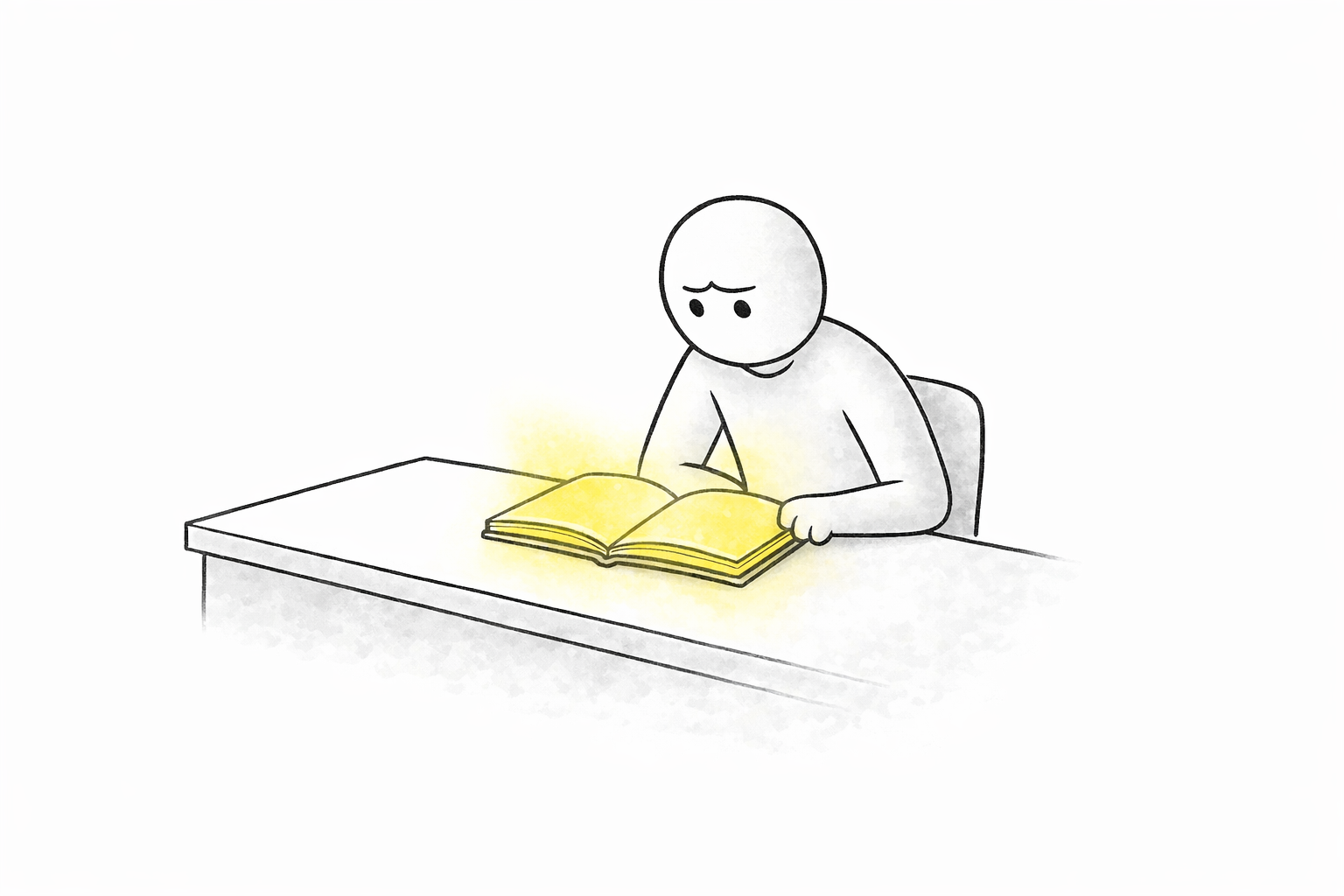
The hour that vanished
You know the one. You sat down to work on something, and then, without quite noticing, an hour passed. Maybe two. Your phone didn't matter. The coffee went cold. The work felt almost effortless, like you were reading rather than writing, following rather than forcing.
And then something interrupted it. And suddenly you were just... back in your chair again. The spell broken. The ordinary world returned.
Most people think that state is rare luck. A gift given occasionally to certain kinds of people. Something you're either in or out of, with little say in the matter.
But what if that's wrong?
Mihaly Csikszentmihalyi spent fifty years studying it. He came to a very different conclusion.
What a rock climber taught a psychologist
In the early 1970s, Csikszentmihalyi started interviewing people who did difficult things for no external reward. Rock climbers. Chess players. Surgeons. Composers. He wanted to understand what made these activities intrinsically worth doing. What they had in common.
What did surgeons have in common with chess players? What did rock climbers share with composers?
The answers were strikingly similar. Not "I love competition" or "I'm talented." People described a particular state: deep absorption, effortless action, a sense that they and the activity had merged. One rock climber put it this way: the rock doesn't exist, the sky doesn't exist, just the movement.
Csikszentmihalyi called it flow, because that was the word people kept reaching for. Something moves through you. You're not pushing; you're following. His 1975 book, Beyond Boredom and Anxiety, introduced the concept. His 1990 book, Flow: The Psychology of Optimal Experience, brought it to the wider world.
But the research question that mattered was: how? And who? And can anyone get there, or only certain people?
Flow isn't something that happens to people. It's something that happens when precise conditions are met.
Nakamura and Csikszentmihalyi, summarizing decades of research in the Handbook of Positive Psychology, identified the consistent prerequisites: a task with clear goals, immediate feedback on progress, and a challenge pitched at roughly the edge of your current ability. Not too easy. Not too hard.
Remove any of those three and flow collapses.
What's happening in your brain
Until recently, flow was a psychological description without a neurological one. What's actually happening in there? Then researchers started putting people in brain scanners.
Ulrich, Keller, Hoenig, Waller, and Grön induced flow in subjects by calibrating a task to match each person's skill level, then scanned their brains while they were in it. The results were striking. Flow correlated with decreased activity in the medial prefrontal cortex, the part of the brain responsible for self-monitoring, evaluation, and second-guessing yourself.
Arne Dietrich had predicted this pattern a decade earlier. He called it "transient hypofrontality": a temporary downregulation of prefrontal activity that lets the implicit system (the fast, automatic, skill-execution circuitry) take over. In a 2004 paper in Consciousness and Cognition, Dietrich argued this is the mechanism underneath flow's signature quality: the work happening through you rather than because of you.
Your analytical mind goes quiet. The parts that run your deeply learned skills take over. You stop thinking about how you're doing it. You just do it.
This is why flow feels effortless even when the work is hard. The effort is real. But the friction of self-scrutiny, the internal commentary, the second-guessing, that part is gone. Sound familiar? It's the opposite of how most of us spend our working hours.
The challenge-skill window
The maddening thing about flow is how narrow the entry conditions are.
Too easy, and your mind wanders. You've automated the task, which means the prefrontal cortex starts drifting toward other things. Yesterday's conversation. Tonight's dinner. The email you haven't answered.
Too hard, and anxiety kicks in. The prefrontal cortex becomes hyperactive, cycling through worst-case scenarios, monitoring for threat. You're in your head rather than in the work.
Flow lives in a band between the two.
Task too easy
Boredom. Your mind wanders because the task has nothing new to offer it. You're on autopilot.
Task too hard
Anxiety. Your brain shifts into threat-monitoring mode. The work feels like a problem to survive, not solve.
The window
Engagement. The task is at the edge of your current ability: hard enough to demand full attention, manageable enough to keep moving.
Johannes Keller and Herbert Bless, in a 2008 paper in Personality and Social Psychology Bulletin, provided the first experimental (causal) test of this model. They manipulated challenge-skill balance directly and showed it causally produced flow experiences. Stefan Engeser and Falko Rheinberg, also in 2008, showed that not only does this balance produce flow, but flow at high challenge-skill levels measurably improves performance. Easy tasks in flow are pleasant. Hard tasks in flow are where your best work lives.
Why you can't get there anymore
If flow has precise entry conditions, the obvious question is: why is it so rare? Why do most people describe it as something that happened to them once, years ago, rather than something they can reliably return to?
The short answer is interruption.
Gloria Mark and her colleagues at UC Irvine have spent years studying how people work in modern offices and at home. Their findings are consistent and grim. Interrupted workers compensate by working faster to catch up, but at the cost of significantly higher stress, frustration, and effort. The experience of deep work collapses entirely.
But interruption isn't only external. The bigger problem, for most people, is internal.
When your mind is carrying twenty open loops, those loops don't wait quietly while you work. They surface. A stray worry. A reminder about something you forgot. The conversation you should have had. Each one is a small interruption, a micro-request from your own brain for processing time.
Csikszentmihalyi, in Nakamura's summary of his research, was specific: flow requires the complete elimination of self-consciousness. Not reduction. Elimination. When you're partly thinking about how the work is going, partly thinking about what comes next, partly thinking about the thing you forgot, you're not in flow. You're in a fractured state that resembles work but produces something much worse.
How many open loops are you carrying right now?
The prefrontal cortex can't go quiet when it has outstanding business.
The prerequisite nobody talks about
Every article about flow tells you to find the challenge-skill sweet spot. Match your task to your ability. Eliminate external distractions. Work in focused blocks.
All of that is true. But there's a step before any of it. What clears the runway?
Your brain needs to believe its open loops are handled.
Masicampo and Baumeister showed this with unfinished tasks in general: just writing down a plan was enough to stop intrusive thoughts about the task. You didn't have to execute anything. You just had to convince your brain you'd made a commitment. The nagging stopped. The mental space opened up.
Flow requires that mental space to exist first. You can have the perfect task at the perfect difficulty level, and still not get there, because the background processes are still running. The open loops are still demanding attention.
Flow isn't a reward for good intentions. It's a state that requires a quiet mind as its entry condition.
This is why the people who report flow most reliably aren't the ones with the most talent or the most discipline. They're the ones who've figured out how to clear the deck. Ritualists. People who write things down before starting. People who close loops before they open new ones. People who create conditions, not just resolve to focus harder.
The preparation isn't the work. But without it, the work never starts.
How to create the conditions
Flow can't be forced, but it can be engineered. The conditions are specific enough to be practical.
Pick one task. Not a category. Not "work on the project." A specific next action, scoped to what you can actually complete in a session. Csikszentmihalyi's research is clear that flow requires clear goals. Vague intentions don't qualify. What, exactly, are you trying to do?
Set the difficulty right. This takes honest self-assessment. A task that bores you won't produce flow. Neither will one that panics you. You're looking for the thing that's right at the edge of what you can do, where you're not sure you'll pull it off but you probably can.
Clear the mental queue first. Write down everything that's trying to get your attention. The worries, the to-dos, the ideas, the half-formed thoughts. Not to process them, just to acknowledge them and park them somewhere. Your brain needs to believe they're handled before it will let go.
Then protect the time. Not from your phone only. From yourself. Don't check if it's going well. Don't monitor your own performance. The moment self-evaluation kicks in, the prefrontal cortex re-engages and the spell starts to break.
The irony is that flow requires less effort, not more. The work doesn't get easier, but the friction around it dissolves. You stop fighting yourself. You just go.
What the research actually says
The neuroscience is worth sitting with for a moment, because it reframes what flow actually is. What if you've been thinking about focus all wrong?
It's not heightened brain activity. It's not maximum effort. It's more like a controlled reduction: the self-monitoring circuitry stands down, the task-relevant networks run unimpeded, and something that's usually fragmented and contested becomes unified and smooth.
That unity is what people describe as the experience of flow. Not that they tried harder. That they stopped interfering.
Dietrich's transient hypofrontality framework suggests that the prefrontal cortex, for all its power, is also the source of the internal noise that makes deep work hard. The analysis, the self-scrutiny, the second-guessing: all of it lives there. When conditions are right, it quiets. What's underneath, your deep skill, your accumulated knowledge, your genuine capability, gets to run.
Which suggests that the question isn't how to push into flow. It's how to stop blocking it. And maybe that's been the answer all along: not more effort, but less interference.
Get the next essay
One article per week on the psychology of thinking clearly. No spam, unsubscribe anytime.
References
- Csikszentmihalyi, M. (1975). Beyond Boredom and Anxiety: The Experience of Play in Work and Games. Jossey-Bass.
- Csikszentmihalyi, M. (1990). Flow: The Psychology of Optimal Experience. Harper & Row.
- Nakamura, J. & Csikszentmihalyi, M. (2002). "The concept of flow." In C. R. Snyder & S. J. Lopez (Eds.), Handbook of Positive Psychology (pp. 89–105). Oxford University Press.
- Dietrich, A. (2004). "Neurocognitive mechanisms underlying the experience of flow." Consciousness and Cognition, 13(4), 746–761.
- Ulrich, M., Keller, J., Hoenig, K., Waller, C., & Grön, G. (2014). "Neural correlates of experimentally induced flow experiences." NeuroImage, 86, 194–202.
- Keller, J. & Bless, H. (2008). "Flow and regulatory compatibility: An experimental approach to the flow model of intrinsic motivation." Personality and Social Psychology Bulletin, 34(2), 196–209.
- Engeser, S. & Rheinberg, F. (2008). "Flow, performance and moderators of challenge-skill balance." Motivation and Emotion, 32(3), 158–172.
- Mark, G., Gudith, D., & Klocke, U. (2008). "The cost of interrupted work: More speed and stress." Proceedings of CHI 2008 (pp. 107–110). ACM.
- Masicampo, E.J. & Baumeister, R.F. (2011). "Consider it done! Plan making can eliminate the cognitive effects of outstanding goals." Journal of Personality and Social Psychology, 101(4), 667–683.
Clarido is a quiet log for a loud mind. Speak or type what's on your mind. Clarido holds it for you so you can return when you have space. Join the beta →