Why You Speed Up Near the Finish Line (and Stall Everywhere Else)
Motivation isn't linear. You sprint at the start, crash in the middle, and sprint again near the end. The goal gradient effect explains why, and what to do about the dead zone in between.
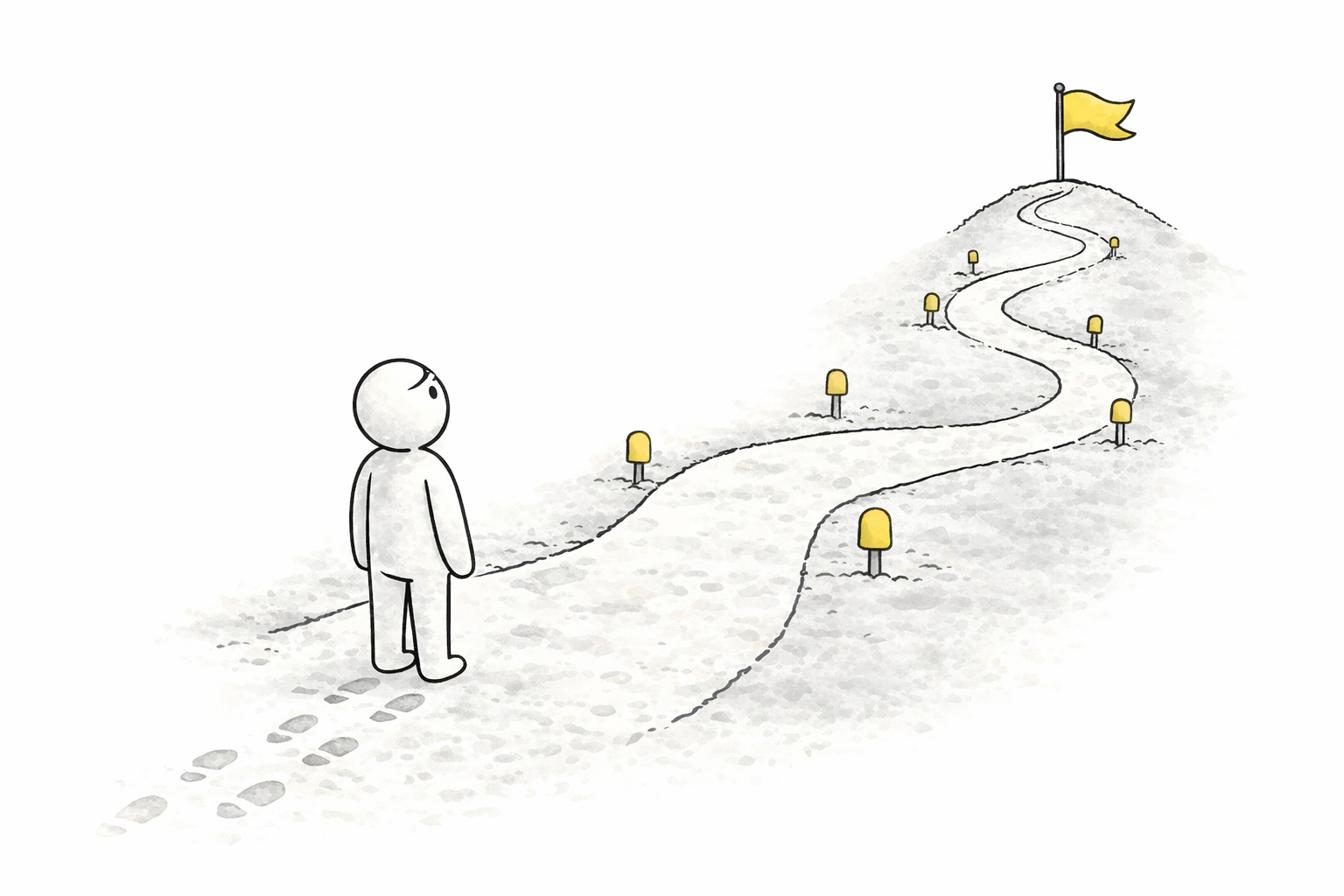
The coffee card problem
Here's something you've probably noticed without thinking about it. You sign up for a loyalty card at a coffee shop. Ten stamps, one free coffee. The first few stamps come easy. You're excited. Then somewhere around stamp five or six, you forget the card exists. It sits in your wallet for weeks. Then one day you notice you only need two more stamps and suddenly you're buying coffee every morning.
What happened in the middle?
This pattern shows up everywhere, not just coffee cards. New Year's resolutions that dissolve by February. Online courses abandoned at lesson four of twelve. Books with bookmarks permanently stuck at page 80. The beginning feels charged with possibility. The end feels urgent with proximity. But the middle? The middle is where motivation goes to die.
And the strange part is: this isn't a character flaw. It's a feature of how your brain calculates progress.
Rats, runways, and the gradient
In 1932, a behaviorist named Clark Hull proposed something called the goal-gradient hypothesis. He'd been watching rats run down straight corridors toward food, and he noticed they didn't run at a constant speed. They started slow and accelerated as they got closer to the reward. The final stretch was always the fastest.
Hull measured this precisely. He built runways with electrical contacts to clock the time rats took to cross each section. The pattern was unmistakable: effort increased with proximity to the goal. Not linearly. Exponentially.
For decades, this remained an interesting footnote in animal behavior research. But here's the question: do humans do the same thing? In 2006, Ran Kivetz, Oleg Urminsky, and Yuhuang Zheng at Columbia decided to find out. Not in mazes. In coffee shops.
They tracked customers in a real café loyalty program. Ten coffees, one free. And the data was strikingly clean: people bought coffee more and more frequently as they approached the free one. The intervals between purchases shortened by about 20% from the first stamp to the last. Same pattern Hull saw in rats. Same exponential curve.
But the researchers did something cleverer. They also gave some customers a 12-stamp card with two stamps already filled in. Same number of coffees needed (ten). Different starting point. And those customers completed their cards faster. Much faster.
Why would two fake stamps change anything?
The illusion that moves you
Joseph Nunes and Xavier Drèze ran a similar experiment at a car wash in 2006. One group got cards requiring eight stamps. Another group got cards requiring ten stamps, but with two already punched. Both groups needed eight more visits. But the group with the head start completed their cards at nearly double the rate: 34% versus 19%.
The task hadn't changed. The perception of progress had. And perception, it turns out, is what drives effort.
This is called the endowed progress effect. When you feel like you've already started, you're more motivated to finish. Your brain doesn't evaluate goals in absolute terms. It evaluates them relative to where it thinks you began. Two free stamps on a 12-stamp card feel like progress. An empty 8-stamp card feels like a blank slate. The math is identical. The psychology isn't even close.
This explains the beginning. The start of any goal feels vivid because the gap between "nothing done" and "something done" is enormous in percentage terms. Going from 0% to 10% feels like a leap. Going from 40% to 50% feels like nothing.
The dead zone
So the beginning is energizing because small amounts of progress feel large. And the end is energizing because the finish line is visible and close. But what about the middle?
In 2011, Andrea Bonezzi, C. Miguel Brendl, and Matteo De Angelis published a paper in Psychological Science called "Stuck in the Middle." They showed that motivation follows a U-shaped curve: highest at the start, lowest around the midpoint, and high again near the end.
Their explanation involves something called reference point switching. At the beginning, you're monitoring how far you've come. "I've done 20% already." That feels good. Near the end, you switch to monitoring how little remains. "Only 20% left." That feels urgent. But in the middle, neither reference point offers much comfort. You're too far from the start for accumulated progress to feel impressive, and too far from the end for remaining distance to feel small.
The beginning
You track what you've done. Small progress feels proportionally large. "I've already finished 2 out of 10."
The middle
Neither frame helps. 50% done doesn't feel impressive. 50% remaining doesn't feel close. Motivation bottoms out.
The end
You track what's left. The remaining gap shrinks fast. "Only 2 left out of 10." Urgency kicks in.
This is the motivational dead zone. Sound familiar? Nearly everyone has been stuck in it, usually without understanding why. You assume you've lost discipline, that you need more willpower, that something is wrong with you. Nothing is wrong with you. You're just in the part of the curve where your brain's progress-monitoring system offers the least encouragement.
The small area trick
Here's where it gets practical. In 2012, Minjung Koo and Ayelet Fishbach published research in the Journal of Consumer Research on what they called the "small-area hypothesis." Their finding was elegant: people are more motivated when they focus on whichever is smaller, the progress they've made or the progress remaining.
Early on, that means focusing on what you've accomplished. "I've already done 20%." That 20% feels meaningful because the completed portion is the smaller number.
Later, it means focusing on what's left. "Only 20% to go." The remaining portion is now the smaller number, and it feels achievable.
The practical implication? You should deliberately shift your attention at the midpoint. Stop counting what you've done. Start counting what's left.
Same situation. Different frame. Measurably different motivation. Koo and Fishbach found that directing attention to the smaller area creates a perception of faster progress, which sustains effort through the dead zone.
Why this matters beyond coffee cards
You might be thinking: this is interesting for loyalty programs, but does it apply to the goals that actually matter? The ones that take months or years?
It does. And the stakes are higher.
Consider someone trying to change careers. The first weeks are exciting: researching, imagining, making plans. The final weeks are exciting too: interviews, offers, the finish line in sight. But the months in between, the studying, the networking, the applications that go nowhere, that's the dead zone. And that's where most people quit. Not because the goal stopped mattering. Because the middle stopped feeling like progress.
Or think about writing a book. Chapter one flows. The last chapter practically writes itself. But somewhere around chapter six, you stare at the screen and wonder why you started this. The plot feels muddled. The ending feels impossibly far away. The beginning feels like it belongs to a different, more motivated version of you.
The goal gradient explains all of this. So what do you do once you see the pattern?
Working with the curve
The research points to a few principles that help.
Break the middle into smaller goals. The dead zone exists because the middle of a large goal offers no nearby finish lines. But if you split a 10-chapter book into three phases (chapters 1-3, 4-7, 8-10), you create artificial endpoints. Each sub-goal has its own gradient, its own acceleration near the end. You're essentially hacking the U-shaped curve by creating multiple U-shaped curves.
Manufacture progress signals. The endowed progress effect shows that perceived progress matters as much as actual progress. A checklist that lets you physically cross things off. A progress bar. A journal entry that records what you did today. These aren't decorative. They're functional tools that feed your brain's progress-monitoring system.
Shift your reference point at the midpoint. When you're in the first half, celebrate what you've accomplished. When you cross the halfway mark, stop looking backward. Focus exclusively on the shrinking distance to the finish. This is Koo and Fishbach's small-area hypothesis in practice, and it works because your brain responds to proportional change, not absolute numbers.
Watch for the quit impulse around 40-60%. Now that you know the dead zone exists, you can recognize it when you're in it. The sudden loss of motivation around the halfway mark isn't a signal that you chose the wrong goal. It's a predictable feature of how brains track progress. Name it. "I'm in the dead zone." That alone can be enough to keep you moving, because now you know the gradient will steepen again.
The finish line problem
There's one more twist worth knowing. Have you ever noticed that doubt doesn't hit evenly across a project? The goal gradient doesn't just affect how hard you work. It affects how you feel about the work.
People in the early and late stages of a goal report higher satisfaction and sense of purpose. People in the middle report more doubt, more second-guessing, more temptation to abandon the goal entirely. The emotional experience mirrors the motivational curve almost perfectly.
Which means the middle isn't just where you slow down. It's where you're most vulnerable to the story that you picked the wrong goal, that this isn't working, that you should start over with something new. How many abandoned projects were actually the right goal, just at the wrong point on the curve? And starting over, of course, puts you right back at the beginning of a new gradient. Temporarily energized. Until you hit the next middle.
The people who finish things aren't the ones with more willpower. They're the ones who learned to keep walking when the middle gets quiet.
That's the real insight here. Motivation isn't a resource you either have or you don't. It's a curve shaped by your brain's perception of progress. And once you understand the shape of that curve, you can stop blaming yourself for the dips and start designing around them.
The beginning will take care of itself. The end will pull you forward. Your only job is to build a bridge across the middle.
Get the next essay
One article per week on the psychology of thinking clearly. No spam, unsubscribe anytime.
References
- Hull, C.L. (1932). "The Goal-Gradient Hypothesis and Maze Learning." Psychological Review, 39(1), 25–43.
- Kivetz, R., Urminsky, O., & Zheng, Y. (2006). "The Goal-Gradient Hypothesis Resurrected: Purchase Acceleration, Illusionary Goal Progress, and Customer Retention." Journal of Marketing Research, 43(1), 39–58.
- Nunes, J.C. & Drèze, X. (2006). "The Endowed Progress Effect: How Artificial Advancement Increases Effort." Journal of Consumer Research, 32(4), 504–512.
- Bonezzi, A., Brendl, C.M., & De Angelis, M. (2011). "Stuck in the Middle: The Psychophysics of Goal Pursuit." Psychological Science, 22(5), 607–612.
- Koo, M. & Fishbach, A. (2012). "The Small-Area Hypothesis: Effects of Progress Monitoring on Goal Adherence." Journal of Consumer Research, 39(3), 493–509.
Clarido is a quiet log for a loud mind. Speak or type what's on your mind. Clarido holds it for you so you can return when you have space. Join the beta →