The Paradox of Choice: Why More Options Make You Less Happy
You'd think more options would make life better. The research says the opposite. Here's why having too many choices leads to paralysis, regret, and less satisfaction with whatever you pick.
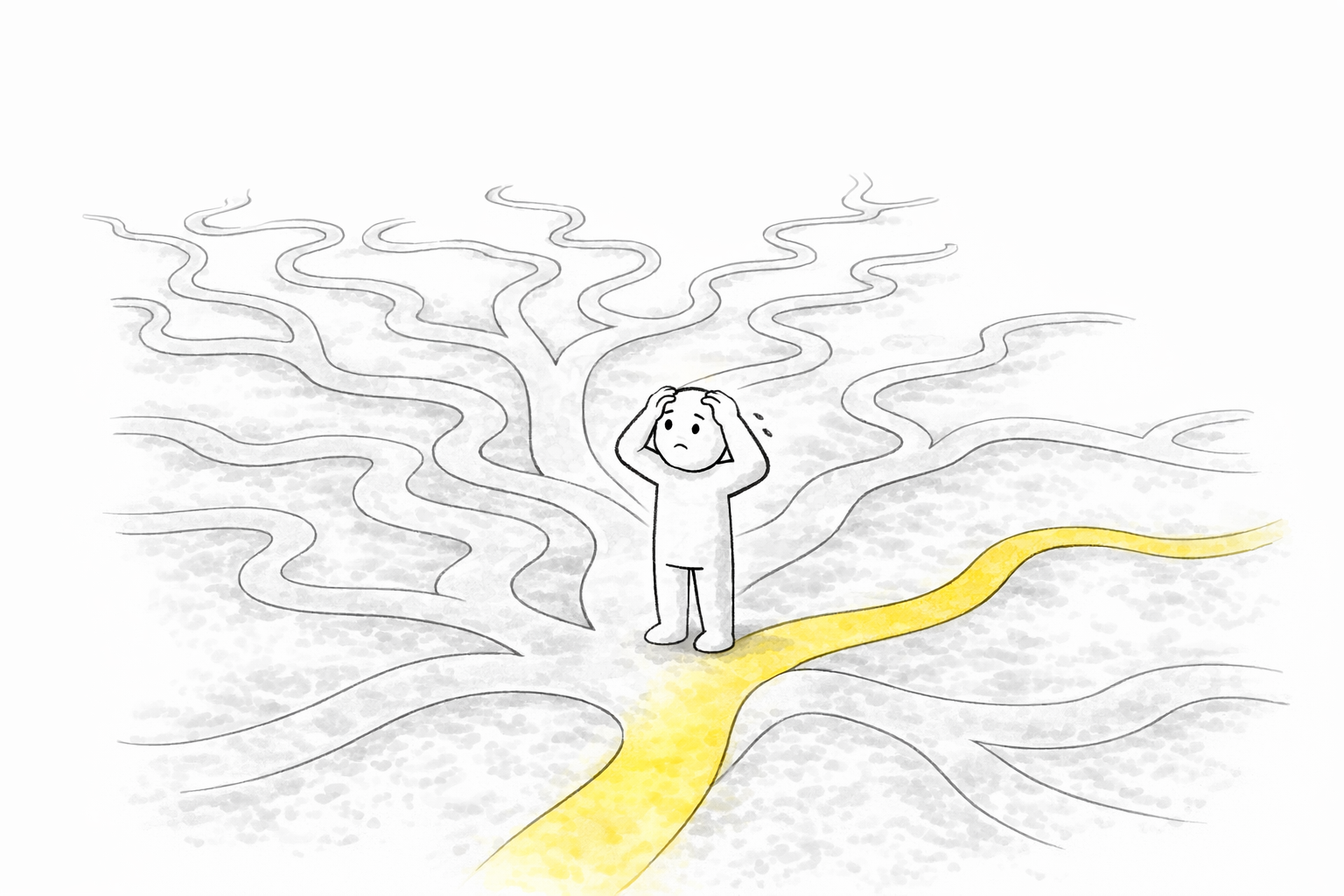
The grocery store problem
You walk into a grocery store looking for jam. Simple enough. But there are 24 varieties on the shelf: strawberry, raspberry, boysenberry, marmalade, three kinds of apricot. You pick up a jar, read the label, put it back. You compare two more. You check prices. Ten minutes later, you leave without buying anything.
What happened?
The obvious answer is that you couldn't decide. But the more interesting answer is that you were undermined by abundance. Having 24 options didn't help you find the right jam. It made finding the right jam feel impossible. And that feeling, multiplied across every domain of modern life, is quietly making people miserable.
The jam study
In 2000, psychologists Sheena Iyengar and Mark Lepper set up a tasting display at an upscale grocery store. On some days, they offered 24 varieties of jam. On others, just six.
The large display attracted more attention. About 60% of shoppers stopped to look, compared with 40% for the small display. More options, more interest. That part was predictable.
But here's where it gets strange. Of the people who stopped at the 24-jam display, only 3% actually bought a jar. At the six-jam display? Nearly 30%.
Read that again. Ten times more people bought jam when they had fewer options to choose from. The large display was better at attracting attention and worse at producing a decision. Choice, beyond a certain threshold, became paralyzing.
Iyengar and Lepper replicated this across multiple experiments. Students offered six essay topics were more likely to complete the assignment than students offered thirty. Participants choosing from a smaller set of chocolates reported greater satisfaction with their selection. The pattern was consistent: more options led to less action and less happiness with the outcome.
Maximizers and satisficers
Barry Schwartz, the psychologist who gave this phenomenon its name, wanted to understand why some people suffer from choice overload more than others. In 2002, he and his colleagues published a study that introduced two personality types.
Maximizers are people who need to find the best option. They compare exhaustively. They research alternatives even after deciding. They can't shake the feeling that something better exists just beyond the options they've seen.
Satisficers have standards too. But once they find something that meets those standards, they stop looking. Good enough is good enough.
Here's what the research found: maximizers and satisficers often make different quality decisions, but not in the direction you'd expect.
Schwartz's team found that people who scored high on maximizing also scored higher on depression, perfectionism, and regret. They scored lower on happiness, optimism, self-esteem, and life satisfaction. The people who tried hardest to make the best choice were, by every measure of well-being, doing the worst.
Why? Because when you're a maximizer surrounded by options, you can never be sure you've found the best one. There's always another restaurant you haven't tried, another apartment you haven't toured, another career path you haven't explored. The search never ends, and the nagging feeling that you chose wrong never fades.
Why more options breed regret
There's a mechanism here that goes beyond simple indecision. More options don't just make choosing harder. They make you less happy with whatever you chose.
Think about it this way. If you choose from two options and your choice disappoints you, well, the other one might have been better, but probably not by much. If you choose from fifty options and your choice disappoints you, the odds seem overwhelming that at least one of those forty-nine alternatives would have been superior. You don't even need evidence. The sheer number of roads not taken is enough to poison your satisfaction.
Psychologists call this counterfactual thinking. It's the mental habit of imagining how things could have gone differently. And it scales with the number of alternatives you rejected.
Every option you don't choose becomes a ghost that haunts the option you did.
This is why people report feeling worse about decisions made from large sets even when they chose objectively well. The quality of the choice isn't the problem. The awareness of everything you gave up is the problem. And in a world that offers you limitless alternatives for everything from careers to toothpaste, that awareness never quiets down.
The nuance
Now, the story isn't quite this clean. Science rarely is.
In 2010, Scheibehenne, Greifeneder, and Todd published a meta-analysis that assembled fifty experiments on choice overload. The average effect size was near zero. Some studies found strong choice overload effects. Others found nothing. A few even found that more options increased satisfaction.
Does that mean choice overload isn't real? Not exactly. A later meta-analysis by Chernev, Böckenholt, and Goodman in 2015, looking at ninety-nine observations, identified the conditions under which it hits hardest. Four factors make choice overload dramatically worse:
You don't know what you want
When your preferences are unclear, more options amplify confusion instead of resolving it.
The options are hard to compare
When choices differ on multiple dimensions (price vs. quality vs. features), comparison becomes exhausting.
The decision feels high-stakes
The more the outcome matters, the more paralyzing a large choice set becomes.
You're aiming to maximize
If your goal is "the best," more options means more to evaluate. If your goal is "good enough," more options just means faster success.
Sound familiar? Think about the decisions that keep people up at night. Career moves. Relationships. Where to live. These aren't jam purchases. They're high-stakes, hard-to-compare, preference-uncertain decisions. Exactly the conditions where choice overload is strongest.
The modern amplifier
Here's what makes this worse than it was fifty years ago: the number of options available to you has exploded, but your cognitive capacity to evaluate them hasn't changed.
In 1970, the average grocery store stocked about 8,000 products. Today it's closer to 50,000. But that's trivial compared to the choices you face outside the store. How many potential careers could you pursue? How many people could you date? How many cities could you live in? How many shows could you watch tonight?
The internet didn't just increase options. It made you aware of all of them simultaneously. Before, you were limited by geography and circumstance. You chose from what was available, and you didn't torment yourself over alternatives you'd never encountered. Now, every option on earth is visible, and every choice you make comes with the full weight of everything you passed up.
This is why so many people feel exhausted by decisions that should be simple. It's why you can scroll Netflix for twenty minutes and give up. It's why choosing a restaurant on a Friday night feels like a chore. You're not bad at deciding. You're drowning in options, and your brain doesn't have the bandwidth to evaluate them all.
What actually helps
The research points to a few things that consistently reduce choice overload. None of them involve finding the perfect option. All of them involve changing how you relate to the search.
Set your criteria before you look. Decide what "good enough" means before you start browsing. Two bedrooms, under $2,000, within twenty minutes of work. Once something meets your criteria, stop searching. The satisficers have this right: the goal isn't the best possible outcome. It's an outcome you can live with happily.
Limit your options deliberately. This feels counterintuitive, but people who artificially narrow their choices report greater satisfaction. Pick three restaurants, not fifteen. Apply to five jobs, not fifty. Constraints aren't limiting. They're liberating.
Make decisions irreversible when you can. Schwartz found that reversible decisions produce less satisfaction than irreversible ones. When you can always change your mind, you never fully commit, and you keep evaluating alternatives long after the decision is made. Cutting off the option to switch forces your brain to invest in the choice you made.
Stop comparing after you choose. The regret that follows large choice sets is fueled by continued comparison. Once you've decided, the research you did on alternatives stops being useful and starts being corrosive. Close the tabs. Delete the bookmarks. Your satisfaction depends on it.
The quieter life
There's a strange freedom in accepting that you will never find the best option. Not because you're settling, but because "the best" is a moving target that recedes the closer you get to it. The people who chase it end up less happy than the people who picked something reasonable and moved on.
What does this look like in practice? It looks like buying the first jam that seems good instead of comparing all twenty-four. It looks like choosing a restaurant in under two minutes. It looks like making a decision and then defending it from your own second-guessing.
The paradox of choice isn't really about jam or Netflix or career paths. It's about a mismatch between the world you live in and the brain you're navigating it with. Your brain evolved to choose between a handful of options in a small environment. It was never designed to evaluate thousands of alternatives simultaneously. And when you ask it to, it doesn't rise to the occasion. It stalls, panics, and regrets.
The fix isn't more information or more time to decide. It's fewer options, clearer standards, and the willingness to stop searching once you've found something that works. Not because it's the best. Because it's enough.
Get the next essay
One article per week on the psychology of thinking clearly. No spam, unsubscribe anytime.
References
- Iyengar, S.S. & Lepper, M.R. (2000). "When Choice is Demotivating: Can One Desire Too Much of a Good Thing?" Journal of Personality and Social Psychology, 79(6), 995–1006.
- Schwartz, B., Ward, A., Monterosso, J., Lyubomirsky, S., White, K., & Lehman, D.R. (2002). "Maximizing Versus Satisficing: Happiness Is a Matter of Choice." Journal of Personality and Social Psychology, 83(5), 1178–1197.
- Schwartz, B. (2004). The Paradox of Choice: Why More Is Less. Harper Perennial.
- Scheibehenne, B., Greifeneder, R., & Todd, P.M. (2010). "Can There Ever Be Too Many Options? A Meta-Analytic Review of Choice Overload." Journal of Consumer Research, 37(3), 409–425.
- Chernev, A., Böckenholt, U., & Goodman, J.K. (2015). "Choice Overload: A Conceptual Review and Meta-Analysis." Journal of Consumer Psychology, 25(2), 333–358.
Clarido is a quiet log for a loud mind. Speak or type what's on your mind. Clarido holds it for you so you can return when you have space. Join the beta →