The Peak-End Rule: Why You're Judging Your Entire Day by Two Moments
Your brain doesn't average your day. It remembers the worst moment and the last moment, then calls that the whole story. Here's what the research says about why your days feel worse than they actually were.
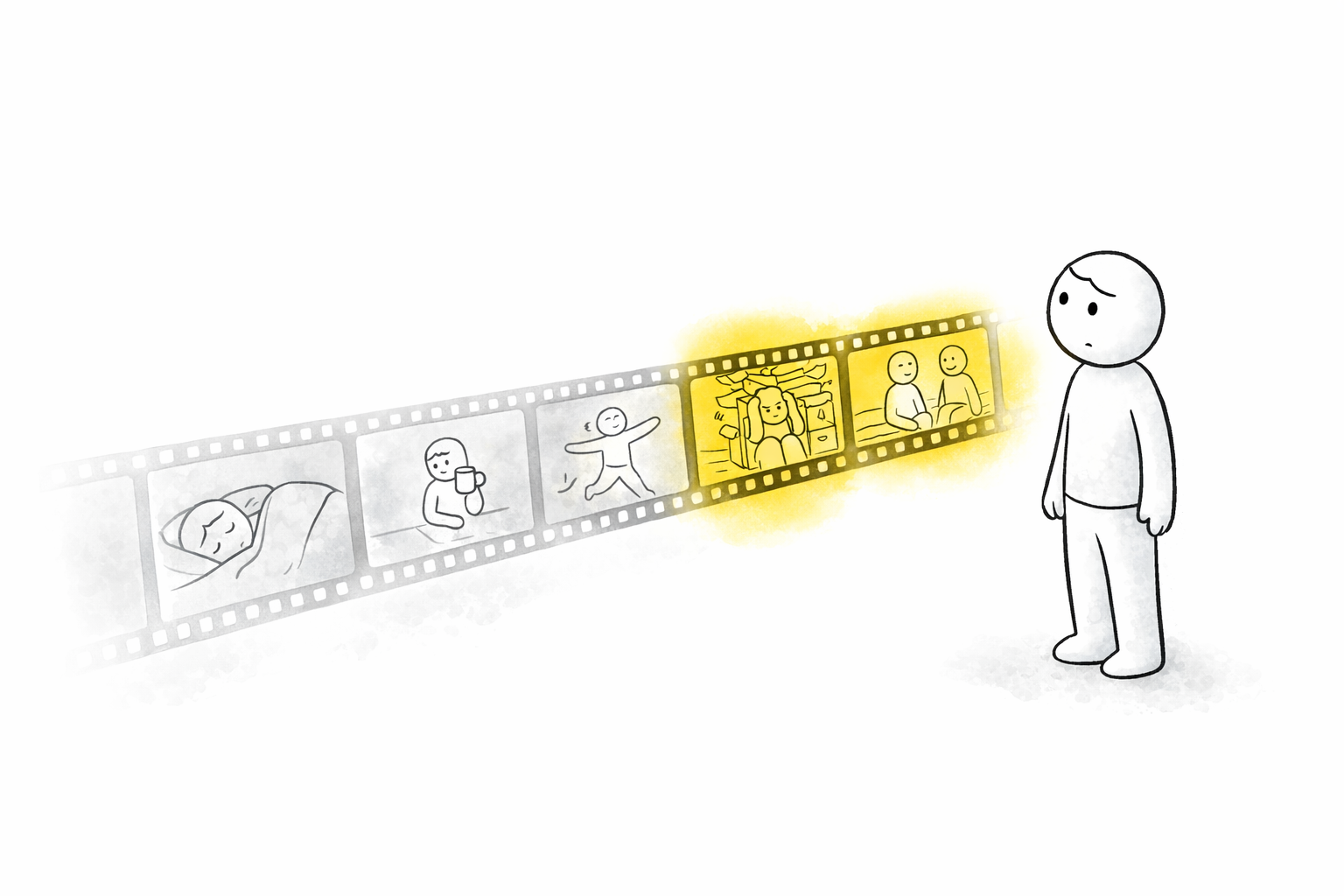
The day that was fine until it wasn't
You had a good day. Productive morning, nice lunch with a friend, a problem at work that you solved cleverly. Then at 4:30, your boss sent a terse email questioning a decision you made. By 9pm, when someone asked how your day was, you said "rough."
Was it rough? Look at the evidence. Most of it was good. Some of it was great. But the email colored everything. The entire day collapsed into that one moment and the lingering feeling it left you with at the end.
This isn't a character flaw. It's not pessimism, or ingratitude, or a sign you need to practice more gratitude. It's a well-documented feature of how your brain builds memories. And understanding it might change how you think about your days, your weeks, and the story you tell yourself about your life.
Two moments, that's it
In the early 1990s, Daniel Kahneman and Barbara Fredrickson ran an experiment that sounds almost comically simple. They showed people film clips of varying lengths and emotional intensity, pleasant and unpleasant, then asked them to rate how they felt about each one afterward.
The finding was striking. When people evaluated the clips from memory, the duration barely mattered. A thirty-second clip and a two-minute clip of comparable intensity got similar ratings. What predicted the overall evaluation? Two things: how intense the experience was at its peak, and how it felt at the very end.
Kahneman called this the "peak-end rule." Your brain doesn't compute an average of all the moments in an experience. It takes a mental snapshot of the peak and the ending, blends them together, and files that as your memory of the whole thing. The rest gets compressed, downweighted, or simply discarded.
Which means: a day with twenty good hours and one terrible moment at 4:30pm gets filed under "bad day." Not because you're irrational. Because your memory system was designed for a world where the most intense moments were the ones most likely to kill you.
The ice water that people chose to repeat
The most famous demonstration of the peak-end rule involves ice water and a choice that makes no logical sense.
In 1993, Kahneman, Fredrickson, Schreiber, and Redelmeier asked people to do two trials. In the first, they held one hand in painfully cold water (14°C) for 60 seconds. In the second, they held the other hand in the same cold water for 60 seconds, then kept it submerged for an additional 30 seconds while the temperature was secretly raised to 15°C. Still uncomfortable, but slightly less so.
Then the researchers asked: which trial would you rather repeat?
The rational answer is the first one. It's shorter. Less total discomfort. But most people chose the second trial. Ninety seconds of pain over sixty seconds of pain.
Why? Because the second trial ended better. That slight warming in the final thirty seconds changed the memory of the entire experience. People chose more suffering because it came with a better ending.
People chose more suffering because it came with a better ending. Your memory doesn't care about duration. It cares about peaks and endings.
Researchers have since replicated this in contexts far more consequential than ice water. In 1996, Redelmeier and Kahneman studied patients undergoing colonoscopies. They recorded pain levels in real time and then compared those recordings to patients' retrospective evaluations. The correlation between actual duration and remembered unpleasantness? Negligible. The correlation between peak pain intensity plus the pain at the end? Strong and consistent.
In a follow-up study, they tried something bold. For half the patients, they left the colonoscope in place for three extra minutes at the end of the procedure without moving it. Uncomfortable, but not painful. Those patients remembered the entire experience as significantly less unpleasant than patients who had the standard (shorter) procedure.
Three extra minutes of discomfort made the memory better, because the ending was gentler.
Duration neglect, or: your brain can't count
There's a companion phenomenon that makes the peak-end rule even more interesting. Kahneman called it "duration neglect." Your brain is remarkably bad at factoring in how long something lasted when it evaluates the experience afterward.
A two-week vacation doesn't get remembered as twice as good as a one-week vacation. A three-hour argument doesn't get remembered as three times worse than a one-hour argument. The length of an experience has a surprisingly weak relationship with how you remember it.
Think about what this means for your daily life. You might spend eight hours feeling calm and content, then thirty minutes feeling anxious before bed. The next morning, your memory of the day will be disproportionately shaped by that anxious half-hour. Not because you're being dramatic. Because your brain literally discounts the eight calm hours.
A 2022 meta-analysis by Cojuharenco and Ryvkin, examining decades of peak-end research, found the effect size was large (r = 0.58) and consistent across different types of experiences. The peak and the end predicted retrospective evaluations about as well as the actual average of all moments combined. Your brain's shortcut is powerful enough to rival the real data.
Why your brain does this
I know this sounds like a design flaw. But it's actually efficient, if you're a creature trying to survive in the wild.
Your ancestors didn't need to remember that the watering hole was pleasant for forty-five minutes before the lion showed up. They needed to remember the lion. The most intense moment of an experience is usually the most informative one. Was this dangerous? Was there a threat? What happened at the end, did I escape?
Peak-end encoding is a compression algorithm. Your brain processes an enormous amount of sensory and emotional data every day. Storing all of it at full resolution would be impossibly expensive. So it keeps the highlights and the conclusion, then reconstructs a plausible narrative from those anchors when you try to remember.
The problem is that this compression algorithm wasn't designed for modern life. In a world where the "peak" of your day is a critical email from your boss, and the "end" is doomscrolling before sleep, your brain is building memories that systematically underrepresent the good parts.
What actually happened
7 hours of focused work, a good conversation with a colleague, satisfying lunch, 20 minutes of stress about a deadline, an okay evening.
What you remember
The deadline stress (peak intensity) and the tired, vaguely anxious feeling while scrolling your phone in bed (the ending).
I think this is why so many people feel like they're having more bad days than they actually are. They're not misremembering. Their memories are accurately reflecting what the peak-end rule produces. The problem is that the peak-end rule is a lossy format.
The ending matters more than you think
Here's where this gets practical. If the end of an experience disproportionately shapes how you remember it, then the last thing you do in a day has outsized influence on whether you file that day as good or bad.
Consider two identical days that diverge only in the final hour. In version one, you spend the last hour before bed reading something you enjoy, or talking to someone you care about, or writing down a few things that went well. In version two, you spend that hour arguing on social media, catching up on bad news, or lying in bed replaying a mistake from earlier.
Same day. Different ending. Different memory.
This isn't about toxic positivity or forcing yourself to "end on a high note." It's about recognizing that your brain is going to disproportionately weight whatever happens last, whether you want it to or not. So the question becomes: do you want to leave that to chance?
The same principle applies to the peak. You can't always control what the most intense moment of your day is. But you can create positive peaks intentionally. A moment of genuine connection. A stretch of deep, absorbing work. A physical experience that fully engages your senses. These moments compete with the negative peaks for the top spot in your memory.
Rewriting the summary
The peak-end rule isn't something you can override. It's baked into how memory works. But knowing about it gives you something valuable: the ability to stop trusting your first answer to "how was my day?"
When you catch yourself thinking "today was terrible," you can pause and ask: was it actually terrible, or did one moment and the ending make it feel that way? What happened in the other fourteen hours? Often, when you look at the full picture instead of the compressed version, the day looks different.
This is also why writing things down before bed changes things. When you capture what actually happened, in real time rather than from memory, you create a record that isn't subject to peak-end distortion. You can look back at a week and see that Tuesday, the one you remember as awful, actually had a wonderful morning and a productive afternoon. The peak-end rule took the 4pm meeting and the late-night worry and built a false summary.
Your memory of a day is not the day itself. It's a two-point summary your brain constructed to save storage space. The actual day had more in it than you remember.
The researchers who study this aren't saying your feelings are wrong. They're saying your memory is compressed, and it favors the intense and the recent over everything else. Once you know that, you can hold your own memories a little more lightly. Question the narrative when it feels too bleak. Look at the evidence when the summary feels off.
And maybe, most practically: pay attention to your endings. Not because the rest doesn't matter. But because your brain has already decided that the rest matters less.
Get the next essay
One article per week on the psychology of thinking clearly. No spam, unsubscribe anytime.
References
- Fredrickson, B.L. & Kahneman, D. (1993). "Duration Neglect in Retrospective Evaluations of Affective Episodes." Journal of Personality and Social Psychology, 65(1), 45-55.
- Kahneman, D., Fredrickson, B.L., Schreiber, C.A., & Redelmeier, D.A. (1993). "When More Pain Is Preferred to Less: Adding a Better End." Psychological Science, 4(6), 401-405.
- Redelmeier, D.A. & Kahneman, D. (1996). "Patients' Memories of Painful Medical Treatments: Real-time and Retrospective Evaluations of Two Minimally Invasive Procedures." Pain, 66(1), 3-8.
- Redelmeier, D.A., Katz, J., & Kahneman, D. (2003). "Memories of Colonoscopy: A Randomized Trial." Pain, 104(1-2), 187-194.
- Cojuharenco, I. & Ryvkin, D. (2022). "All's Well That Ends (and Peaks) Well? A Meta-Analysis of the Peak-End Rule and Duration Neglect." Organizational Behavior and Human Decision Processes, 170, 104-135.
Clarido is a quiet log for a loud mind. Speak or type what's on your mind. Clarido holds it for you so you can return when you have space. Join the beta