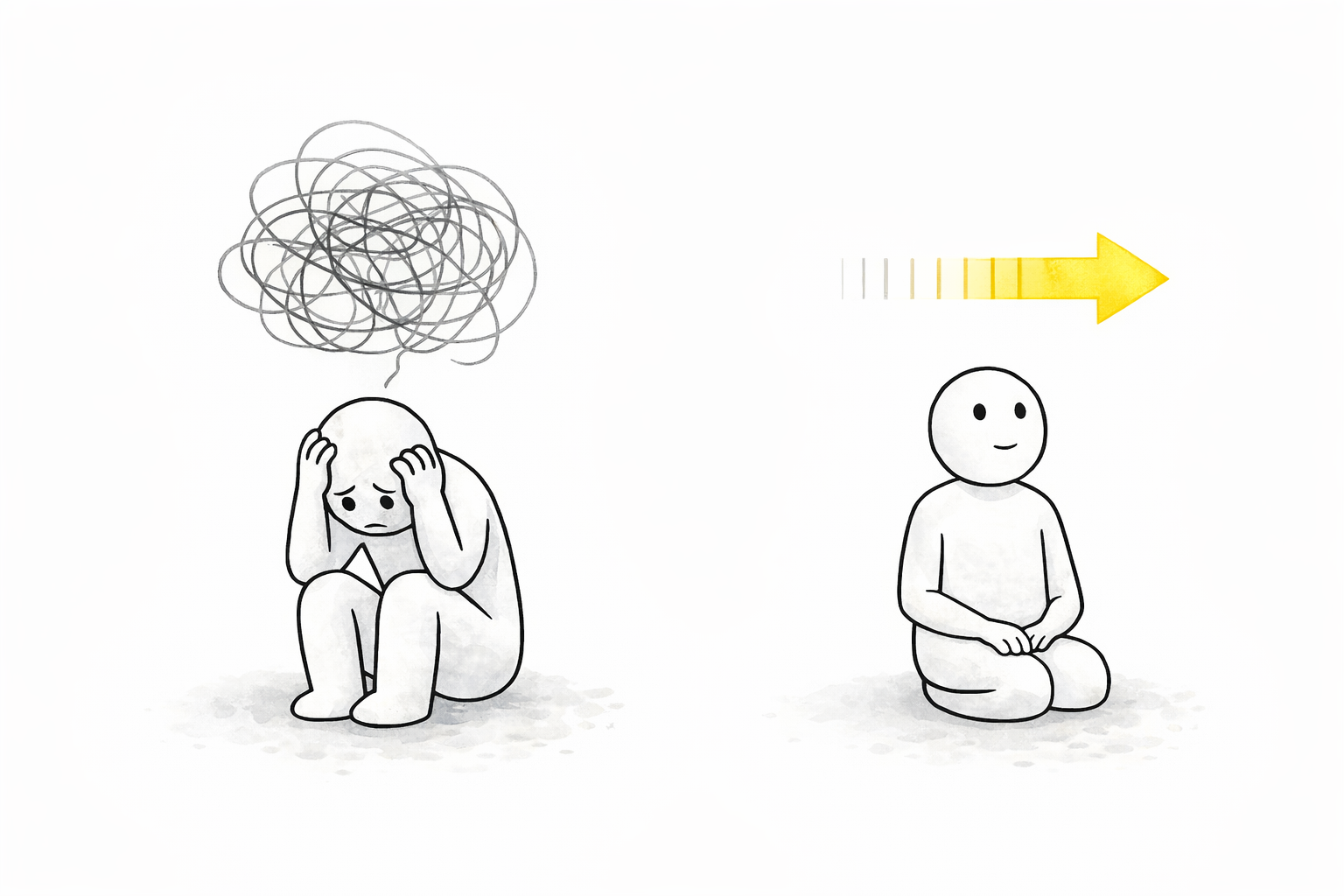
The Difference Between Thinking and Spiraling
Rumination feels like you're working through a problem. You're not. You're replaying it. Here's the sharp line between productive reflection and the loop that makes everything worse.

You've been here before
You're sitting with something that's bothering you. A conversation that went sideways. A decision you're not sure about. Something someone said three days ago that you can't shake.
So you do what feels responsible. You think about it.
You turn it over. You examine it from different angles. You replay the conversation, the moment, the choice. An hour later, you're still in it. Nothing has shifted. No new understanding, no resolution, no peace. Just the same loop, wearing a deeper groove.
Here's the uncomfortable question: were you actually thinking? Or were you just doing the same thing over and over and calling it reflection?
Most people can't tell the difference in the moment. That's the problem. Rumination and reflection feel identical while you're doing them. They both involve sustained attention to a problem. Both feel effortful. Both seem productive. But one of them moves you forward, and the other keeps you stuck. The research on what separates them is clear, and once you see it, you can't unsee it.
The loop that looks like work
In 1991, a psychologist named Susan Nolen-Hoeksema proposed something that would reshape how we understand depression. She called it the Response Styles Theory, and the core idea was simple: when people feel bad, the way they respond to that feeling matters more than the feeling itself.
Some people ruminate. They focus inward on their symptoms, their causes, their consequences. Why do I feel this way? What's wrong with me? What does this mean? Others distract themselves, or start solving problems. Nolen-Hoeksema's research, published in the Journal of Abnormal Psychology, showed that ruminators stayed depressed longer. Not because their problems were worse, but because their response to the problems kept the cycle going.
What makes this tricky is that rumination disguises itself as productive thinking. You're not avoiding the problem. You're engaging with it. You're sitting with discomfort and trying to understand it. That sounds like healthy self-awareness. It feels like effort. But the effort goes nowhere.
Rumination is the illusion of progress. You're spending mental energy, which makes it feel like work. But the energy produces nothing new.
Four years later, Lyubomirsky and Nolen-Hoeksema proved this in the lab. They published a study in the Journal of Personality and Social Psychology showing that rumination doesn't just fail to help you solve problems. It actively makes you worse at solving them. Participants who were induced to ruminate generated fewer effective solutions to interpersonal problems and rated their solutions as lower quality. The very thing rumination promises (I'm working through this), it destroys.
The two faces of repetitive thought
For years, researchers treated rumination as one thing. You're either doing it or you're not. Then, in 2003, Treynor, Gonzalez, and Nolen-Hoeksema published a factor analysis in Cognitive Therapy and Research that split the concept in two.
They found that what we call "rumination" actually contains two distinct components:
Brooding is passive, self-critical, and abstract. It dwells on the gap between where you are and where you wish you were. Reflection is active, curious, and concrete. It analyzes specific causes with the aim of understanding and change.
The results were striking. Brooding predicted increases in depression over a one-year period. Reflection predicted decreases. Same person, same problems, same amount of time spent thinking. The only difference was the quality of the thinking.
Edward Watkins expanded this in a landmark 2008 review in the Psychological Bulletin. He examined decades of research on repetitive thought and found that the single biggest factor determining whether it helps or hurts is the level of construal. Abstract thinking ("Why does this always happen?") leads to unconstructive rumination. Concrete thinking ("What specifically went wrong in that conversation at 2pm?") leads to constructive reflection.
The "why" question is the trap. It sounds deep. It sounds like you're getting to the root of something. But "why" pulls you toward abstract self-evaluation, which is exactly the mode that keeps the loop running. "What," "when," and "how" push toward specifics, which is the mode that breaks it.
The fly on the wall
So if the key is shifting from abstract to concrete, how do you actually do that when you're in the middle of spiraling?
Ethan Kross and Ozlem Ayduk found one answer. Working at the University of Michigan and UC Berkeley, they published a series of studies showing that self-distancing transforms how people process negative experiences. Their 2011 paper in Current Directions in Psychological Science summarized the mechanism.
The technique is straightforward. Instead of replaying an upsetting event from inside your own perspective (the way rumination naturally unfolds), you shift to a third-person view. You become a fly on the wall watching yourself in the scene.
This isn't suppression. You're still engaging with the experience. But the shift in perspective changes what your brain does with it. From a self-immersed perspective, people relive the emotional details, looping through them. From a distanced perspective, people reconstruct the meaning. They step back far enough to see the bigger picture.
The results were consistent. Self-distancers experienced less emotional reactivity in the moment. They ruminated less in the following days. And when they thought about the experience a week later, they felt less distress. A small shift in vantage point interrupted the loop that a direct approach couldn't break.
Writing breaks the circuit
There's another way out of the spiral, and it connects to something you might already do.
In 2006, Gortner, Rude, and Pennebaker published a study in Behavior Therapy that tested expressive writing on people vulnerable to depression. Participants wrote for 20 minutes on three consecutive days, either about their deepest thoughts and feelings or about a neutral topic.
The finding that matters: writing specifically reduced brooding while leaving reflective pondering intact. It didn't shut down all repetitive thought. It selectively dampened the destructive kind.
Why would putting words on paper do this? Writing forces translation. A ruminating mind works in fragments: flashes of the conversation, surges of emotion, half-formed accusations and defenses swirling together without resolution. To write it down, you have to convert that fog into sentences. Sentences require structure. Structure requires specificity. And specificity, as Watkins showed, is the mechanism that shifts repetitive thought from destructive to constructive.
This also explains why rumination tends to worsen at night, in the shower, during long drives. Moments with no external structure. Your mind defaults to its favorite loops, and without the constraint of having to articulate anything, those loops run without interruption. Writing imposes the structure your mind won't create on its own.
The tell
How do you know which one you're doing right now?
There's a simple diagnostic. After ten minutes of thinking about something, ask yourself: do I understand this differently than when I started?
Reflection produces movement. Even small movement. You notice something you hadn't noticed before. You reframe the problem slightly. You see the other person's perspective. You identify one concrete thing you could do. Something moves, even if the movement is subtle.
Rumination produces nothing new. You arrive back at the same feelings, the same conclusions, the same frustration. The loop is perfectly circular. You could continue for another hour and end up in exactly the same place.
Reflection sounds like
"The specific thing that bothered me was when she said X, because it reminded me of Y. Next time, I could try Z."
Rumination sounds like
"Why does this always happen to me? I can't believe she said that. What's wrong with me that I let it get to me?"
Notice the difference. One has details, cause and effect, and forward motion. The other has generalizations ("always"), self-blame, and no destination.
The shift
You don't have to solve the problem to stop ruminating. You just have to change the quality of your attention.
Move from "why" to "what." Why am I anxious becomes what specifically is making me anxious. Why can't I get over this becomes what happened, concretely, and what would help me move forward.
Move from inside to outside. Stop replaying the scene from your own eyes and describe it as if you're watching someone else go through it. What would you notice? What would you tell that person?
Move from your head to the page. Write it down. Not in polished sentences. Not in a journal with prompts and structure. Just get the noise out of your head and onto something you can look at. The act of translating mental fog into words is often enough to break the circuit.
The people who carry the heaviest mental loads aren't usually the ones with the worst problems. They're the ones whose brains default to a mode of thinking that feels productive but isn't. Not because they're doing something wrong. Because rumination is what the brain does when it doesn't have a better option. Give it one, and the loop breaks.
Get the next essay
One article per week on the psychology of thinking clearly. No spam, unsubscribe anytime.
References
- Nolen-Hoeksema, S. (1991). "Responses to Depression and Their Effects on the Duration of Depressive Episodes." Journal of Abnormal Psychology, 100(4), 569–582.
- Lyubomirsky, S. & Nolen-Hoeksema, S. (1995). "Effects of Self-Focused Rumination on Negative Thinking and Interpersonal Problem Solving." Journal of Personality and Social Psychology, 69(1), 176–190.
- Treynor, W., Gonzalez, R., & Nolen-Hoeksema, S. (2003). "Rumination Reconsidered: A Psychometric Analysis." Cognitive Therapy and Research, 27(3), 247–259.
- Gortner, E.M., Rude, S.S., & Pennebaker, J.W. (2006). "Benefits of Expressive Writing in Lowering Rumination and Depressive Symptoms." Behavior Therapy, 37(3), 292–303.
- Watkins, E.R. (2008). "Constructive and Unconstructive Repetitive Thought." Psychological Bulletin, 134(2), 163–206.
- Kross, E. & Ayduk, O. (2011). "Making Meaning out of Negative Experiences by Self-Distancing." Current Directions in Psychological Science, 20(3), 187–191.
Clarido is a quiet log for a loud mind. Speak or type what's on your mind. Clarido holds it for you so you can return when you have space. Join the beta →