motivationself-determination-theorypsychologypurposewell-being

The Three Things Every Human Needs to Feel Alive

You're not lazy. You're not broken. You might just be missing one of the three psychological ingredients that decades of research say every person requires to thrive.

Clarido Team··9 min read
The Three Things Every Human Needs to Feel Alive

The feeling that something is missing

You know that stretch where everything looks fine on paper? You have the job, the apartment, the routine. People would trade places with you. But something feels flat. You're going through the motions, checking things off, getting through the week. Not miserable, exactly. Just not alive.

Most people blame themselves for this. They call it laziness, or a bad attitude, or some character flaw they should fix. They try motivational podcasts and morning routines and setting bigger goals. Sometimes it works for a week. Then the flatness comes back.

What if the problem isn't you? What if it's something about the conditions of your life?


The theory nobody talks about

In 1985, two psychologists at the University of Rochester published a book that quietly redefined how we understand human motivation. Edward Deci and Richard Ryan proposed something that flew in the face of conventional wisdom: humans are not primarily motivated by rewards and punishments. We are driven by three innate psychological needs. When those needs are met, we flourish. When they're not, we wilt.

They called it Self-Determination Theory.

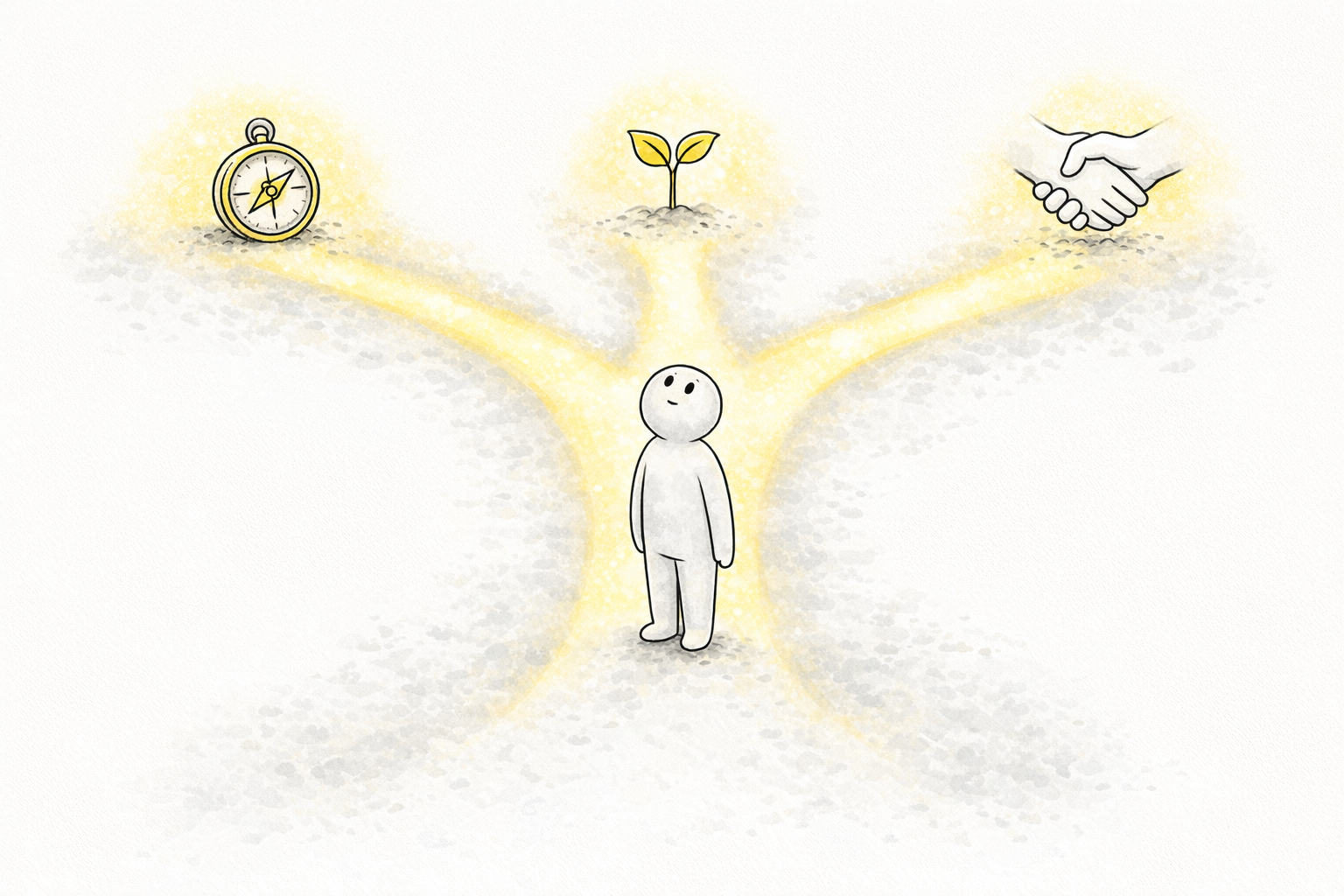
The three needs are autonomy, competence, and relatedness. Not "nice to have" extras. Not personality traits that some people have and others don't. Fundamental requirements for psychological health, as basic to your mind as food and water are to your body.

Autonomy

The feeling that your actions are your own. That you're choosing your life, not just following orders.

Competence

The feeling that you're effective. That you can do things, learn things, grow at things that matter to you.

Relatedness

The feeling that you belong. That someone sees you, and you see them.

Here's what makes SDT different from most motivation theories: it doesn't tell you to want harder or try more. It says the drive is already in you. The question is whether your environment is feeding it or starving it.


The experiment that proved rewards can backfire

Here's something counterintuitive. Paying people to do something they already enjoy can make them enjoy it less.

Deci, Koestner, and Ryan analyzed 128 experiments in a massive 1999 meta-analysis published in Psychological Bulletin. The pattern was consistent: tangible, expected rewards (money, prizes, gold stars) significantly undermined intrinsic motivation. The effect was not small.

Think about that for a second. A kid who loves drawing gets a certificate for every picture she makes. Within weeks, she draws less. A volunteer who finds deep satisfaction in mentoring gets offered a stipend. Somehow the work starts feeling like a chore.

Why? Because the reward shifts something internally. The question in your mind goes from "I'm doing this because I want to" to "I'm doing this because I'm getting paid to." Autonomy erodes. The activity becomes a transaction. And transactions, it turns out, are terrible fuel for the human spirit.

The problem is rarely that people lack motivation. It's that something in their environment is draining it away.

The critical nuance: rewards that acknowledged competence without feeling controlling could actually help. It wasn't rewards themselves that caused damage. It was the loss of autonomy. The feeling that someone else was pulling the strings.


What actually makes people satisfied

If autonomy, competence, and relatedness sound reasonable but vague, consider what happened when researchers put them to the test against the alternatives.

Kennon Sheldon and his colleagues ran a study in 2001 (published in the Journal of Personality and Social Psychology) that pitted ten candidate psychological needs against each other. The contenders included self-esteem, self-actualization, physical thriving, security, pleasure, popularity, and money. Participants described their most satisfying recent experiences, and researchers measured which needs those experiences fulfilled.

The results were striking. Autonomy, competence, and relatedness consistently ranked at the top. Money and popularity ranked at the bottom.

3 psychological needs consistently outranked money, popularity, pleasure, and seven other candidates in predicting human satisfaction.

This is not a philosophical claim. It's an empirical finding, replicated across multiple studies. The things we chase hardest (status, wealth, security) matter far less to our psychological well-being than the things we barely think about (feeling effective, feeling connected, feeling like the author of our own lives).

Which raises an uncomfortable question: how many of your daily decisions optimize for the wrong list?


The dark side: what happens when the needs get crushed

There's an important distinction that researchers didn't fully appreciate until more recently. Not having your needs met is one thing. Having them actively thwarted is something worse.

Bartholomew and colleagues published a 2011 study in the Journal of Sport and Exercise Psychology that measured what happens when coaches don't just fail to support autonomy, competence, and relatedness, but actively undermine them. Think: a boss who micromanages every decision (crushing autonomy), who criticizes without constructive feedback (crushing competence), who plays favorites and isolates team members (crushing relatedness).

The effects were not just "low satisfaction." Need thwarting predicted burnout, depression, disordered eating, and physical symptoms. It's the difference between a plant that's not getting enough sunlight and a plant that someone is actively pouring salt on.

Need frustration "My input doesn't matter here. I just execute what I'm told."
Need satisfaction "I chose this direction. I'm getting better at it. And I'm doing it with people I respect."

A 2020 review by Vansteenkiste, Ryan, and Soenens in Motivation and Emotion extended this further. When psychological needs are thwarted, people don't just feel bad. They compensate. Overeating. Oversleeping. Substance use. Doomscrolling. The behaviors we pathologize as lack of discipline often trace back to something simpler: a fundamental psychological need that's going unmet.

Maybe you're not addicted to your phone. Maybe you're lonely.


Why this matters more than you think

Here's the part that tends to hit people hardest. Once you know the three needs, you start seeing them everywhere.

That Sunday dread before the work week? Check whether Monday means eight hours of doing things someone else decided, in ways someone else prescribed, with feedback that amounts to silence or criticism. That's autonomy and competence, both starved.

The restlessness after a promotion? You got the title, the salary, the status. But the role moved you further from the work you loved and the people you cared about. Competence and relatedness, traded for external markers that SDT predicts won't satisfy.

The strange energy you feel during a weekend project nobody asked for? That's all three needs firing at once. You chose it (autonomy). You're building something (competence). You're sharing it with someone who cares (relatedness).

The diagnostic question When something feels off, ask: Which of the three is missing? Am I feeling controlled? Am I feeling ineffective? Am I feeling disconnected? The answer is usually right there.

Gagné and Deci applied this framework to the workplace in a 2005 paper in the Journal of Organizational Behavior that became one of the most influential articles in the field. The finding was straightforward: people with autonomous motivation (doing the work because it aligns with their values, not because they're afraid of consequences) perform better, persist longer, and report higher satisfaction. Not a little better. Meaningfully better.

A later meta-analysis by Slemp and colleagues (2018, Motivation and Emotion), covering 72 studies and nearly 33,000 employees, confirmed the other side of the coin: managers who support autonomy get thriving teams. Controlling leaders get distress.


The three-word audit

So what do you do with this?

You could start with a simple exercise. Look at the last week of your life. Not the highlights you'd post online. The actual texture of your days. Then ask three questions.

Did I choose? Not every minute has to be self-directed. But was there a meaningful portion of your week where you felt like the author of your own actions? Or did most of your time feel dictated by obligations, expectations, and other people's agendas?

Did I grow? Did you do something that challenged you? Did you get better at something, even slightly? Or did the week feel like repetition, the same competencies applied to the same problems on autopilot?

Did I connect? Not surface interaction. Not "How was your weekend? Good, good." Was there a moment where someone genuinely saw you, or you genuinely saw them?

You don't need to overhaul your life. You need to notice which ingredient is missing and find one small way to add it back.

If autonomy is the gap, look for one decision you can reclaim. It doesn't have to be dramatic. Choose the order of your tasks. Pick the restaurant. Take a different route. Small acts of authorship remind your brain that you're a person, not a process.

If competence is missing, find something to learn. Not for career advancement. Not for productivity. Because the feeling of "I couldn't do this yesterday and I can do it today" is one of the most deeply satisfying experiences available to a human brain.

If relatedness is the weak link, reach out. Not with "We should catch up sometime." With something real. Send the specific text. Make the specific plan. Relatedness doesn't come from having relationships. It comes from using them.


The motivation you already have

Here's the part that Deci and Ryan got most right, the part that separates SDT from every other motivation framework: you don't need to manufacture drive. You were born with it.

Watch any toddler. They explore relentlessly. They want to do things themselves (autonomy). They light up when they master something new (competence). They seek connection constantly (relatedness). Nobody taught them to want these things. The desire is built in.

What happens over the next twenty, thirty, forty years is that the desire gets buried. Under reward systems that make everything transactional. Under environments that crush initiative. Under relationships that became routine. The drive never disappears. It just gets harder to hear.

Cross-cultural research by Chen and colleagues (2015, Motivation and Emotion), studying participants across the United States, Peru, Belgium, and China, found that these three needs predicted well-being and ill-being in every culture tested. This is not a Western phenomenon. It's not a personality type. It's the operating system.

So the next time you feel that flatness, that going-through-the-motions numbness, don't reach for a productivity hack. Don't add another goal. Stop and listen.

The thing that's missing probably has a name. And it's probably one of three.


References

  • Deci, E.L. & Ryan, R.M. (1985). Intrinsic Motivation and Self-Determination in Human Behavior. New York: Plenum Press.
  • Ryan, R.M. & Deci, E.L. (2000). "Self-Determination Theory and the Facilitation of Intrinsic Motivation, Social Development, and Well-Being." American Psychologist, 55(1), 68–78.
  • Deci, E.L., Koestner, R., & Ryan, R.M. (1999). "A Meta-Analytic Review of Experiments Examining the Effects of Extrinsic Rewards on Intrinsic Motivation." Psychological Bulletin, 125(6), 627–668.
  • Sheldon, K.M., Elliot, A.J., Kim, Y., & Kasser, T. (2001). "What Is Satisfying About Satisfying Events? Testing 10 Candidate Psychological Needs." Journal of Personality and Social Psychology, 80(2), 325–339.
  • Bartholomew, K.J., Ntoumanis, N., Ryan, R.M., & Thogersen-Ntoumani, C. (2011). "Psychological Need Thwarting in the Sport Context: Assessing the Darker Side of Athletic Experience." Journal of Sport and Exercise Psychology, 33(1), 75–102.
  • Vansteenkiste, M., Ryan, R.M., & Soenens, B. (2020). "Basic Psychological Need Theory: Advancements, Critical Themes, and Future Directions." Motivation and Emotion, 44(1), 1–31.
  • Gagné, M. & Deci, E.L. (2005). "Self-Determination Theory and Work Motivation." Journal of Organizational Behavior, 26, 331–362.
  • Slemp, G.R., Kern, M.L., Patrick, K.J., & Ryan, R.M. (2018). "Leader Autonomy Support in the Workplace: A Meta-Analytic Review." Motivation and Emotion, 42, 706–724.
  • Chen, B., Vansteenkiste, M., et al. (2015). "Basic Psychological Need Satisfaction, Need Frustration, and Need Strength Across Four Cultures." Motivation and Emotion, 39, 216–236.

Clarido is a quiet log for a loud mind. Speak or type what's on your mind. Clarido holds it for you so you can return when you have space. Join the beta →