self-distancingself-talkemotional-regulationoverthinkingdecision-making

Why Talking to Yourself in Third Person Actually Works

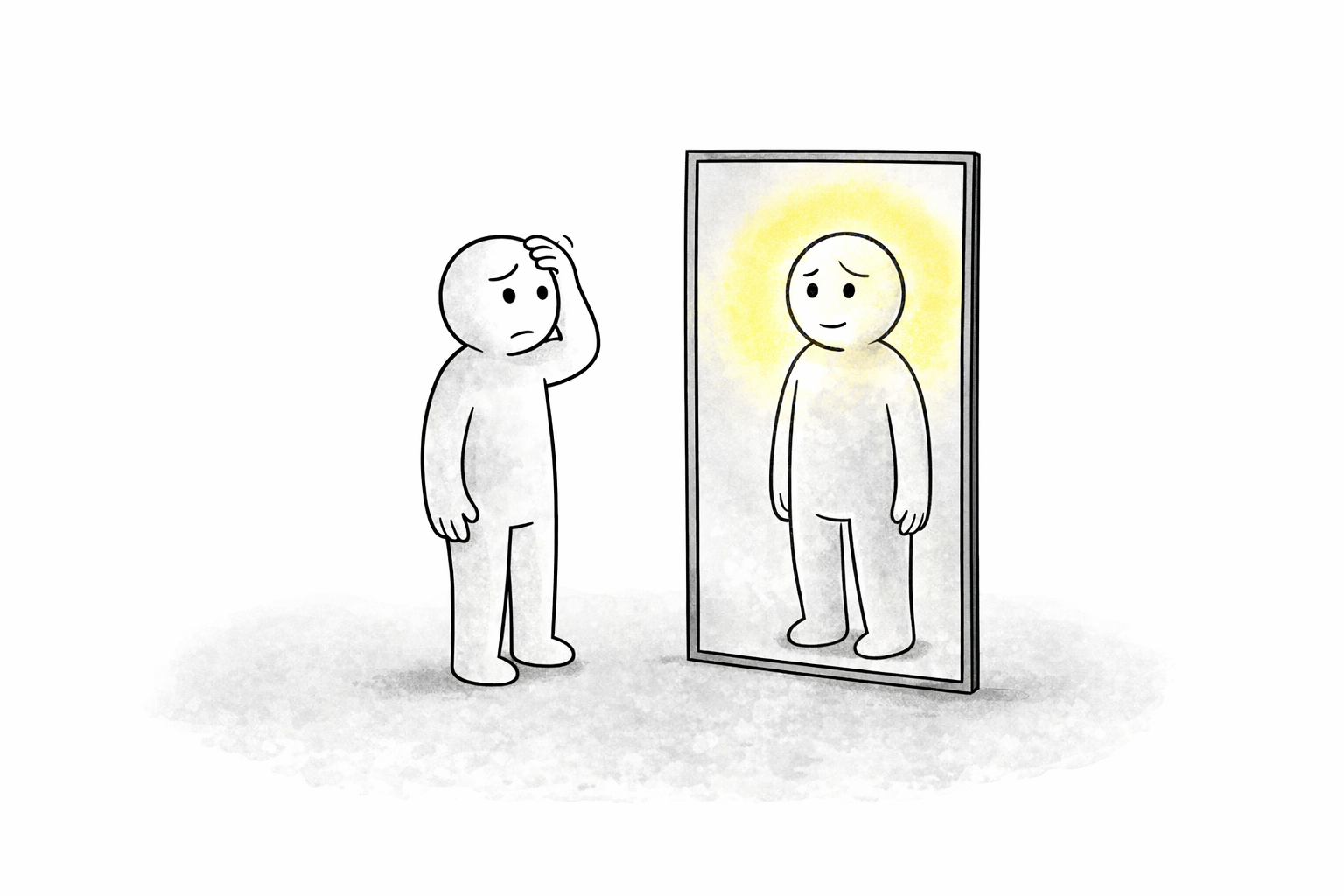
You give great advice to friends but can't take your own. Psychologists call this Solomon's Paradox, and the fix is surprisingly simple: change one word in how you talk to yourself.

Clarido Team··7 min read
Why Talking to Yourself in Third Person Actually Works

The friend problem

You know the feeling. A friend calls you with a problem. Maybe they're agonizing over a job offer, or spiraling about something they said at a dinner party, or stuck in a relationship that clearly isn't working. And you can see it so clearly. The answer feels obvious. You lay it out for them: here's what's happening, here's what matters, here's what you should do.

Then you hang up the phone, and you're right back in your own mess. The same kind of problem, the same kind of spiral. But now the clarity is gone. You can't see your own situation with anything close to the objectivity you just offered your friend.

Why is that? Why are you so much better at understanding other people's problems than your own?


Solomon's Paradox

Psychologists have a name for this. They call it Solomon's Paradox, after the biblical king who dispensed legendary wisdom to everyone around him while making catastrophically bad decisions in his own life.

Igor Grossmann and Ethan Kross explored this phenomenon in a 2014 study published in Psychological Science. Across three experiments with 693 participants, they confirmed what most of us already suspect: people reason more wisely about other people's conflicts than about their own. When reflecting on a friend's relationship problem, participants showed greater intellectual humility, more willingness to consider opposing perspectives, and a better sense of how things might change over time. When reflecting on their own identical problems? They got tunnel vision.

You can see the whole chessboard when it's someone else's game. When it's yours, you can only see the piece that's about to be taken.

The question that matters is: what's different? What changes between "thinking about their problem" and "thinking about my problem"?

The answer is distance.


The proximity trap

When you think about your own problems, you think from the inside. You're immersed. Every emotion, every fear, every worst-case scenario is right there, at full volume, demanding attention. You replay conversations word by word. You feel the sting again. You catastrophize. Psychologists call this "self-immersed" processing, and it's the default mode your brain drops into when something hurts.

The trouble is, immersion doesn't help you think. It helps you feel. And when you're trying to figure out what to do next, feeling more intensely is rarely what you need. What you need is perspective. The same perspective you naturally have when you're thinking about someone else's situation.

Kross and Ayduk outlined this in a 2011 paper in Current Directions in Psychological Science: when people analyze negative experiences from a self-immersed perspective, they tend to recount the emotional details over and over. They ruminate. But when they shift to a self-distanced perspective, something changes. They start reconstruing. Finding meaning. Seeing the situation from new angles. The emotional charge drops, and insight rises.

So the real question becomes: can you create that distance on demand?


One word changes everything

Here's where the research gets interesting.

In 2014, Ethan Kross and his colleagues ran seven studies with 585 participants. They published the results in the Journal of Personality and Social Psychology with a straightforward title: "Self-talk as a regulatory mechanism: How you do it matters."

The setup was simple. Participants were told they'd have to give a speech (a reliable way to make people anxious). One group was told to prepare by thinking about their feelings using "I." Why am I nervous? What am I afraid of? The other group was told to use their own name instead. Why is Sarah nervous? What is Sarah afraid of?

That's it. One pronoun shift.

The results were consistent across all seven experiments. People who used their own name (or "you" or "he/she") experienced less anxiety, performed better under pressure, and engaged in less post-event rumination than people who used "I." They weren't suppressing their emotions. They were processing them from a vantage point that allowed clearer thinking.

1 second is all it takes. Brain imaging shows third-person self-talk reduces emotional reactivity within one second of encountering a stressor.

That speed matters. Jason Moser and colleagues demonstrated it in a 2017 study published in Scientific Reports. Using both EEG and fMRI, they found that third-person self-talk reduced a brain marker of self-referential emotional reactivity (the late positive potential) almost immediately. And here's the part that surprised them: it did this without activating the brain regions associated with effortful cognitive control. The prefrontal areas that light up when you're trying hard to reappraise a situation or suppress a feeling? They stayed quiet.

In other words, this isn't willpower. It's not gritting your teeth and forcing yourself to think differently. It's more like flipping a switch that lets your brain treat your problem the way it already treats everyone else's.


Why it works

The theoretical framework behind this comes from construal level theory, developed by Yaacov Trope and Nira Liberman. Their work, published in Psychological Review in 2010, describes a fundamental relationship between psychological distance and abstract thinking.

The core idea is simple: the farther away something feels, the more abstractly you think about it. Close things get concrete, detailed, emotional processing. Distant things get the big picture treatment. This is true across every type of distance: physical space, time, social distance, even hypothetical scenarios.

When you use your own name in self-talk, you're creating social distance from yourself. You're treating yourself as another person. And your brain responds accordingly. It shifts from low-level, immersed processing (every detail at full intensity) to high-level, distanced processing (what actually matters here?).

Self-immersed "Why do I always mess things up? I can't believe I said that. I'm going to lose this job."
Self-distanced "Why is Alex upset about this? What would he tell a friend in this situation? What does Alex actually want here?"

Notice what happens in the second version. The questions shift from emotional spiraling to problem-solving. Not because you forced them to, but because the linguistic frame changed what your brain does with the information.


It works when it matters most

A reasonable objection: maybe this only works for minor stressors. Maybe when things get genuinely intense, the trick falls apart.

Ariana Orvell and colleagues tested exactly this in a 2021 study published in Clinical Psychological Science. They had participants reflect on negative experiences across a wide range of emotional intensity, from mildly annoying to deeply painful. The result? Distanced self-talk reduced emotional reactivity across the full spectrum. It worked for mild stressors and severe ones alike.

More importantly, it worked for people who scored high on measures of emotional vulnerability. The participants who needed it most benefited just as much as everyone else.

This isn't positive thinking Self-distancing doesn't ask you to pretend things are fine. You're not replacing "I'm scared" with "Everything will work out." You're replacing "I'm scared" with "Why is she scared?" The emotions are still there. You're just looking at them from a place where you can actually work with them.

And that's why it resolves Solomon's Paradox. Remember the Grossmann and Kross study? When they instructed participants to self-distance while reasoning about their own relationship conflicts, the gap between self-wisdom and other-wisdom disappeared. People reasoned just as wisely about their own problems as they did about their friends'. The wisdom was always there. It was the proximity that blocked it.


What to do with this

You don't need a therapist or a meditation practice to start using this. The next time you're caught in a loop, try one thing: switch the pronoun.

Instead of "What should I do?" ask "What should [your name] do?" Instead of "Why am I so upset about this?" try "Why is [your name] upset about this?"

It feels strange the first time. That's fine. The strangeness is the point. It's the cognitive shift that creates the distance.

A few situations where this is particularly useful:

Before a hard conversation

Use your name to think through what you want to say. You'll focus on the outcome instead of the anxiety.

When you're spiraling at night

Narrate the worry in third person. It shrinks. What felt catastrophic starts to feel like a problem with edges.

After something went wrong

Instead of replaying what you did, ask what your name would tell a friend who did the same thing. Then take your own advice.

The deeper point is this: you're not bad at handling your own problems. You're too close to them. The advice you give your friends is proof that you already know how to think clearly about hard things. You just need a way to access that clarity when the hard thing is yours.

And sometimes, all it takes is changing "I" to your name.


References

  • Kross, E., Bruehlman-Senecal, E., Park, J., Burson, A., Dougherty, A., Shablack, H., & Bremner, R. (2014). "Self-talk as a regulatory mechanism: How you do it matters." Journal of Personality and Social Psychology, 106(2), 304–324.
  • Grossmann, I. & Kross, E. (2014). "Exploring Solomon's Paradox: Self-Distancing Eliminates the Self-Other Asymmetry in Wise Reasoning About Close Relationships in Younger and Older Adults." Psychological Science, 25(8), 1571–1580.
  • Kross, E. & Ayduk, O. (2011). "Making Meaning out of Negative Experiences by Self-Distancing." Current Directions in Psychological Science, 20(3), 187–191.
  • Moser, J.S., Dougherty, A., Mattson, W.I., Katz, B., Moran, T.P., Guevarra, D., Shablack, H., Ayduk, O., Jonides, J., Berman, M.G., & Kross, E. (2017). "Third-person self-talk facilitates emotion regulation without engaging cognitive control: Converging evidence from ERP and fMRI." Scientific Reports, 7, 4519.
  • Trope, Y. & Liberman, N. (2010). "Construal-Level Theory of Psychological Distance." Psychological Review, 117(2), 440–463.
  • Orvell, A., Vickers, B.D., Drake, B., Verduyn, P., Ayduk, O., Moser, J., Jonides, J., & Kross, E. (2021). "Does Distanced Self-Talk Facilitate Emotion Regulation Across a Range of Emotionally Intense Experiences?" Clinical Psychological Science, 9(1), 68–78.

Clarido is a quiet log for a loud mind. Speak or type what's on your mind. Clarido holds it for you so you can return when you have space. Join the beta →