Nobody Is Thinking About You as Much as You Think
You walked out with toothpaste on your shirt and spent the whole day convinced everyone noticed. They didn't. Here's the psychology behind why we massively overestimate our own visibility.
The t-shirt experiment
You're a college student and a researcher hands you a t-shirt. On the front is a giant picture of Barry Manilow's face. Not ironically. Not as a costume. Just... Barry Manilow. In all his feathered-hair glory.
Now put it on and walk into a room full of your peers.
This is what Thomas Gilovich and his colleagues at Cornell actually did in 2000. And they asked the participants a simple question afterward: how many people in the room do you think noticed the shirt?
The wearers guessed about half. The real number? Roughly a quarter. They'd overestimated their own visibility by nearly double.
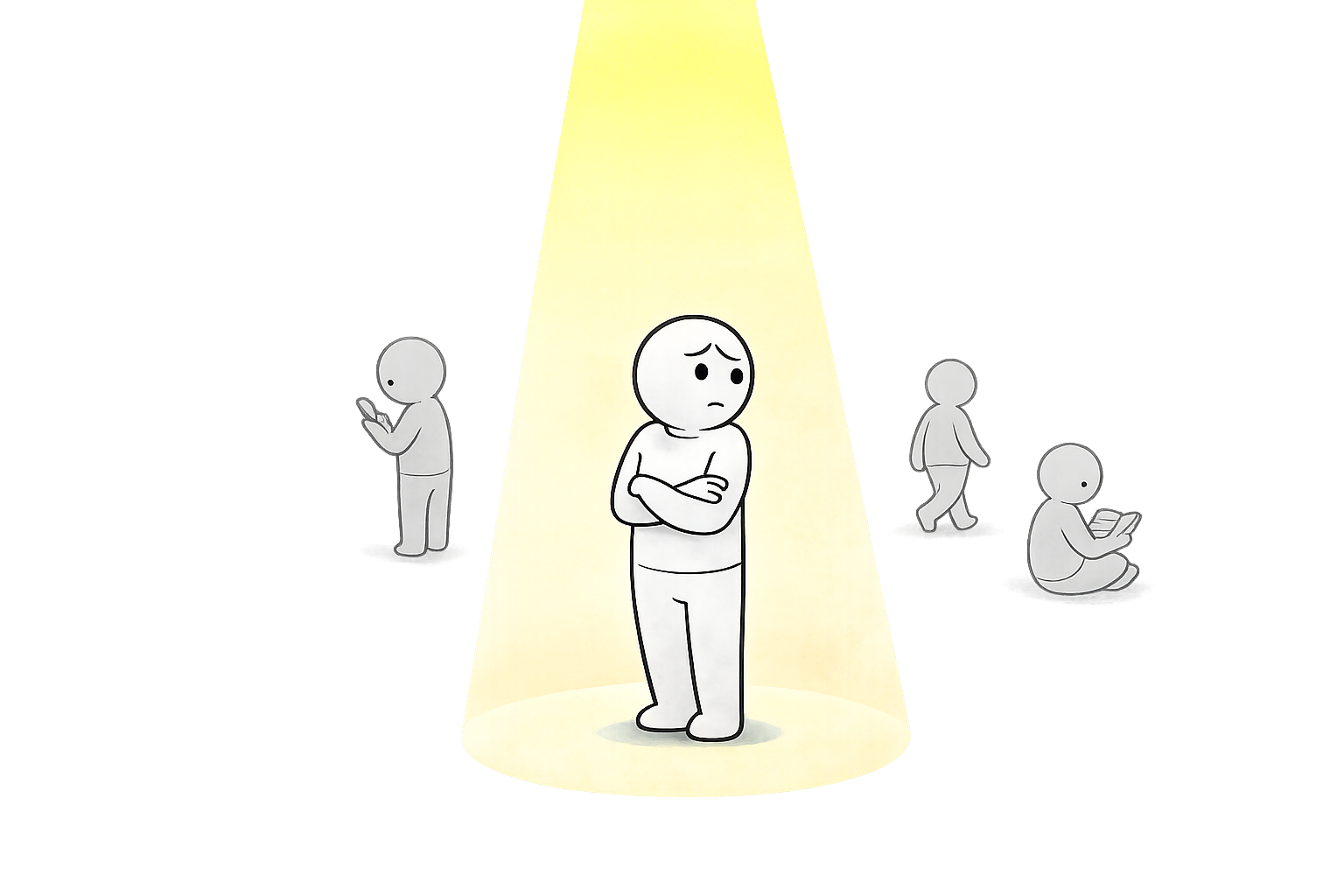
That gap between how much you think people notice you and how much they actually do has a name. Psychologists call it the spotlight effect. And if you've ever spent an entire day replaying something awkward you said in a meeting, wondering if your hair looked weird, or agonizing over whether you laughed too loud at dinner, you've felt it.
The spotlight that isn't there
Here's what makes the spotlight effect so persistent: it feels rational. You tripped on the stairs. Everyone was right there. Of course they noticed. Of course they're thinking about it.
But they're not. Or at least, not nearly as much as you assume.
The mechanism is something psychologists call anchoring. You start with your own experience (which is vivid, detailed, and emotionally charged) and try to estimate what others noticed from there. But you don't adjust enough. You know your palms were sweating during the presentation. You know your voice cracked on that one word. So you assume everyone else registered it too.
They didn't. They were thinking about lunch. Or their own presentation. Or nothing in particular. Other people's attention is a scarce resource, and you're getting far less of it than you think.
It gets worse (in your head)
The spotlight effect has a companion bias that makes everything stickier. Gilovich and Savitsky called it the illusion of transparency: the belief that your internal states leak out and are visible to others.
Feeling nervous? You assume everyone can tell. Hiding a secret? You feel like it's written on your face. Trying not to laugh at something inappropriate? Surely the whole room sees you fighting it.
In one experiment from their 1998 paper in the Journal of Personality and Social Psychology, participants tasted drinks, some of which were intentionally disgusting. The tasters were convinced their reactions were obvious to observers. The observers barely noticed.
You are the center of your own universe. But nobody else's.
This combination is what makes social anxiety so exhausting. You feel spotlit and transparent. Like everyone is watching, and like they can see right through you. The cognitive load of monitoring yourself under those conditions is enormous. Every word gets rehearsed. Every gesture gets second-guessed. And the irony is that all that self-monitoring actually makes you perform worse in social situations, which gives you more material to agonize over later.
David Clark and Adrian Wells described this cycle in their 1995 cognitive model of social phobia. When you enter a social situation feeling anxious, you turn your attention inward. You start constructing a mental image of how you must look from the outside. That image is almost always worse than reality. But because you're focused on it instead of on the actual social interaction, you miss the evidence that would correct it: the person smiling at your joke, the room that has clearly moved on from your stumble.
Nobody remembers your worst moments
Here's the part that might actually change something for you.
Kenneth Savitsky, along with Nicholas Epley and Gilovich, ran a study in 2001 asking participants to predict how harshly others would judge their failures. People who bombed a quiz in front of peers, who were described in embarrassing terms, who made social blunders. In every case, the prediction was the same: others would judge them severely. And in every case, the reality was the same too: others barely cared.
Not because people are callous. Because people are busy. Your stumble is one data point in someone else's day full of data points. They have their own internal spotlight consuming their attention. Your embarrassing moment registers, maybe, for a few seconds before getting displaced by whatever's next.
This asymmetry is almost comical once you see it. You're constructing elaborate narratives about other people's judgments of you. Meanwhile, those people are constructing elaborate narratives about other people's judgments of them. Everyone is so busy worrying about their own spotlight that they have no bandwidth left to shine one on you.
They like you more than you think
If the spotlight effect is about overestimating negative attention, the liking gap is about underestimating positive regard. And it's just as pervasive.
In 2018, Erica Boothby and her colleagues at Yale published a study in Psychological Science that tracked what happens after people have conversations. Afterward, both participants rated how much they liked the other person and how much the other person liked them. Consistently, people underestimated how much they were liked.
This wasn't subtle. The gap was large, and it showed up everywhere the researchers tested it: strangers in a lab, college freshmen getting to know their dormmates, adults at a professional workshop. The dormmate study was particularly striking. The liking gap persisted for months. Students kept underestimating how much their hallmates enjoyed them well into the school year.
The mechanism is the same anchoring problem. After a conversation, you have vivid access to every awkward pause, every joke that didn't land, every moment you searched for words. You remember the parts where you felt uncomfortable. The other person, meanwhile, remembers the parts where they felt connected. Same conversation, two completely different highlight reels.
The self-monitoring trap
So why does this matter beyond social discomfort?
Because the spotlight effect doesn't just make you feel bad after social interactions. It changes how you behave during them. When you believe you're being closely watched and evaluated, you shift into performance mode. You monitor every word. You rehearse responses. You avoid saying anything that might draw attention.
Social filtering
You edit yourself so heavily that the real you never shows up. Conversations become performances instead of connections.
Post-event rumination
After every interaction, you replay what you said and how it was received. This mental review can last hours and colors your memory of the event negatively.
Avoidance
Over time, the cognitive cost of all this monitoring makes social situations feel exhausting. So you start avoiding them. Which means fewer corrections to your distorted self-image.
Rapee and Heimberg's 1997 model of social anxiety describes exactly this cycle. You construct a mental representation of how you appear to others (always unflattering), compare it against what you think they expect (always impossibly high), and conclude you're falling short. Then you avoid or escape the situation, which prevents you from ever learning that the audience was never paying that much attention to begin with.
The cruelest part? The people who experience the strongest spotlight effect are often the most thoughtful and considerate. They care about others' experiences. They pay close attention to social dynamics. And they project that same level of attention onto everyone else, assuming the world is as observant of them as they are of the world.
It's not. Not even close.
What actually helps
You can't think your way out of the spotlight effect. Telling yourself "nobody's watching" while your brain insists otherwise doesn't work. But a few things do.
Run the experiment. Ask a friend what they remember about a social interaction you've been agonizing over. Not for reassurance. Genuinely ask. You'll be startled by how little they noticed. Do this enough times and the pattern starts to override the bias.
Redirect attention outward. The spotlight effect is powered by self-focused attention. When you shift focus to the other person (what they're saying, what they seem interested in, what makes them laugh), the internal spotlight dims. You stop monitoring your own performance because you're too engaged with someone else's.
Notice the asymmetry. Next time you're convinced everyone noticed your blunder, flip it. Did you notice the last time someone else stumbled over a word? Mispronounced something? Wore something odd? Probably not. Or if you did, you forgot about it within seconds. You're extending grace to everyone else that you refuse to extend to yourself.
The same brain that obsesses over what others think of you barely registers what you think of them.
Name the spotlight. This one comes from the affect labeling research. When you notice yourself spiraling about a social moment, try saying (to yourself or on paper): "I'm experiencing the spotlight effect right now. I'm overestimating how much attention I got." Labeling the bias doesn't eliminate it. But it creates just enough distance to loosen its grip.
The quiet truth
Here's what the research keeps pointing to, across decades and dozens of studies: you are far less visible than you feel. Your stumbles are noticed less, remembered less, and judged less harshly than you expect. And the warmth people feel toward you? You're systematically underestimating that too.
This doesn't mean nobody ever notices anything. It means the amount of social bandwidth dedicated to evaluating you is a fraction of what your brain budgets for worrying about it. The spotlight feels blinding because you're the one standing in it. From the audience, it barely registers.
Most of the social anxiety you carry around isn't a response to real scrutiny. It's a response to imagined scrutiny that your brain invented by projecting its own self-awareness onto others. You feel watched because you're watching yourself. And everybody else is doing the same thing, staring into their own spotlight, convinced that you're staring at them.
You're not. And they're not either.
Get the next essay
One article per week on the psychology of thinking clearly. No spam, unsubscribe anytime.
References
- Gilovich, T., Medvec, V.H., & Savitsky, K. (2000). "The Spotlight Effect in Social Judgment: An Egocentric Bias in Estimates of the Salience of One's Own Actions and Appearance." Journal of Personality and Social Psychology, 78(2), 211-222.
- Gilovich, T., Savitsky, K., & Medvec, V.H. (1998). "The Illusion of Transparency: Biased Assessments of Others' Ability to Read One's Emotional States." Journal of Personality and Social Psychology, 75(2), 332-346.
- Savitsky, K., Epley, N., & Gilovich, T. (2001). "Do Others Judge Us as Harshly as We Think? Overestimating the Impact of Our Failures, Shortcomings, and Mishaps." Journal of Personality and Social Psychology, 81(1), 44-56.
- Boothby, E.J., Cooney, G., Sandstrom, G.M., & Clark, M.S. (2018). "The Liking Gap in Conversations: Do People Like Us More Than We Think?" Psychological Science, 29(11), 1742-1756.
- Clark, D.M. & Wells, A. (1995). "A Cognitive Model of Social Phobia." In R.G. Heimberg et al. (Eds.), Social Phobia: Diagnosis, Assessment, and Treatment (pp. 69-93). Guilford Press.
- Rapee, R.M. & Heimberg, R.G. (1997). "A Cognitive-Behavioral Model of Anxiety in Social Phobia." Behaviour Research and Therapy, 35(8), 741-756.
Clarido is a quiet log for a loud mind. Speak or type what's on your mind. Clarido holds it for you so you can return when you have space. Join the beta