Why You Stay in Things You Should Have Left a Year Ago
You've put in too much to quit now. But what if that feeling is exactly what's keeping you stuck? The psychology of sunk costs explains why walking away feels impossible.
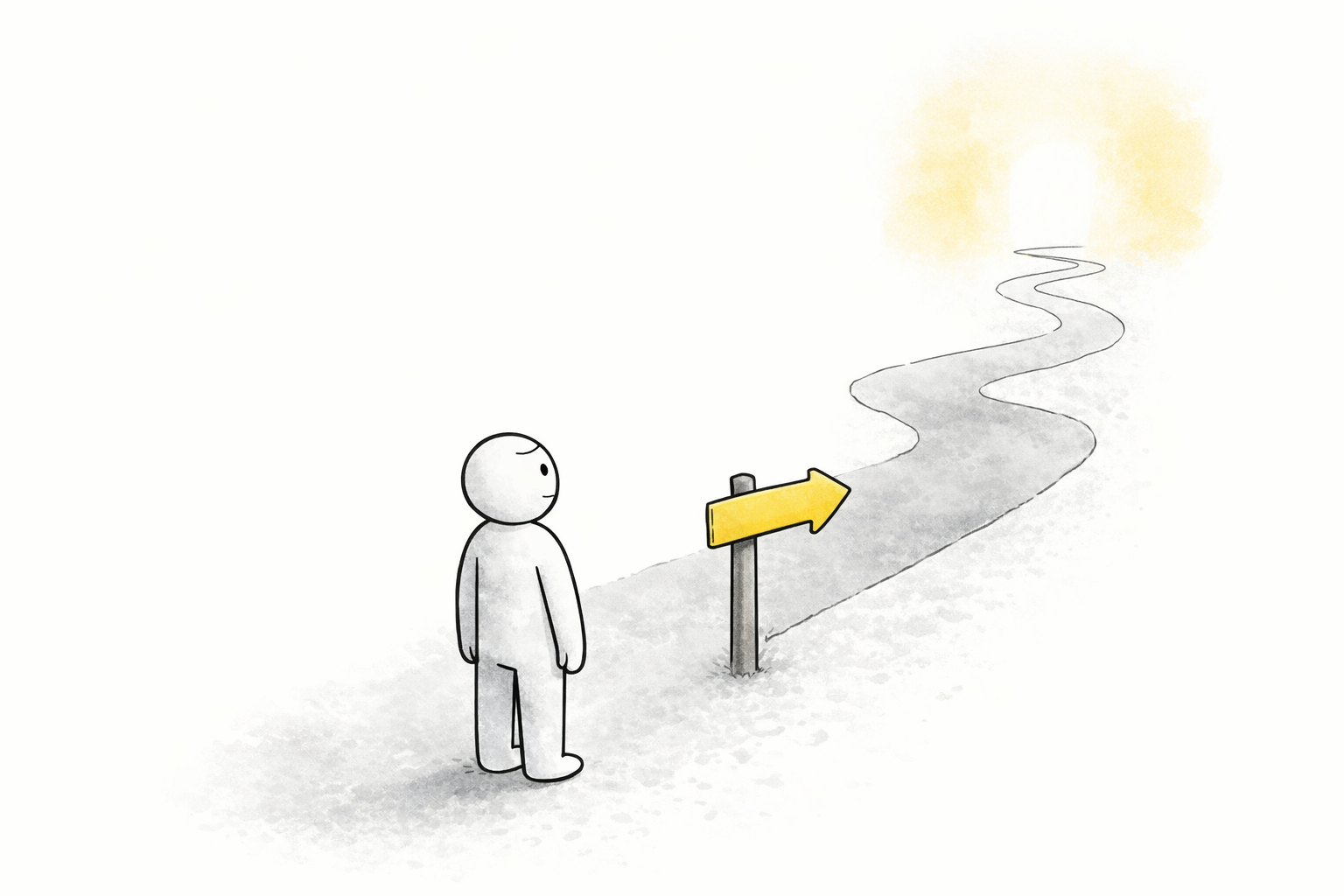
The project you can't kill
You know you should quit. The relationship, the project, the career path, the book you're 200 pages into that you stopped enjoying at page 40. Something in you already knows it's not working. But you don't stop. You keep going. And when someone asks why, the answer always sounds the same.
"I've already put so much into this."
That sentence feels like a reason. It sounds rational. You've invested time, money, energy, emotion. Walking away would mean all of that was wasted. So you push forward, hoping the next chapter will justify the ones that came before.
But here's the question worth sitting with: would you start this thing today, knowing what you know now? If the answer is no, then the only reason you're still in it is because of yesterday. And yesterday is a terrible compass.
The theater ticket experiment
In 1985, psychologists Hal Arkes and Catherine Blumer ran a deceptively simple experiment. They sold season tickets to a university theater series, but they secretly varied the prices. Some buyers paid full price. Others got a moderate discount. A third group got a large discount. Same seats, same plays, same experience.
Then they watched who actually showed up.
The full-price buyers attended significantly more performances than the discounted groups. Not because the plays were better for them. Not because they loved theater more. But because they'd paid more, and skipping a show would feel like wasting that money.
This is the sunk cost effect: a tendency to continue doing something because of what you've already invested, rather than because of what you'll get going forward. Arkes and Blumer documented it across ten experiments, and the pattern held every time. The more people had sunk into something, the harder it became to walk away.
What makes this finding unsettling is how invisible the bias is. Nobody in that theater thought, "I'm only here because I overpaid." They thought they were making a free choice. They weren't.
Knee-deep in the big muddy
A decade earlier, organizational psychologist Barry Staw had already uncovered something darker about this pattern. He gave 240 business students a simulation: they were a financial vice president who had to allocate R&D funding between two divisions of a company. One division was struggling. One was doing fine.
Here's the twist. Half the students were told they had personally made the initial investment in the struggling division. The other half were told someone else had made that call.
The students who felt personally responsible for the original decision poured significantly more money into the failing division. They escalated their commitment precisely because it was their mistake. Admitting the division was a lost cause would mean admitting they'd been wrong.
Staw titled the paper "Knee-Deep in the Big Muddy," after the Pete Seeger anti-war song. The metaphor is vivid and accurate. Each step deeper makes the next step harder to reverse. Not because the mud gets deeper (though it does), but because turning around would mean acknowledging how far you've gone in the wrong direction.
The more responsible you feel for a bad decision, the harder it becomes to abandon it. Your ego gets tangled up with the outcome.
This is why founders run startups into the ground. Why managers throw good money after bad projects. Why you stay in a relationship for year five when you knew at year three. It's not stupidity. It's identity protection. Walking away means confronting the possibility that a big chunk of your past was a mistake. And your brain will do almost anything to avoid that confrontation.
What your brain is actually doing
So why does this happen? Why can't we just look at the situation clearly and decide based on what's ahead?
Neuroscience has started to answer this. An fMRI study by Haller and colleagues, published in NeuroImage in 2014, scanned people's brains while they made decisions involving sunk costs. What they found was striking: sunk costs and future benefits are processed by entirely different neural systems. Previous investments activated the amygdala (your brain's threat detector) and the anterior cingulate cortex (which processes conflict). Future rewards activated the striatum and ventromedial prefrontal cortex (your brain's reward system).
In other words, when you're weighing whether to continue something you've invested in, your brain isn't running a single rational calculation. It's running two competing systems. One is saying "but you'll lose what you already put in" and the other is saying "here's what you could gain." And the loss system, as Daniel Kahneman and Amos Tversky demonstrated in their Nobel Prize-winning work on prospect theory, is roughly twice as powerful.
The loss signal
Amygdala and anterior cingulate fire when you consider abandoning a prior investment. This feels like anxiety, dread, and waste.
The reward signal
Striatum and vmPFC activate when you evaluate future outcomes. This feels like opportunity and hope.
The loss signal is louder. That's why "I've already put so much into this" drowns out "but this isn't going anywhere." Your brain treats the past investment as a threat to be defended, not information to be weighed. The feeling isn't rational. But it is real, and it's powerful enough to keep people in bad jobs, bad relationships, and bad investments for years longer than they should stay.
It's contagious
Here's something stranger. You don't even need to be the one who made the investment.
Christopher Olivola's 2018 research, published in Psychological Science, demonstrated what he called the "interpersonal sunk-cost effect." Across eight experiments with over 6,000 participants, he showed that people honor sunk costs even when someone else paid them. If your friend spent a lot on concert tickets and then feels sick, you'll pressure them to go. If a colleague has spent months on a project, you'll feel reluctant to suggest killing it.
We don't just fall for our own sunk costs. We enforce them on each other. "You can't quit now, you've come so far." "You can't leave him, you've been together for seven years." "You can't drop out, think of all the tuition." These aren't encouragements. They're sunk cost arguments dressed up as support.
And they work because they tap into something deeper than economics. They tap into a cultural narrative that equates quitting with failure and persistence with virtue. We admire people who never give up. We tell stories about perseverance paying off. What we don't tell enough stories about is the wisdom of walking away.
The quit question
So how do you actually escape this? Knowing about the sunk cost fallacy doesn't automatically immunize you against it. Plenty of economists fall for it in their personal lives. The bias runs deeper than knowledge.
But there is a technique that works remarkably well. Researchers call it the "blank slate" test.
This works because it strips out the sunk costs entirely. You're not asking "should I quit?" (which triggers loss aversion). You're asking "would I start?" (which engages your forward-looking reward system). It's the same decision, reframed to bypass the neural machinery that's tripping you up.
Hafenbrack, Kinias, and Barsade found something complementary in their 2014 study in Psychological Science. Brief mindfulness meditation reduced sunk cost bias by pulling people's attention into the present moment. When participants focused on what they were feeling right now, rather than ruminating on past investments or worrying about future waste, they made more rational decisions. The mechanism was simple: mindfulness reduced negative affect and shifted temporal focus away from past and future, both of which feed the sunk cost trap.
You don't need to meditate for an hour. Even a few minutes of deliberately asking yourself "what do I actually want right now, independent of what I've already done?" can shift the calculation.
The real cost of staying
We talk about sunk costs as if the only risk is wasting what you've already spent. But there's a bigger cost that rarely gets named: the opportunity cost of staying.
Every month you spend in a job that's going nowhere is a month you're not spending building something that could. Every year in a relationship that makes you smaller is a year you don't get back. The sunk cost fallacy doesn't just keep you in bad situations. It keeps you out of better ones. That's the part people miss.
The past is spent. It doesn't come back whether you stay or go. The only variable you control is what happens next. And "what happens next" deserves to be decided on its own merits, not weighed down by the ghost of decisions you made when you knew less than you know now.
That's hard to internalize. Walking away from three years of anything feels like throwing those years in the trash. But they're already gone. The only question is whether you'll add a fourth year to the pile.
When persistence is right
Not every act of sticking with something is a sunk cost error. Sometimes the right move genuinely is to push through difficulty. How do you tell the difference?
The distinction is forward-looking evidence. If you have concrete reasons to believe things will improve, reasons independent of what you've already invested, then staying makes sense. A startup that just signed its first major client has forward-looking evidence. A relationship where both people are actively working on it has forward-looking evidence.
What doesn't count: "I've put too much in to quit." "It has to get better eventually." "I'll feel like a failure if I stop." These are backward-looking. They're about protecting past investments, not building future ones.
The people who navigate this well aren't the ones who never quit and aren't the ones who quit at the first sign of trouble. They're the ones who can honestly distinguish between "this is hard but worth it" and "this is hard and I'm only here because leaving would mean admitting I was wrong."
Putting it down
There's a moment, in every stuck situation, where you already know. Before you've articulated it, before you've admitted it to anyone, some part of you knows this isn't working. The sunk cost fallacy is what fills the gap between knowing and acting. It's the voice that says "but you've come so far" when the more honest voice is whispering "but you're not going anywhere."
Naming it helps. Not because naming a cognitive bias magically dissolves it, but because it gives you language for what's happening. "I'm not staying because this is good. I'm staying because leaving feels like losing." Once you can say that clearly, the spell weakens. Not all at once. But enough to start asking the right questions.
Would you choose this today? Is there forward-looking evidence that it gets better? Or are you just protecting yesterday's decision from today's clarity?
The answers don't always mean you should leave. Sometimes they confirm you should stay. But either way, you'll be deciding based on where you're going, not where you've been. And that's a different kind of thinking entirely.
Get the next essay
One article per week on the psychology of thinking clearly. No spam, unsubscribe anytime.
References
- Arkes, H.R. & Blumer, C. (1985). "The Psychology of Sunk Cost." Organizational Behavior and Human Decision Processes, 35(1), 124–140.
- Staw, B.M. (1976). "Knee-Deep in the Big Muddy: A Study of Escalating Commitment to a Chosen Course of Action." Organizational Behavior and Human Performance, 16(1), 27–44.
- Kahneman, D. & Tversky, A. (1979). "Prospect Theory: An Analysis of Decision Under Risk." Econometrica, 47(2), 263–292.
- Haller, A. & Schwabe, L. (2014). "Sunk Costs in the Human Brain." NeuroImage, 97, 127–133.
- Olivola, C.Y. (2018). "The Interpersonal Sunk-Cost Effect." Psychological Science, 29(7), 1072–1083.
- Hafenbrack, A.C., Kinias, Z., & Barsade, S.G. (2014). "Debiasing the Mind Through Meditation: Mindfulness and the Sunk-Cost Bias." Psychological Science, 25(2), 369–376.
Clarido is a quiet log for a loud mind. Speak or type what's on your mind. Clarido holds it for you so you can return when you have space. Join the beta →