Your Brain Thinks Future-You Is a Stranger
When you blow off the gym or scroll instead of sleeping, you're not lazy. Your brain literally processes your future self as someone else. Here's the neuroscience of why, and what actually helps.
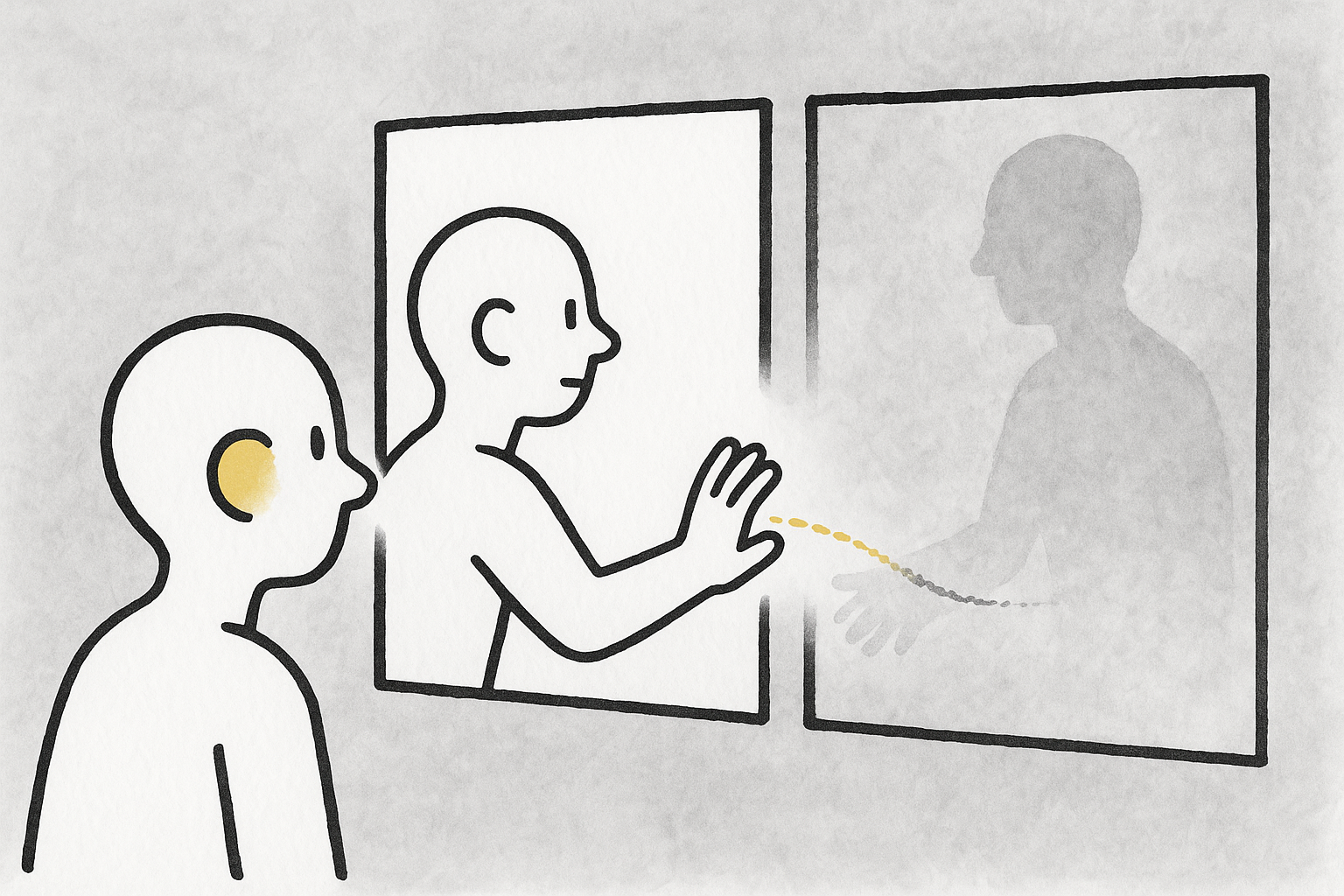
The person who has to deal with it
You stay up too late, knowing tomorrow will be brutal. You skip the workout because right now the couch feels better. You put off the hard conversation, the tax filing, the doctor's appointment. And every time, some part of you knows you'll regret it.
So why do you keep doing it?
The standard explanation is willpower. You don't have enough of it. You're lazy, undisciplined, bad at planning. But that explanation has a problem: it doesn't match the neuroscience. What's actually happening is stranger and more interesting than a character flaw.
Your brain processes your future self as a different person.
Not metaphorically. When researchers put people in an fMRI scanner and asked them to think about themselves in ten years, the brain region that lit up was the same one that activates when you think about a stranger. Your future self, the one who has to wake up exhausted, deal with the consequences, pay the bill, isn't you as far as your neural circuitry is concerned.
Which changes the entire framing. You're not failing at self-control. You're making a perfectly rational decision to benefit yourself at the expense of someone you barely know.
Two brains in one skull
In 2004, a team of researchers at Princeton and Harvard (Samuel McClure, David Laibson, George Loewenstein, and Jonathan Cohen) published a study in Science that revealed something remarkable about how the brain handles decisions involving time.
They put people in an fMRI scanner and gave them choices: $10 now or $11 tomorrow. $10 now or $15 in two weeks. Variations on the same theme. While the subjects deliberated, the researchers watched which brain regions activated.
What they found was two distinct systems competing for control.
The limbic system
Your emotional brain. It fires up when an immediate reward is on the table. It wants what feels good right now. It doesn't think in weeks or months.
The prefrontal cortex
Your planning brain. It evaluates both options rationally, regardless of timing. It can weigh next month as easily as next minute.
Here's the critical part: when the choice involved something available right now, the limbic system dominated. The emotional brain hijacked the decision. But when both options were in the future (say, $10 in six months versus $15 in seven months), the prefrontal cortex handled it calmly and people made patient, rational choices.
This is why you can plan to wake up at 6am while lying in bed at 10pm, genuinely meaning it, and then slam the snooze button at 6am without hesitation. At 10pm, both options are in the future. Your planning brain is in charge. At 6am, one option is right now, and your emotional brain takes over.
You're not inconsistent. You have two systems that disagree about what matters.
The stranger in the scanner
Hal Hershfield, now a professor at UCLA, wanted to understand why people are so bad at saving for retirement. The numbers are staggering: most people know they should save more, want to save more, and plan to save more. Then they don't.
His hypothesis was counterintuitive. What if the problem isn't information or discipline? What if people genuinely don't feel connected to the person who will need that money in forty years?
To test this, Hershfield and his colleagues ran an fMRI study in 2009. They asked participants to think about four different targets: their current self, their future self (ten years ahead), a current other person, and a future other person. The question was simple: does your brain treat "future you" more like "current you" or more like "someone else"?
When people thought about their future selves, the brain activation pattern looked remarkably similar to when they thought about a stranger.
A region called the rostral anterior cingulate cortex (rACC) showed far more activation for current-self judgments than for future-self judgments. And here's what made the study powerful: the size of that gap predicted real behavior. People whose brains treated their future selves most like strangers were the steepest temporal discounters. They chose $50 now over $100 later. They prioritized present comfort over future wellbeing.
Not because they were irrational. Because, neurologically, they were being generous to themselves and stingy with someone they didn't recognize.
What procrastination actually is
This reframes procrastination completely.
Fuschia Sirois and Timothy Pychyl published a paper in 2013 that pulled the pieces together. Procrastination, they argued, isn't a time management problem. It's an emotion regulation problem. When you face a task that feels boring, difficult, or anxiety-inducing, your brain does what brains do: it tries to make you feel better right now.
Scrolling your phone instead of starting the report? That's your brain choosing immediate mood repair. Watching another episode instead of going to bed? Mood repair. Putting off the hard conversation until "next week"? Mood repair.
And who pays the cost? Future-you. The person who has to cram at midnight. The person who wakes up exhausted. The person who now has an even harder conversation to have because you waited.
Sirois and Pychyl's insight was that this isn't stupidity or laziness. It's a temporal bias. Your brain weights the present so heavily that future consequences barely register. And the less connected you feel to your future self, the less those consequences feel like they belong to you.
The marshmallow problem (and its limits)
You've probably heard of the marshmallow test. In the late 1960s, Walter Mischel gave preschoolers a choice: one marshmallow now, or two if they could wait fifteen minutes. The kids who waited went on to have higher SAT scores, better health outcomes, and more successful careers.
It became one of the most famous studies in psychology. It was also more complicated than the popular version suggests.
A 2018 replication by Tyler Watts, Greg Duncan, and Haonan Quan, using a sample ten times larger and far more diverse than Mischel's original, found the effect was about half the size. And most of it disappeared once they controlled for family background and early cognitive ability. The marshmallow test was measuring something real, but it wasn't measuring raw willpower. It was measuring circumstances.
Why does this matter? Because it challenges the willpower narrative. The kids who waited weren't morally superior. Many of them came from stable homes where promises got kept. They had reason to trust that the second marshmallow would appear. The kids who grabbed the first one? Many came from environments where waiting didn't pay off.
Temporal discounting isn't just a brain quirk. It's calibrated by experience. If your past has taught you that the future is unreliable, your brain adjusts accordingly. Grabbing what's available right now becomes the smart move.
Making the stranger familiar
So if the core problem is disconnection from your future self, the solution isn't more discipline. It's more connection.
Hershfield tested this directly. In a 2011 study, he used virtual reality to show participants age-progressed versions of their own faces. They walked into a VR environment, looked in a virtual mirror, and saw themselves at seventy. Wrinkled, gray-haired, older.
The result? Participants who saw their aged selves allocated more than twice as much money to retirement savings compared to the control group. An average of $172 versus $80. Same people, same financial situation. The only difference was that, for a few minutes, their future self stopped being abstract.
You don't need a VR headset to apply this principle. The research points to a simpler mechanism: anything that makes your future self feel more real, more concrete, more like you, reduces temporal discounting.
Write to future-you
Literally write a letter to yourself six months from now. Describe what you hope their life looks like. It forces your brain to treat that person as real.
Visualize the morning after
Before a decision, spend ten seconds picturing how you'll feel tomorrow. Not abstractly. Specifically: the alarm going off, the fatigue, the regret or the relief.
Close the time gap
Frame future consequences in present terms. "Saving $200/month" is abstract. "I'm buying 65-year-old me a month of freedom" is personal.
The research suggests that even small interventions work because the bar is so low. Your brain's default is to treat the future self as essentially nobody. Anything that nudges it above "stranger" helps.
The kindness reframe
There's something unexpectedly compassionate about all of this.
When you procrastinate, when you stay up too late, when you eat the thing you told yourself you wouldn't, the typical inner monologue is harsh. What's wrong with me? Why can't I just do the right thing?
But the science tells a different story. There's nothing wrong with you. Your brain evolved in an environment where the future was uncertain and immediate rewards were scarce. Prioritizing the present kept your ancestors alive. The mismatch isn't in your character. It's between the brain you inherited and the world you live in.
You're not failing at self-discipline. You're navigating a conflict between two neural systems that evolved for a world that no longer exists.
Which means the fix isn't punishment or white-knuckling. It's designing your environment so the two systems stop fighting. Make the future feel closer. Make the right choice the easy choice. And when you catch yourself choosing present comfort over future wellbeing, recognize what's happening: your brain is doing exactly what it was built to do. The question is whether you can gently redirect it.
The people who get better at this aren't the ones with superior willpower. They're the ones who stop treating their future self like a stranger and start treating them like someone they care about. Someone who deserves consideration. Someone worth protecting.
That shift, from obligation to compassion, turns out to be the whole game.
Get the next essay
One article per week on the psychology of thinking clearly. No spam, unsubscribe anytime.
References
- Hershfield, H.E., Wimmer, G.E., & Knutson, B. (2009). "Saving for the Future Self: Neural Measures of Future Self-Continuity Predict Temporal Discounting." Social Cognitive and Affective Neuroscience, 4(1), 85-92.
- Hershfield, H.E., Goldstein, D.G., Sharpe, W.F., Fox, J., Yeykelis, L., Carstensen, L.L., & Bailenson, J.N. (2011). "Increasing Saving Behavior Through Age-Progressed Renderings of the Future Self." Journal of Marketing Research, 48(SPL), S23-S37.
- McClure, S.M., Laibson, D.I., Loewenstein, G., & Cohen, J.D. (2004). "Separate Neural Systems Value Immediate and Delayed Monetary Rewards." Science, 306(5695), 503-507.
- Sirois, F., & Pychyl, T. (2013). "Procrastination and the Priority of Short-Term Mood Regulation: Consequences for Future Self." Social and Personality Psychology Compass, 7(2), 115-127.
- Mischel, W., Shoda, Y., & Rodriguez, M.L. (1989). "Delay of Gratification in Children." Science, 244(4907), 933-938.
- Watts, T.W., Duncan, G.J., & Quan, H. (2018). "Revisiting the Marshmallow Test: A Conceptual Replication Investigating Links Between Early Delay of Gratification and Later Outcomes." Psychological Science, 29(7), 1159-1177.
Clarido is a quiet log for a loud mind. Speak or type what's on your mind. Clarido holds it for you so you can return when you have space. Join the beta →