The Things That Matter Don't Usually Interrupt You
Almost everything that wants your attention has a way to appear in front of you. The things you want for your own life are usually much quieter.
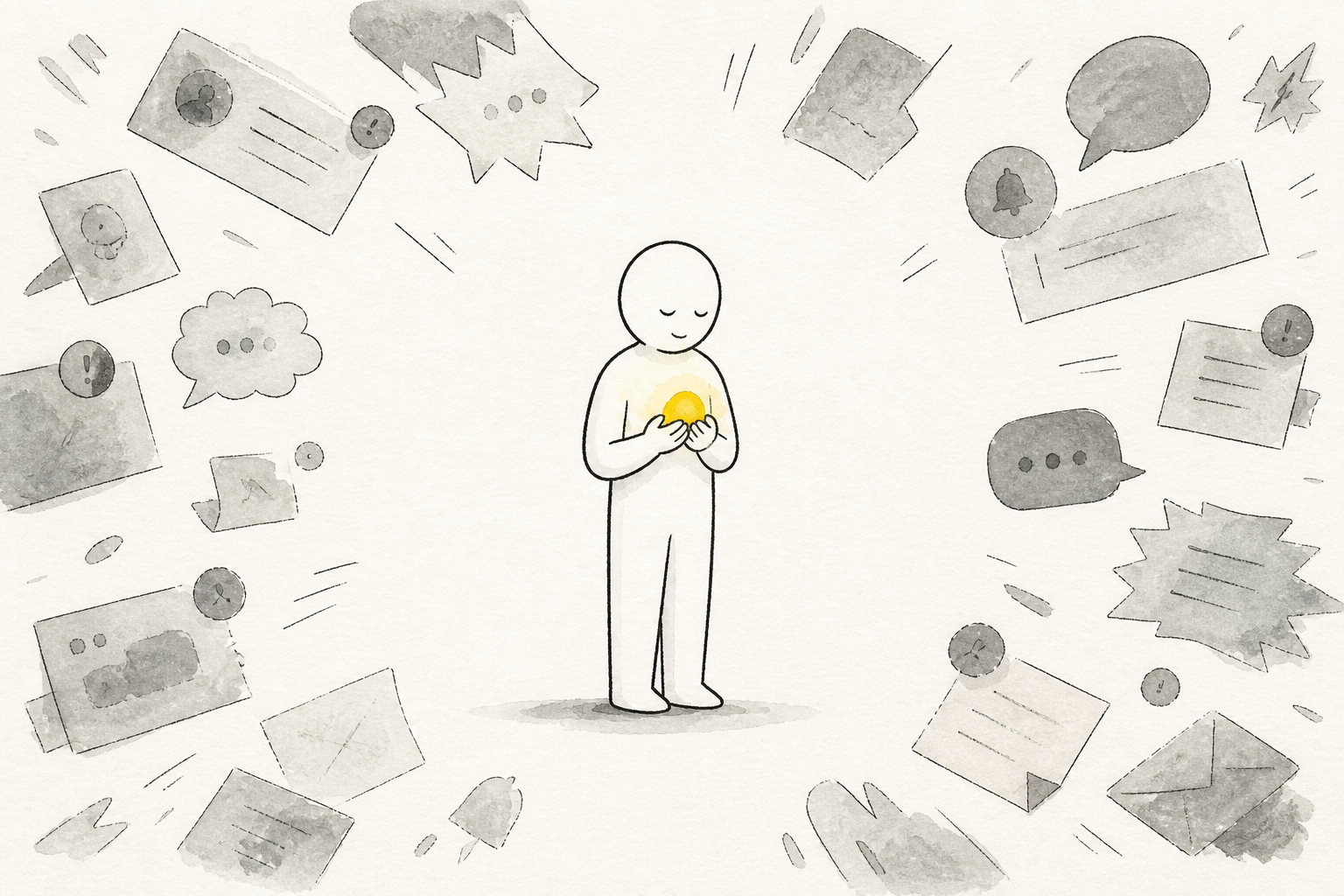
At some point, most people have had this strange experience: you reach the end of a day and realize that you barely thought about the things you claim matter most.
You answered messages. You handled whatever became urgent. You kept up with work, checked the group chat, and found ten spare minutes for someone you have never met to explain their morning routine on TikTok.
But you didn't call the person you miss. You didn't touch the project you keep saying you want to make. You weren't particularly present. The day filled itself before you decided what it was for.
This can feel like evidence that your priorities aren't real. "If writing mattered, wouldn't I write? If my health mattered, wouldn't I protect it? If someone mattered, wouldn't I remember to show up differently?"
But caring about something and remembering it at the right moment are not the same ability.
The world is full of systems designed to bring certain things back to mind. Work has notifications. Friends have messages. Brands have ads. News has alerts. Almost everything that wants your attention has found a way to appear in front of you.
The things you want for your own life are usually much quieter.
What gets remembered gets a chance to matter
Think about something you genuinely want to protect right now. Maybe you want to be less defensive with your partner. You want to make music again, move your body, or stop letting work follow you into every room. Perhaps you just want to be the kind of friend who listens without reaching for a phone.
You can mean all of this sincerely at nine in the morning.
Then the day begins.
By noon, your attention has been reorganized around what arrived most recently. A request becomes a deadline. A notification opens into a conversation. One difficult task sends you looking for relief, and twenty minutes disappear into a feed. None of this requires a conscious decision to abandon what mattered. Your original intention simply stops being present.
This is easy to misunderstand because we talk about priorities as though they were fixed objects. "My health is a priority." "My relationship comes first." "This is the year I take my work seriously."
The statement may be true. But a priority written somewhere in your beliefs is different from a priority available during a choice.
Psychologists use the term prospective memory for our ability to remember an intention at the moment we can act on it. Remembering that you wanted to buy coffee is ordinary memory. Remembering to buy it when you pass the shop tomorrow is prospective memory. The intention has to return while your mind is busy doing something else.
That last part matters. Daily life does not pause to ask what you had hoped to remember.
A 2021 review by Winston Jones, Jared Benge, and Michael Scullin examined 73 studies that tried to improve prospective memory. External memory aids produced some of the strongest results, although many of those studies used small clinical samples. The finding is not a blanket endorsement of every reminder. It points to something more basic: an intention has a better chance of surviving when the environment helps carry it.
We accept this immediately for practical tasks. Medication sits beside the coffee maker. Keys go near the door. A calendar alert remembers the appointment until we need to.
When the subject is who we want to be, however, we expect memory to run on conviction alone.
The moral story we tell about forgetting
When something important keeps slipping away, the explanation often becomes personal.
"Maybe I don't want it badly enough."
It is a harsh conclusion, and an appealing one. At least it makes the world feel orderly. People who care follow through; people who fail must not care.
The research on intention and behavior tells a messier story. Thomas Webb and Paschal Sheeran reviewed 47 experiments that successfully changed how strongly people intended to do something. Those interventions produced a medium-to-large change in intention, but only a small-to-medium change in behavior.
People became more committed. Their actions changed much less.
The gap appears everywhere because we rarely make a choice in the same state of mind in which we planned it. "I want to protect my health" makes sense while thinking clearly on Sunday evening. On Wednesday morning, protecting your health looks like leaving a warm bed. "I want to be honest" sounds right in private. In a real conversation, honesty arrives disguised as the risk of disappointing someone.
An intention is formed in one state of mind and tested in another.
This does not absolve us of responsibility. It changes where responsibility begins. Instead of asking only, "Why can't I care more?" we can ask, "What keeps coming to mind when I make the choice?"
That question turns the environment from background scenery into part of the story.
Your surroundings don't choose your priorities. They influence which ones come to mind.
Your environment is already reminding you who to be
A phone is not simply a tool waiting for instructions. Its surfaces contain opinions about what deserves attention.
The red badge says, "Deal with this." The incoming message says, "Someone needs you now." The suggested video says, "You might enjoy this more than whatever you were about to do." None of these messages has to be spoken aloud. Repetition and placement do the work.
Over time, the phone becomes extraordinarily good at returning certain parts of life to mind: unfinished work, other people's reactions, breaking news, things to buy, and people to compare yourself with.
It is much worse at returning what you chose for yourself.
This is not an argument that phones are evil or that attention was pure before the internet. Human environments have always shaped what comes to mind. A guitar left on its stand is easier to remember than one sealed in a case. Running shoes by the door can bring a morning plan back before the day takes over. A photograph can return a relationship to mind in the middle of an ordinary room.
Researchers who study habits have shown why stable contexts matter. Wendy Wood and Dennis Rünger describe habits as responses that become associated with recurring situations through repeated action. The environment eventually begins to cue the response. Seeing running shoes does not create a running habit, but it can help place the intended action near a moment when it is possible.
That distinction is important. A cue cannot do the thing for you.
A sentence about courage cannot make the difficult call. A reminder to be present cannot make you put the phone down. Repeatedly seeing the words "I take care of my body" does not exercise a single muscle.
What a cue can do, is restore a choice.
Without it, an old response may happen before the intention returns. With it, there may be a brief moment of recognition: Right. This is the part of the day I wanted to meet differently.
That moment is small, but it is where an intention becomes useful. Not while it is being admired, written, or discussed. While another action is still possible.
Repetition is not magic
This is where claims about repetition often become difficult to believe.
"Say the words enough and they will rewire your brain." "Look in the mirror and declare who you are." "Repeat an affirmation until reality catches up."
There is a simpler way to understand why repetition can matter.
You do not see an intention repeatedly so that the sentence can hypnotize you into becoming someone else. You see it because life will repeatedly make you forget.
Every encounter gives what matters another opportunity to enter the day. Sometimes it will arrive at the wrong time and pass without consequence. Sometimes you will see it and ignore it. But occasionally it will return just before a choice that could go either way.
Perhaps you see "Choose the honest conversation" before opening the message you have avoided all week. "Protect your peace" appears while you are deciding whether to reopen work at 10 p.m. "Make something before consuming something" meets you as your hand moves toward the same app again.
The words have not changed you. They have helped you remember what you wanted while there is still time to act on it.
Then action does what the reminder cannot. Each time you follow through, you gain an actual memory of behaving that way. The intention becomes less like an attractive sentence and more like something you have practiced.
This is also why the same reminder can eventually stop working. Familiar things fade into the background. A sentence that once felt exact can become white noise, or life can change enough that the intention no longer fits.
Repetition stays meaningful when it remains connected to experience. "Did these words enter a real decision? What made them useful? What got in the way? Is this still what I need to remember?"
The goal is not to look at the same sentence forever. It is to keep something meaningful present long enough to live with it, learn from it, and change it when necessary.
Giving what matters a place
Most advice about attention begins with removal. Turn off notifications. Delete the app. Put the phone in another room.
That can help. But removal answers only half the question. Once some noise is gone, what do you want to be present instead?
Clarido began with that question.
What if something you chose deserved the same visibility as everything competing to choose for you?
Not another notification demanding action. Not a list of ten goals. One intention, placed somewhere you already look, so the life you want has a way to re-enter the life you are actually living.
The lock screen wallpaper and widget are useful for this precisely because it is ordinary. You do not have to remember to open a journal, find a note, or begin a reflective practice before encountering the words. They meet you on a surface already woven into the day.
The intention may come from a conversation about what feels unresolved, what keeps happening, or what kind of person the moment is asking you to become. It might be direct: "Finish what you start." It might be gentler: "You do not have to earn rest." The language matters because it has to feel like yours. A generic quote may be pleasant. A personal intention should make a choice easier to recognize.
Later, reflection keeps the words from becoming decoration. Did you show up for the intention? Where did it help? Where did it disappear? Do you want to recommit, make it more concrete, or admit that something else matters now?
Clarido cannot supply the answer. It cannot make a person brave, present, disciplined, or kind. The point is not to hand those decisions to an app.
The point is to give your own answer somewhere to live.
What deserves to keep returning?
Attention is often discussed as though it were a possession we either control or lose. But attention is also a relationship with an environment. What surrounds us keeps proposing what to notice, what to remember, and what to do next.
Most of those proposals were chosen by someone else.
You still get to choose what matters. The harder part is helping that choice survive an ordinary Wednesday, when nothing feels profound and whatever arrived last seems most important.
That is why caring is not always enough. What matters needs a way to remain present.
Not so it can control every decision. Not so you never get distracted or fail to follow through. The aim is smaller: in a life full of things asking for your attention, something you chose gets to ask too.
Get the next essay
Occasional articles on choosing what matters and returning to it. Unsubscribe anytime.
References
- Jones, W.E., Benge, J.F., & Scullin, M.K. (2021). "Preserving Prospective Memory in Daily Life: A Systematic Review and Meta-Analysis of Mnemonic Strategy, Cognitive Training, External Memory Aid, and Combination Interventions." Neuropsychology, 35(1), 123–140.
- Webb, T.L. & Sheeran, P. (2006). "Does Changing Behavioral Intentions Engender Behavior Change? A Meta-Analysis of the Experimental Evidence." Psychological Bulletin, 132(2), 249–268.
- Wood, W. & Rünger, D. (2016). "Psychology of Habit." Annual Review of Psychology, 67, 289–314.