Why Your To-Do List Keeps Failing You
To-do lists, habit trackers, and note apps all organize what you have to do. None of them touch who you're trying to become. Here's the difference, and what to reach for instead.
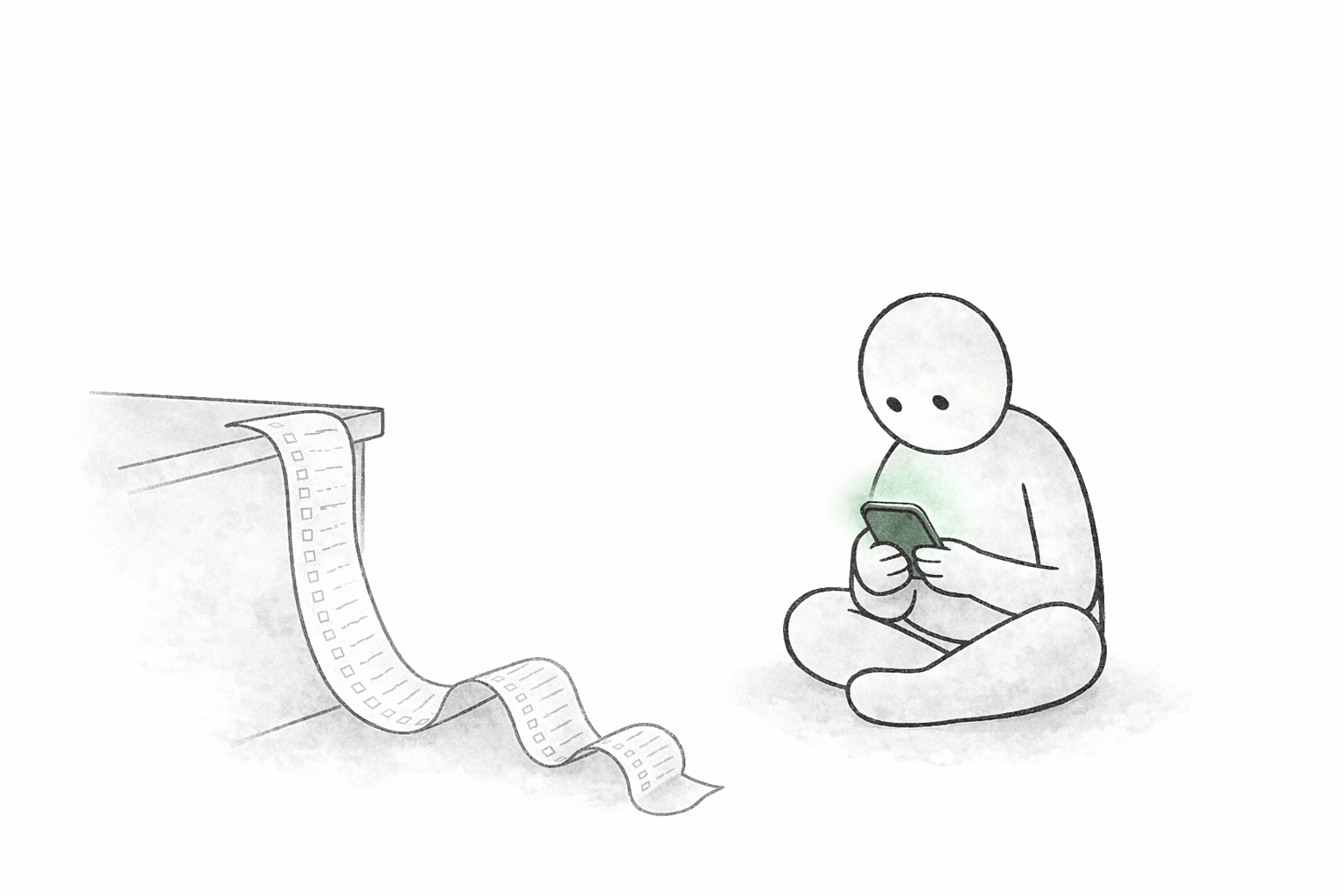
The list that's never done
You cross off six things and five new ones appear before lunch. The list is never empty. That's not a flaw in how you're using it. It's what a list is. A to-do list is a bucket, and buckets fill.
Here's the stranger part. Find your list from a year ago, if you still have it somewhere. Different tasks, same person. You completed hundreds of items, maybe thousands. And the shape of your life looks roughly like it did twelve months ago. All that motion, and somehow you didn't move.
If that lands a little too hard, this is about why.
What a to-do list is good at
To-do lists are not the enemy. Todoist, Things, Apple Reminders: these are good tools, and the best of them are a pleasure to use. They answer one question extremely well. What's next? Capture the task, park it somewhere you trust, get it out of your head. There's real science behind why that alone makes you feel lighter, but that's a different article.
Notice the question, though. What's next. It's a question about the next few hours. Your to-do list has no opinion about the next few years, and no way to form one. It can tell you to email Sarah. But can it tell you whether the life made of ten thousand emails is the one you meant to build? It can't, and it has no way to learn.
That's the gap. And it's wider than it looks.
The gap between meaning to and becoming
In 2002, a psychologist named Paschal Sheeran gathered up the research on a question most productivity advice skips entirely: how well do our intentions predict what we do? He reviewed dozens of studies. The answer was humbling.
Intending to do something, it turns out, is only loosely wired to doing it. And a to-do list is a machine for recording intentions. It's superb at capturing what you meant to do, and completely silent on the harder question of whether the meaning ever becomes a person.
Because that's the layer tasks can't reach. Edward Higgins spent years mapping the distance between who we are and who we want to be, and found that the gap itself drives how we feel and act. A to-do list lives entirely on the near side of that gap. It sorts the hours. It leaves the distance untouched. So the days fill with whatever is loudest, the meeting, the notification, the small fire, and the larger question of who all this motion is turning you into just sits there, unasked, while you stay busy answering the small one.
And what does a year of that produce? You can finish every item on a list, for years, and remain exactly who you were when you started.
Where the other tools stop short
If you've felt this, you've probably already tried the next tools over. They each get closer. They each stop somewhere short.
Habit trackers
They target repeated behavior, which is closer to identity than a one-off task. But they optimize the streak, not the self. You can hold a hundred-day meditation streak and still not be a calm person. And miss one day, and most people abandon the whole thing.
Note and journaling apps
They're where reflection goes. The trouble is that reflection goes there and stays there. You write down who you want to be, close the app, and never look back. Insight with no cue to act on it is gone by morning.
Goal planners
They set outcomes: run the marathon, ship the book. But an outcome is a distant abstraction, and the brain discounts the future steeply. "Someday I'll be" is not something you can do on a Tuesday afternoon.
None of these are bad. They're just all pointed at the same layer: what you do, when you do it, how often you repeat it. None of them is pointed at the layer underneath, which turns out to be the one running the show.
The layer underneath
Here's the reframe, and it sounds soft until you sit with it. What you do flows from who you believe you are.
Wendy Wood, who has spent a career studying habits, describes them not as feats of willpower but as behaviors that have quietly become expressions of an identity. Daphna Oyserman calls the engine identity-based motivation: we act in ways that feel congruent with the self we think we already are, usually without deciding to. Nobody reasons their way to brushing their teeth. A person who thinks of themselves as someone who takes care of themselves simply does it, and would feel strange not to.
You don't rise to the level of your to-do list. You fall to the level of your identity.
That reframes the whole project. The most powerful thing you can change, I've come to think, isn't the task on the list. It's the sentence you'd use to describe yourself. Compare these two. Which one bends the next small decision?
The task dies the moment it's done, and the next one slides into its place, and nothing about you has shifted. The identity, held long enough, quietly reorganizes every task that comes after it. Phillippa Lally's research put a rough number on "long enough": in her study, a new behavior took an average of about two months of daily repetition to turn automatic, though the range ran from a few weeks to the better part of a year. Two months of acting like the person, and you stop having to choose it.
Why it has to live somewhere you look
An identity you name once and forget is just a nice thought. This is the part the note apps miss.
In 1999, Peter Gollwitzer showed that people who paired an intention with a specific cue, in the shape of "when X happens, I'll do Y," followed through at dramatically higher rates than people who merely intended. The cue does the work. It removes the moment of deciding, because the environment decides for you.
So the question turns concrete. What do you look at, forty, eighty, a hundred times a day? Your phone. Which means the most powerful place to keep who you're becoming is not a journal you open on Sundays. It's the screen you already can't put down.
What a tool built on the other premise looks like
This is why Clarido isn't a to-do list. It doesn't hold your tasks. It holds one intention at a time, written as an identity ("I am present when my kids are in the room," not "spend more time with kids"), and it puts that intention where you'll meet it: your lock screen, your home screen, your watch. Every time you reach for the phone, you meet the person you said you're becoming, a half-second before the noise of the day tells you who to be instead.
One intention, not ten. Held for as long as it takes, days or months, then set down for the next. And framed toward who you want to be rather than away from who you're afraid of being, because moving toward something is a place you can live, and moving away from something never is.
It will not clear your inbox. That's the point. The inbox was never the thing.
The question underneath the question
Your to-do list will be there tomorrow, as full as it is right now. Cross off what you can. It's a good tool for what it does.
But the reason a year of finished tasks can leave you standing in the same spot is that the list was answering the small question the entire time, the one about the next few hours, while the large one waited underneath it, unasked. Not what's next. Who you're becoming. You can't put that on a list. You can only decide it, and then keep it somewhere you'll see.
Get the next essay
Occasional articles on choosing what matters and returning to it. Unsubscribe anytime.
References
- Sheeran, P. (2002). "Intention–Behavior Relations: A Conceptual and Empirical Review." European Review of Social Psychology, 12(1), 1–36.
- Higgins, E.T. (1987). "Self-Discrepancy: A Theory Relating Self and Affect." Psychological Review, 94(3), 319–340.
- Wood, W. & Neal, D.T. (2007). "A New Look at Habits and the Habit–Goal Interface." Psychological Review, 114(4), 843–863.
- Oyserman, D., Bybee, D., & Terry, K. (2006). "Possible Selves and Academic Outcomes: How and When Possible Selves Impel Action." Journal of Personality and Social Psychology, 91(1), 188–204.
- Gollwitzer, P.M. (1999). "Implementation Intentions: Strong Effects of Simple Plans." American Psychologist, 54(7), 493–503.
- Lally, P., van Jaarsveld, C.H.M., Potts, H.W.W., & Wardle, J. (2010). "How Are Habits Formed: Modelling Habit Formation in the Real World." European Journal of Social Psychology, 40(6), 998–1009.
Clarido helps you name who you're becoming and keep it in front of you. One intention at a time.