Why Unfinished Tasks Follow You to Bed
Your brain treats every incomplete task like an open tab, running in the background and keeping you awake. The fix isn't finishing everything. It's much simpler than that.
The thing that won't go away
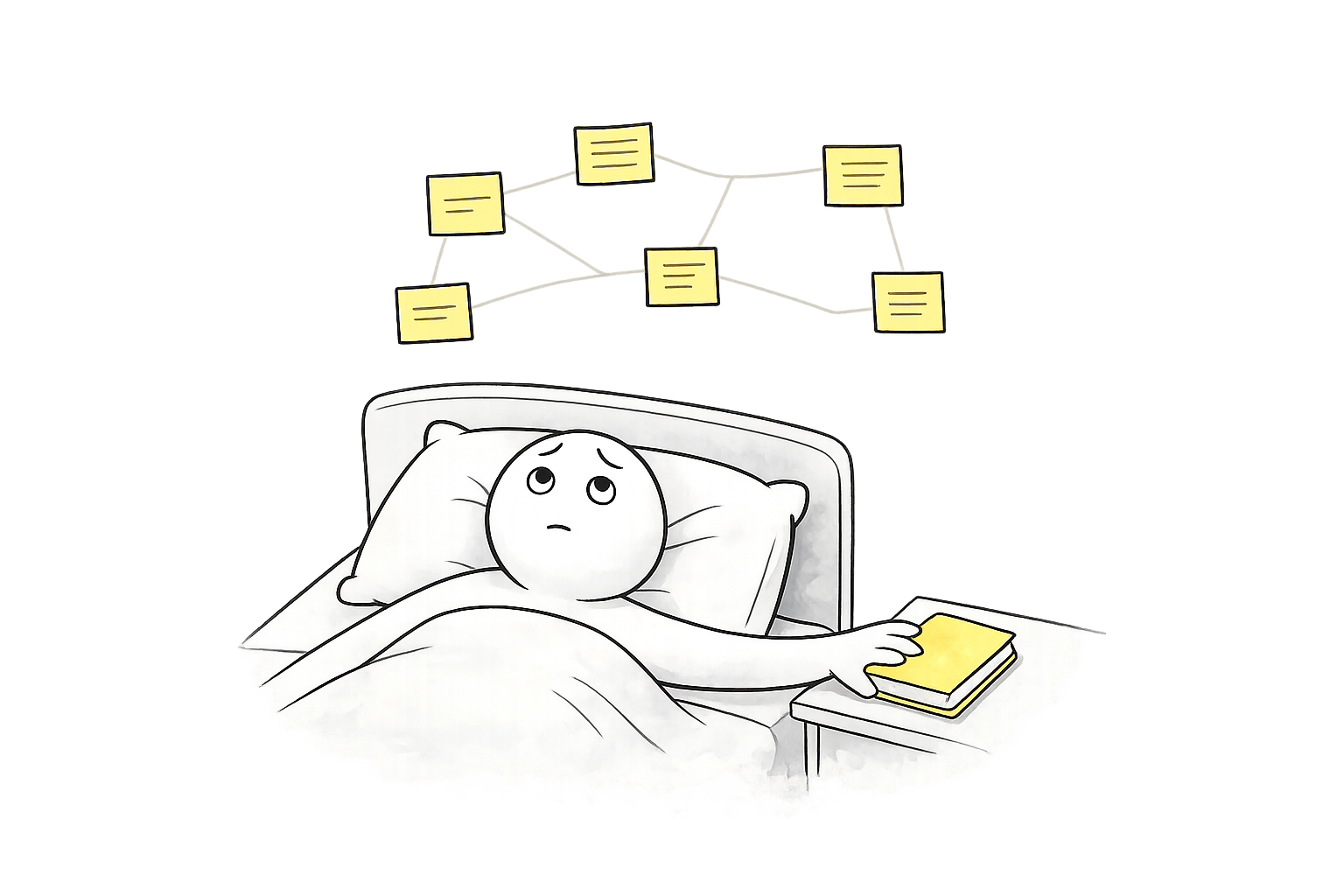
You're lying in bed. You're tired. The room is dark, your phone is charging, you've done all the reasonable things a person does before sleep. And then your brain says: Did you respond to that email?
You didn't. You know you didn't. And now, at 11:47pm, your brain has decided this is the most important thing in the world.
It's not just the email, of course. Once the door opens, everything walks in. The appointment you need to schedule. The conversation you've been avoiding. The thing you told someone you'd do last week that you still haven't done. None of these require action right now. Your brain doesn't care.
Why does this happen? Why do unfinished things have this specific, almost aggressive hold on your attention? And why does it always seem to get worse at night?
The answer starts in a restaurant in Vienna, almost a hundred years ago.
The waiter who remembered everything
In the 1920s, a psychologist named Kurt Lewin was having dinner with his students at a restaurant in Vienna. He noticed something odd about their waiter. The man could recall complex orders for large tables without writing anything down. Every dish, every modification, every drink. Perfect recall.
But when Lewin returned after paying the bill and asked the waiter about what his group had ordered, the waiter couldn't remember a thing.
The order was complete. Delivered. Closed. And with it, the memory had vanished.
Lewin found this fascinating. He had a theory about why it happened: when you start working toward a goal, your mind creates what he called a "tension system." A kind of psychological charge that keeps the task active in your awareness. Once the goal is complete, the tension resolves and the memory gets filed away. But while the task is still open? The tension persists. The task stays live.
One of Lewin's students, Bluma Zeigarnik, decided to test this. She gave participants a series of simple tasks: stringing beads, solving puzzles, doing mental arithmetic. She let them finish some tasks but interrupted them midway through others. An hour later, she asked them to recall which tasks they'd worked on.
The finding was striking enough to earn a name: the Zeigarnik effect. Incomplete tasks don't just linger in memory. They demand attention. They push their way to the front of the line, insisting on being noticed, long after you've moved on to something else.
Open tabs
The metaphor that works best here is browser tabs.
Every unfinished task in your life is an open tab. Each one runs in the background, consuming a small amount of processing power. One or two open tabs? No problem. But most of us are carrying dozens. The email you haven't responded to. The doctor's appointment you need to make. The gift you meant to buy. The project at work with no clear next step. The thing your friend said that's been bothering you.
None of these are particularly difficult or urgent. That's not the point. The point is that each one maintains its own tension system, consuming its own slice of your mental bandwidth, even when you're not actively thinking about it.
Schiffman and Greist-Bousquet found something telling in a 1992 replication study: people consistently overestimate how long they spent on interrupted tasks, even when the actual time was identical to completed ones. Open loops don't just occupy space. They distort your sense of how much you're carrying. The unfinished things feel bigger and heavier than they actually are.
And here's the part that makes it worse. Lewin's tension systems don't take the night off.
Why it hits at night
During the day, your brain has noise to hide behind. Meetings, conversations, screens, movement. There's enough activity to keep the open loops partially drowned out. But when you lie down in the dark and the noise stops? Every unfinished task that's been humming in the background becomes the loudest thing in the room.
Christine Syrek and her colleagues studied this directly. In a 2017 paper titled, quite literally, "Zeigarnik's Sleepless Nights," they tracked employees over three months and found that unfinished tasks at the end of the work week consistently impaired sleep on the weekend. The mechanism was affective rumination: the emotional replay of unresolved things that loops without ever reaching a conclusion. Not productive problem-solving. Just the same thoughts circling.
Your brain isn't trying to solve the problem at 2am. It's just reminding you the problem exists. Over and over.
Sound familiar? The frustrating part is that the rumination isn't useful. You're not lying awake productively working through solutions. You're lying awake while your brain runs a notification loop, pinging you about things you already know about but can't act on right now.
The Zeigarnik effect evolved to be useful. If you needed to find water before nightfall, you wouldn't want your brain to forget about it and wander off. The tension system kept survival-critical tasks front and center. But modern life has given that same system thirty or forty things to track simultaneously, and it has no way to prioritize. The unpaid bill gets the same psychological urgency as the unresolved fight with your partner. The grocery list competes for attention with the career decision.
Your brain can't distinguish between "I need to buy milk" and "I need to figure out my life." Both are open loops. Both generate tension. Both follow you to bed.
The fix you wouldn't expect
Here's the part that surprised me most when I first read about it.
You might assume the only way to resolve an open loop is to complete the task. Close the tab. Finish the thing. But in 2011, E.J. Masicampo and Roy Baumeister ran a series of experiments that upended this assumption: you don't have to finish the task. You just have to make a plan for it.
In their study, published in the Journal of Personality and Social Psychology, participants who had unfulfilled goals showed all the classic Zeigarnik symptoms. The goals intruded on unrelated tasks. They interfered with reading comprehension. They hijacked attention. But when participants were asked to write down a specific plan (when, where, and how they would complete the task), the interference vanished.
Not reduced. Vanished.
Think about what this means. The nagging, the rumination, the 2am thought spirals: they're not really about the tasks themselves. They're about the fear of forgetting. When you convince your brain that something won't be forgotten, it releases its grip.
Ever notice how writing a to-do list feels so good even before you've done anything on it? Why talking through your problems with someone brings relief even when nothing changes. Why dumping your thoughts into a journal quiets your mind. In each case, you're not resolving the tasks. You're externalizing them. Moving them from your head (where your brain has to maintain tension to keep them active) to somewhere external (where they're safely stored without ongoing cognitive cost).
The bedtime experiment
Michael Scullin at Baylor University tested this in the most direct way possible. He brought 57 young adults into a sleep lab and, five minutes before lights out, asked them to write. Half were told to write a to-do list of things they needed to do in the coming days. The other half were told to write about tasks they'd already completed.
Nine minutes. That's a meaningful difference, and it was measured with polysomnography (brain wave monitoring), not self-report. The to-do list writers actually, physically fell asleep faster.
Here's what made it even more interesting: participants who wrote more specific, detailed to-do lists fell asleep even faster than those who wrote vague ones. Specificity matters. "Work on project" doesn't close the loop. "Draft introduction section of quarterly report, send to Sarah for review by Thursday" does.
This maps directly to what Masicampo and Baumeister found. The more specific the plan, the more convincing the signal to your brain. Vague intentions keep the tension alive. Concrete plans resolve it.
What this actually looks like
So what does all of this actually look like in practice?
You don't need a perfect system. You don't need an app with twelve features or a color-coded bullet journal. You need one thing: a reliable place to put what's on your mind so your brain believes it won't be forgotten.
Five minutes before bed. Write down what's still open. Be specific: not "deal with work stuff" but "reply to Jake's email about the timeline, call insurance company about the claim, review budget spreadsheet before Thursday's meeting." That's it.
Externalize
Get the open loops out of your head and into a place you trust. Paper, phone, voice memo. The medium doesn't matter.
Be specific
Vague items ("figure out finances") stay open. Concrete ones ("transfer $500 to savings account on Friday") close.
Don't optimize
This isn't a productivity system. It's a pressure valve. Just get it out. Sorting and prioritizing can happen tomorrow.
The paradox is that the people who need this most are the least likely to do it. When your mind is racing and you're overwhelmed by everything you need to track, the idea of sitting down to write it all out feels like one more task. But the research is consistent: the act of externalizing, even for five minutes, produces immediate cognitive relief. Not because anything in your life has changed. Because your brain finally has permission to stop running those background processes.
The quiet part
Here's what I keep coming back to.
Zeigarnik's original insight is almost a hundred years old, and we're still learning from it. Your brain is not broken for doing this. It's not a character flaw that you can't stop thinking about unfinished things. It's a feature. One that kept your ancestors alive.
The problem isn't the mechanism. It's that the mechanism was designed for a world with three open loops, not thirty.
The fix is not to finish everything. You can't. The fix is to convince your brain that nothing will be forgotten. Write it down. Be specific. Put it somewhere you trust.
And then, maybe, your brain will do what the waiter's did in that Vienna restaurant. Let it go. And let you sleep.
Get the next essay
One article per week on the psychology of thinking clearly. No spam, unsubscribe anytime.
References
- Zeigarnik, B. (1927). "On Finished and Unfinished Tasks." Psychologische Forschung, 9, 1–85.
- Lewin, K. (1935). A Dynamic Theory of Personality: Selected Papers. McGraw-Hill.
- Schiffman, N. & Greist-Bousquet, S. (1992). "The Effect of Task Interruption and Closure on Perceived Duration." Bulletin of the Psychonomic Society, 30(1), 9–11.
- Masicampo, E.J. & Baumeister, R.F. (2011). "Consider It Done! Plan Making Can Eliminate the Cognitive Effects of Unfulfilled Goals." Journal of Personality and Social Psychology, 101(4), 667–683.
- Syrek, C.J., Weigelt, O., Peifer, C., & Antoni, C.H. (2017). "Zeigarnik's Sleepless Nights: How Unfinished Tasks at the End of the Week Impair Employee Sleep on the Weekend Through Rumination." Journal of Occupational Health Psychology, 22(2), 225–238.
- Scullin, M.K., Krueger, M.L., Ballard, H.K., Pruett, N., & Bliwise, D.L. (2018). "The Effects of Bedtime Writing on Difficulty Falling Asleep: A Polysomnographic Study." Journal of Experimental Psychology: General, 147(1), 139–146.
Clarido is a quiet log for a loud mind. Speak or type what's on your mind. Clarido holds it for you so you can return when you have space. Join the beta →