Goals vs. Intentions: What’s the Difference?
A goal names a result you want. An intention guides how you show up. See examples for family, work, and personal time, and learn how to use both.

A goal names a result you want to reach. An intention describes how you want to show up. “Have dinner together three nights this week” is a goal. “Be present with my family” is an intention. You can use the goal to make time together and the intention to guide what you do with that time.
You might get everyone to the table, then spend dinner answering messages. You met the goal, but missed some of the connection you wanted. An intention gives you something else to come back to: the people sitting in front of you.
Goals and intentions at a glance
| Goal | Intention | |
|---|---|---|
| Main question | What do I want to achieve? | How do I want to act? |
| Focus | A result to work toward | A way to approach your choices |
| Time frame | Often has a deadline or target | Can stay with you across many days |
| Looking back | Did I reach the result? | When did my choices reflect what mattered? |
Neither is better: choose a goal when you need a result to plan toward, and an intention when you want a direction for everyday choices.
Here, “intention” means a personal direction to practice. In research, the word also covers commitments to goals and if-then plans. Gollwitzer and Sheeran explain those uses.
Examples of goals and intentions
The same goal can support different intentions. Going for a walk might be about caring for yourself, spending time with a friend, or noticing your surroundings. Choose words that reflect why the goal matters to you.
| Goal | Intention to carry with it |
|---|---|
| Finish a work project by Friday | Give my attention to the work in front of me. |
| Call a friend this weekend | Listen without rushing to give advice. |
| Go for three walks this week | Make room to care for myself. |
An intention should help you picture a choice. “Be successful” leaves a lot open. “Ask for help when I'm stuck” gives you something to try when a workday gets hard.
Our 15 intention examples pair more words you can borrow with small ways to practice them.
Put a goal and an intention together
Choose a goal you're working on. Write down how you want to approach it, then one action you can take today:
If you know the action but keep forgetting it, connect it to a moment: “When I open the draft, I'll close messages.” Our guide to if-then plans shows how to make that link.
How do you know if you're living your intention?
Look at what happened in a specific moment. With “Be present with my family,” you might notice that you put your phone away, asked a question, or let someone finish their story.
You might also notice where you got pulled away. That gives you something to change. If work messages kept interrupting dinner, you could agree on a time to answer them afterward.
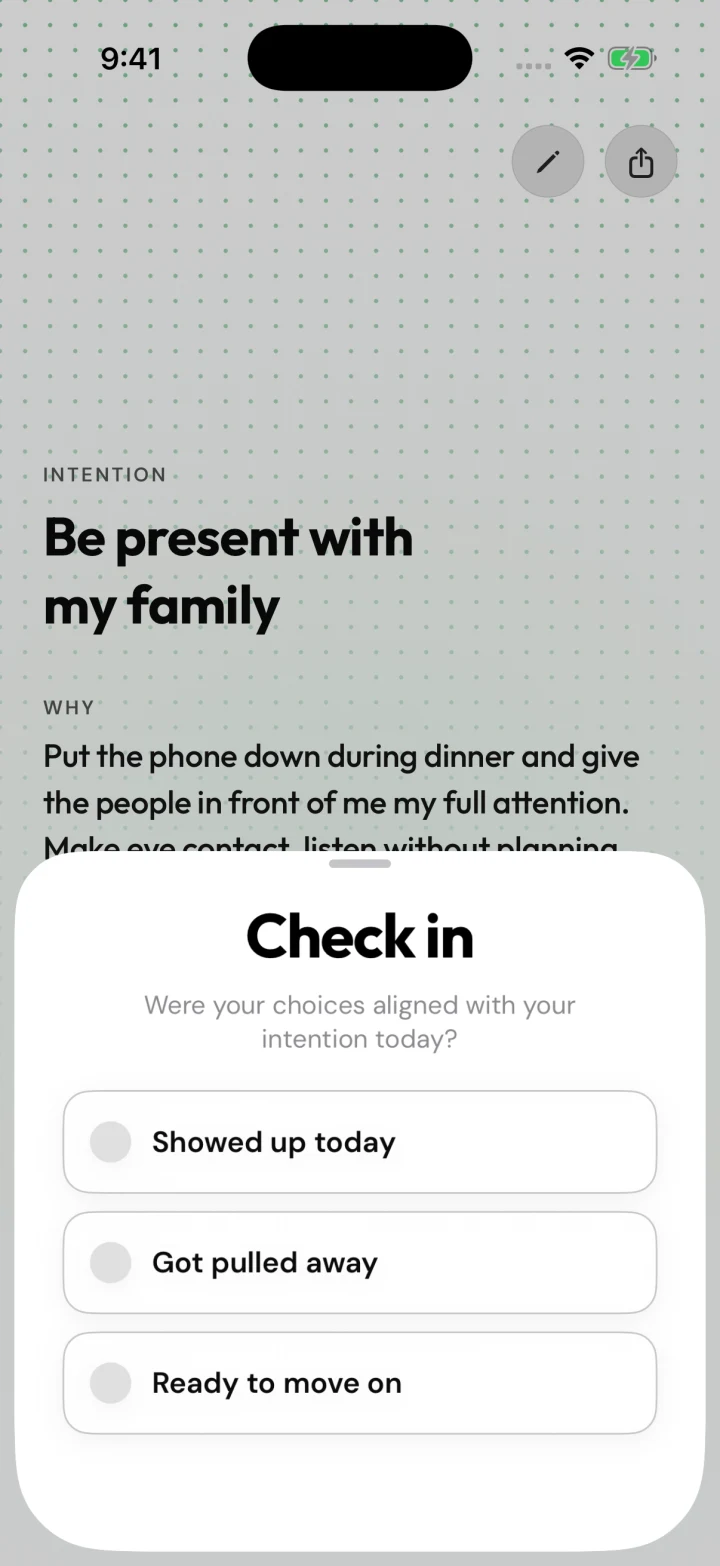
What happened when it mattered?
A check-in is a chance to notice how you acted and choose what to try next.
Clarido sample content · Tap screen to enlarge.
Keep an intention for as long as it fits
A family trip may end, while “Be present with my family” still matters at breakfast the next morning. Reaching a goal doesn't mean you need new words.
You can also carry an intention without a goal attached. “Listen before I respond” can guide a conversation with your partner, a colleague, or a friend. Keep it while it's useful, and change it when your priorities shift.
Choose an intention to carry with you
Start with a goal you already have, or a part of your day that needs more care. Ask how you want to show up there. For help finding the words, follow our guide to setting an intention.
Clarido helps you talk through what matters, choose one intention, and put it on your lock screen. Later, a check-in gives you space to notice how you showed up. The words stay close to the moments when you want to use them.
Get the next essay
Occasional articles on choosing what matters and returning to it. Unsubscribe anytime.