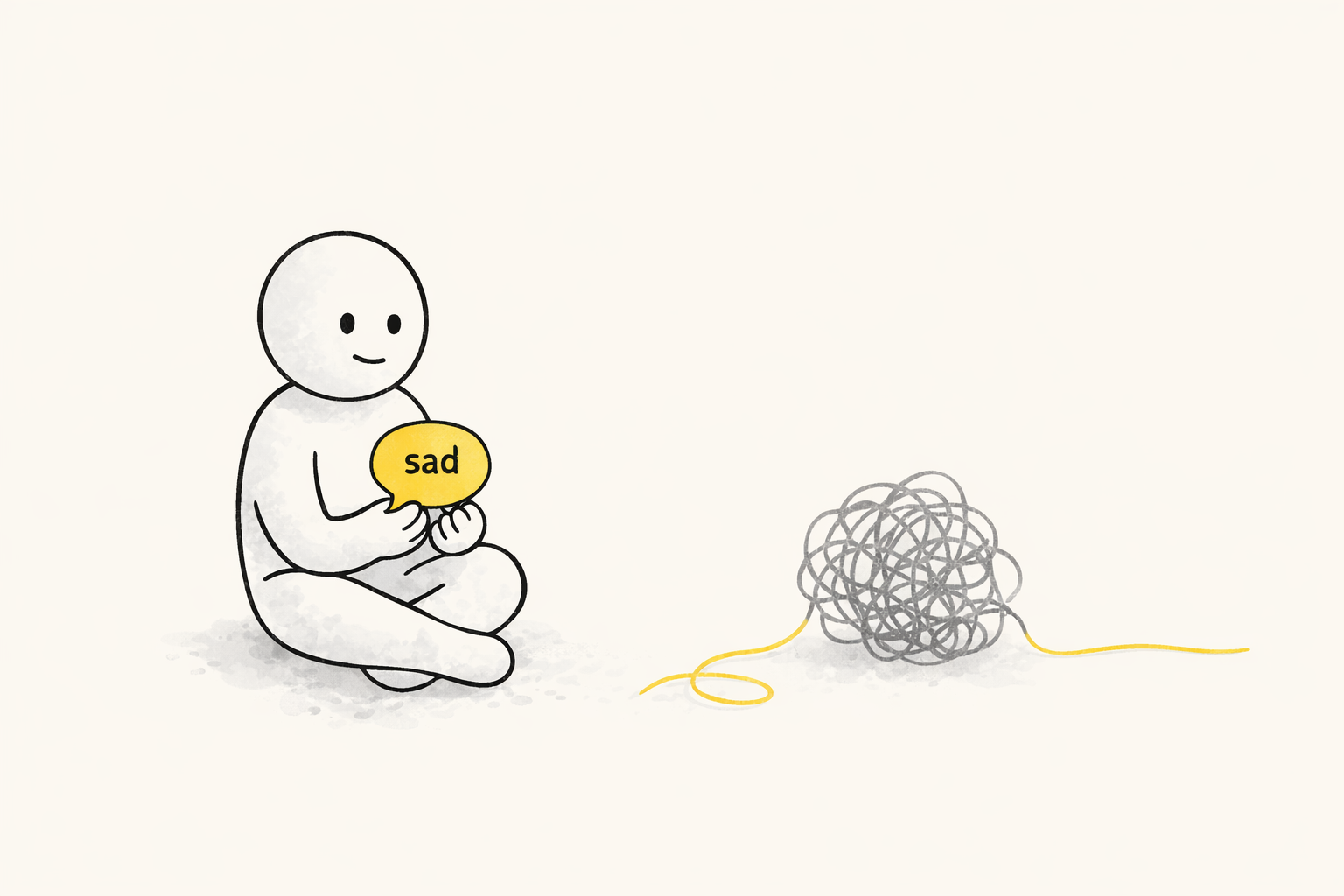
Why Naming the Feeling Makes It Smaller
You can't think clearly when you're swamped by a feeling you can't name. Decades of neuroscience explain why putting words to what you feel is one of the most powerful things you can do.

That feeling you can't quite name
You know the one. Something's been off all day. Not sad exactly. Not angry. Just... heavy. A background hum of something you can't pin down that colors everything you do.
Most people try to push through it. Or distract themselves. Or wait for it to pass.
But the single most effective thing you can do is also the simplest: say what it is.
"I'm anxious." "I'm frustrated." "I feel guilty and I don't know why."
Something happens when you do this. The feeling gets quieter. Not gone, but genuinely reduced in intensity. And the explanation for why this works is one of the more interesting findings in modern neuroscience.
What your brain does when you name a feeling
In 2007, a research team at UCLA led by Matthew Lieberman put people in an fMRI scanner and showed them images of faces expressing strong emotions. When participants simply looked at the faces, their amygdala lit up. The amygdala is your brain's alarm system. It's the part that says something is happening, pay attention, react.
But when those same participants chose a word for what they saw ("angry," "afraid," "sad"), something changed. Amygdala activity dropped. And a different region, the right ventrolateral prefrontal cortex, activated instead.
What was happening? The act of labeling the emotion was shifting the brain from reacting to processing. From feeling to thinking about feeling. And that shift, subtle as it sounds, reduced the emotional response itself.
Lieberman called this "affect labeling." The mechanism works like this: when you put a word to what you feel, you recruit your prefrontal cortex (the thinking, planning part of your brain), and that activation dampens the amygdala's response. You're not suppressing the feeling. You're processing it through language, and that processing reduces its raw intensity.
The surprising part? It works even when you're not trying to calm down. Unlike strategies like deep breathing or telling yourself "it's not that bad," affect labeling doesn't require deliberate effort. A 2018 review by Torre and Lieberman in Emotion Review confirmed that labeling is a form of implicit emotion regulation. It works automatically, below conscious intention. You don't have to believe it will help. It just does.
It's not a momentary trick
Does the effect last, or does the feeling bounce back once you stop talking about it?
Golnaz Tabibnia and colleagues tested this in 2008. They showed participants disturbing images paired with either emotional labels or neutral descriptions, then brought them back a week later. The group that had labeled their emotions during the first session showed significantly lower physiological fear responses to the same images seven days later. The neutral-description group showed no such benefit.
So it's not distraction. Distraction wears off. Something about the act of naming rewires how your brain stores and responds to the emotional experience. The label doesn't just reduce the feeling in the moment. It changes how your brain files that experience for next time.
Naming beats "thinking positive"
Here's where it gets interesting for anyone who's ever been told to look on the bright side.
In 2012, Katharina Kircanski, Lieberman, and Michelle Craske ran a study with 88 spider-phobic participants. Real spiders. Real phobia. They divided participants into four groups during exposure therapy: one group labeled their emotions out loud ("I feel anxious and afraid of that ugly spider"), one practiced reappraisal ("that spider can't hurt me"), one used distraction, and one just did standard exposure.
A week later, all groups returned. Different room. Different spider.
The group that had named their fear showed the lowest physiological fear response of all four groups. Lower than reappraisal. Lower than distraction. Lower than exposure alone.
And here's the counterintuitive detail: participants who used the most fear and anxiety words during the labeling session showed the greatest reduction in fear at follow-up. Speaking the feeling didn't amplify it. Speaking it dissolved it.
This runs against every instinct. We avoid naming painful emotions because we assume that saying "I'm afraid" will make the fear bigger. The research says the opposite. The feelings you refuse to name are the ones that keep their grip on you.
Why "fine" is not a feeling
There's a catch. The precision of your label matters.
Lisa Feldman Barrett has spent decades studying what she calls "emotional granularity": the ability to make fine-grained distinctions between emotional states. In a 2001 study with James Gross, she found that people who distinguish between guilt and shame and embarrassment (rather than lumping them all as "I feel bad") are significantly better at regulating those emotions. Especially when the intensity is high.
Why would precision matter? Think of it this way. Saying "I feel bad" leaves your brain with an undefined problem. Bad how? Bad like sad? Bad like guilty? Bad like physically exhausted from pretending all day? Each of those has different causes and different solutions. When you label precisely, you give your brain something it can actually work with.
Todd Kashdan, Barrett, and Patrick McKnight extended this in a 2015 review. People with high emotional granularity don't just regulate better. They're less likely to binge drink when stressed, less aggressive, less prone to self-harm, and experience less severe anxiety and depression. Not because they feel less, but because they understand what they feel with enough precision to respond appropriately instead of reactively.
The skill isn't about having a large vocabulary. It's about paying enough attention to your inner experience to notice the difference between anxious and overwhelmed, between angry and hurt, between lonely and bored. Those distinctions matter. Your brain uses them.
Writing makes it work harder
You can label emotions out loud, in your head, or on paper. But writing appears to amplify the effect.
James Pennebaker's research, spanning decades and dozens of studies, consistently shows that writing about emotional experiences for as little as 15 to 20 minutes over three to four days makes people healthier. Fewer doctor visits. Improved immune function. Reduced blood pressure.
But here's the finding that connects directly to affect labeling: the benefit depends on the words you use. Pennebaker found that participants who started with messy, scattered descriptions and gradually found precise words for what they felt showed the greatest improvements. The healing wasn't in the writing itself. It was in the naming. The process of finding the right words for what you felt.
What this looks like in practice
You don't need a journal or a therapist or a dedicated routine. The minimum viable version is noticing you're feeling something and putting a word on it. Out loud works. In your head works. Written down works better.
In the moment
Pause and name it
"I feel defensive right now."
End of day
Two minutes, name what you carried
When overwhelmed
Write until the fog clears
That third example matters. You don't need to get the label right on the first try. The process of searching for the right word is the regulation. Fumbling toward "dread" from "bad" is doing the work. Your prefrontal cortex is engaging, your amygdala is quieting, and you're building the granularity that Barrett and Kashdan's research says predicts better mental health outcomes across the board.
The people who benefit most from this aren't the ones who already have a rich emotional vocabulary. They're the ones who start with "I feel bad" and learn, over time, to be more specific. The skill develops with practice. And the payoff is real: less reactivity, less overwhelm, more capacity to deal with what's bothering you instead of being swamped by it.
The quiet skill
There's something almost too simple about this. Name the thing and the thing gets smaller? It sounds like a trick.
But the neuroscience is consistent. The clinical applications work. And the mechanism makes sense: your brain can't fully react to an emotion and process it through language at the same time. When you label a feeling, you force a shift from one mode to the other. Reaction decreases. Understanding increases. And the feeling, still present, becomes something you can work with instead of something that works on you.
Most people walk around carrying feelings they haven't named. A vague tightness. A persistent unease. A heaviness they attribute to being tired when it's actually grief, or resentment, or fear about something specific they could articulate if they tried. The feeling persists partly because it hasn't been articulated. It's running in the background, consuming resources, because your brain hasn't filed it properly. (If that sounds familiar, it's the same open-loop problem that makes unfinished tasks haunt you. Unexamined emotions work the same way.)
So the next time you feel that fog, try the simplest thing. Give it a name. Be wrong about it. Try again. Get more specific. You're not doing therapy. You're just giving your brain the one thing it needs to start letting go.
Get the next essay
One article per week on the psychology of thinking clearly. No spam, unsubscribe anytime.
References
- Lieberman, M.D., Eisenberger, N.I., Crockett, M.J., Tom, S.M., Pfeifer, J.H., & Way, B.M. (2007). "Putting Feelings into Words: Affect Labeling Disrupts Amygdala Activity in Response to Affective Stimuli." Psychological Science, 18(5), 421–428.
- Torre, J.B. & Lieberman, M.D. (2018). "Putting Feelings into Words: Affect Labeling as Implicit Emotion Regulation." Emotion Review, 10(2), 116–124.
- Tabibnia, G., Lieberman, M.D., & Craske, M.G. (2008). "The Lasting Effect of Words on Feelings." Emotion, 8(3), 307–317.
- Kircanski, K., Lieberman, M.D., & Craske, M.G. (2012). "Feelings into Words: Contributions of Language to Exposure Therapy." Psychological Science, 23(10), 1086–1091.
- Barrett, L.F., Gross, J.J., Christensen, T.C., & Benvenuto, M. (2001). "Knowing What You're Feeling and Knowing What to Do about It: Mapping the Relation between Emotion Differentiation and Emotion Regulation." Cognition and Emotion, 15(6), 713–724.
- Kashdan, T.B., Barrett, L.F., & McKnight, P.E. (2015). "Unpacking Emotion Differentiation: Transforming Unpleasant Experience by Perceiving Distinctions in Negativity." Current Directions in Psychological Science, 24(1), 10–16.
- Pennebaker, J.W. (1997). "Writing about Emotional Experiences as a Therapeutic Process." Psychological Science, 8(3), 162–166.
Clarido is a quiet log for a loud mind. Speak or type what's on your mind. Clarido holds it for you so you can return when you have space. Join the beta →