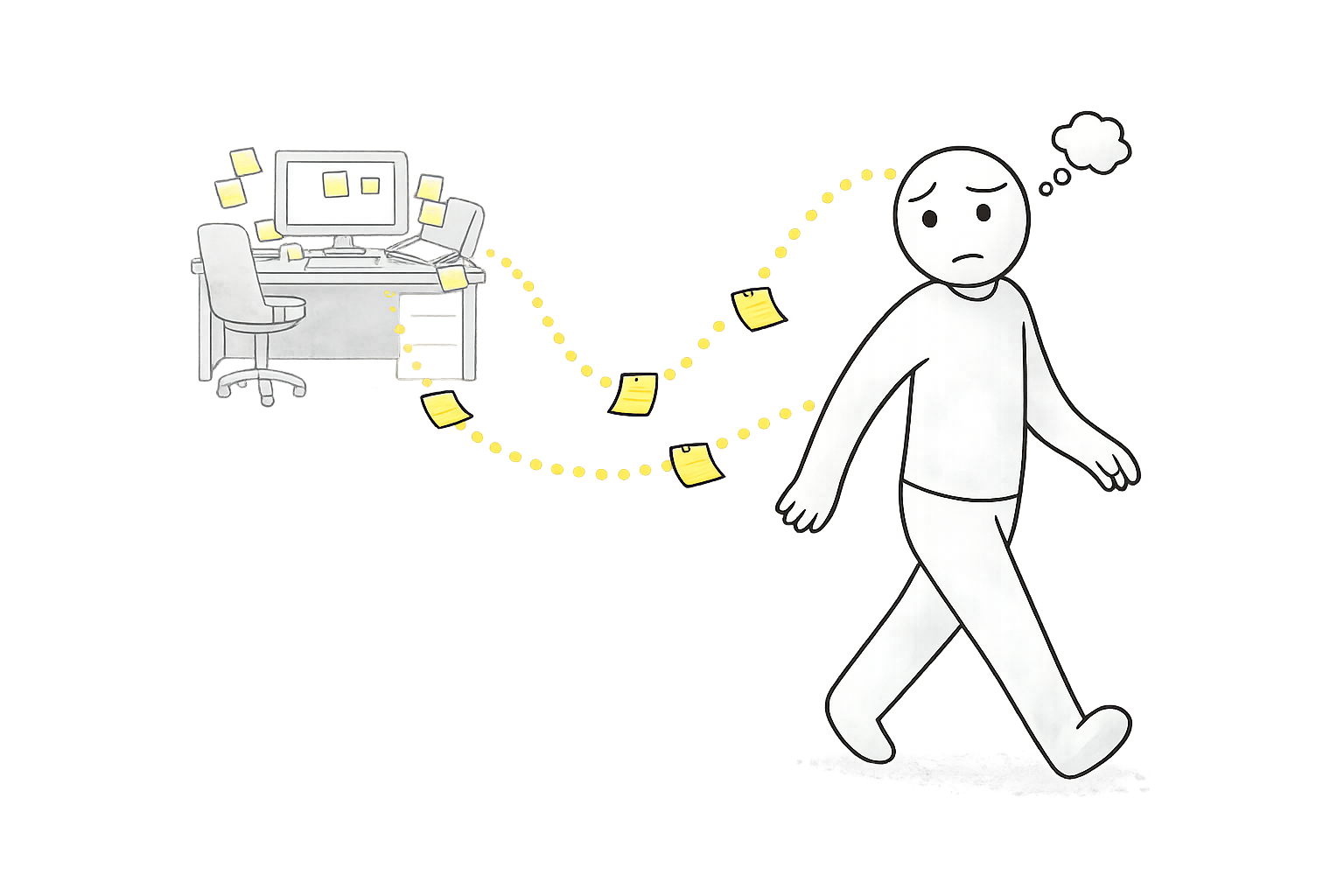
Attention Residue: Why You're Still Thinking About the Last Thing
Attention residue is why you can't focus after switching tasks — part of your brain stays stuck on what you were doing before. Here's the science behind it and how to clear it.

The meeting is over. Your brain didn't get the memo.
You close your laptop after a stressful meeting and open a document you need to write. The cursor blinks. You stare at it. Five minutes pass, and you haven't typed a word. Not because the document is hard. Because your brain is still in the meeting. You're replaying what your manager said, composing the response you wish you'd given, worrying about the follow-up.
The meeting ended twenty minutes ago. But a piece of your attention never left.
This isn't a focus problem. It's not a motivation problem. It's a specific cognitive phenomenon that a researcher at the University of Minnesota identified in 2009, and it explains something that most productivity advice completely ignores: your brain can't switch cleanly between tasks. Every time you move from one thing to another, a residue of the previous task stays behind, occupying space in your working memory and quietly degrading your ability to think.
What attention residue actually is
Sophie Leroy was studying why knowledge workers struggle to perform well after switching tasks. The obvious explanation was that switching takes time. You need to load new information, recall where you left off, get oriented. That's true. But Leroy found something more interesting.
In experiments published in Organizational Behavior and Human Decision Processes, she demonstrated that when people switch from Task A to Task B, their attention doesn't fully come with them. Part of it stays stuck on Task A, especially when Task A was left unfinished. She called this "attention residue."
When you switch tasks before finishing, a piece of your attention stays stuck on the thing you left behind.
And it's not subtle. Participants with high attention residue performed significantly worse on the subsequent task. Slower. Less accurate. More likely to miss things. Not because the new task was hard, but because they were trying to do it with a fraction of their cognitive resources.
Here's what makes this different from the usual "multitasking is bad" advice: it's not about doing two things at once. It's about what happens when you stop doing one thing and start doing another. The switch itself creates the problem. And you don't even have to be "multitasking" to experience it. You just have to change what you're working on.
The switch cost you can't see
How much does switching actually cost?
In 2001, Joshua Rubinstein, David Meyer, and Jeffrey Evans ran a series of experiments at the University of Michigan to measure exactly this. Their paper in the Journal of Experimental Psychology broke down what happens in your brain during a task switch into two stages: goal shifting (deciding to switch) and rule activation (loading the new task's rules into working memory).
Both stages take time. And the time increases with the complexity of the task you're switching to. Simple tasks? Small cost. Complex, cognitively demanding work? The cost is substantial.
That number comes from Gloria Mark's research at UC Irvine. She and her colleagues tracked knowledge workers in real offices and found that after an interruption, the average worker didn't just take a moment to refocus. They drifted through multiple other tasks before circling back to the original one. Twenty-five minutes later, they were finally back where they started.
Stephen Monsell's 2003 review in Trends in Cognitive Sciences added something uncomfortable: switch costs are never fully eliminated, even when you know the switch is coming and have time to prepare. Your brain still pays a penalty. Every single time. You can't train it away, and you can't willpower through it.
So what does this mean for a typical workday? Every time you check your email between tasks, glance at Slack during a meeting, or respond to a quick question while working on something complex, you're not just losing the few seconds it takes to read the message. You're smearing a layer of cognitive residue across whatever you do next. And you probably don't notice, because the residue doesn't feel like distraction. It feels like your normal state.
What if this foggy, scattered feeling you've accepted as normal isn't normal at all?
It's not just your focus. It's your body.
The cost of constant switching goes beyond worse thinking. It shows up physically.
Gloria Mark's 2008 study, published in the CHI conference proceedings, tracked workers through interrupted and uninterrupted conditions. The interrupted workers actually completed their tasks slightly faster (about 7%). But the price was steep: significantly higher stress, frustration, time pressure, and mental effort. They compensated for the disruption by pushing harder, and their bodies absorbed the cost.
In 2023, a team led by Lena Becker published the most rigorous study yet on the biological cost of task switching. Their randomized controlled trial, in Psychoneuroendocrinology, measured salivary markers of stress in participants assigned to multitasking, interrupted, and single-task conditions. The multitaskers showed significant increases in alpha-amylase, a marker of sympathetic nervous system activation. The same system that raises your heart rate and blood pressure when you feel threatened.
Your body treats constant task switching the way it treats a low-grade threat. Not like a car crash. More like an alarm that never turns off.
Why your brain does this
So why can't it switch cleanly? Why does it leave residue behind?
Because switching was never the design spec. Your prefrontal cortex, the part responsible for managing attention and executing tasks, evolved for sustained focus on a single problem. The ability to switch between tasks is a feature, but it's a slow, effortful one. It requires actively suppressing the neural patterns associated with the previous task and activating new ones. And suppression is incomplete. Traces of the old task linger.
Think of it like a whiteboard. You erase the previous meeting's notes to start fresh, but the ghost of the old writing is still faintly visible underneath. You can see through it, but it's slightly harder to read what you write next.
This is worse when the previous task was unfinished. Leroy's research showed it explicitly: attention residue was strongest when participants hadn't completed the prior task or didn't have a clear stopping point. Your brain treats unfinished business as an open loop (the same Zeigarnik effect that keeps incomplete tasks running in the background of your mind). When you switch away from something incomplete, your brain doesn't just leave residue. It actively keeps processing the unfinished task, pulling resources away from whatever you're supposed to be focusing on now.
What actually helps
Can you reduce attention residue? Yes. And the most effective intervention is surprisingly simple.
In 2018, Leroy and Theresa Glomb published a follow-up study in Organization Science that tested a straightforward technique. Before switching tasks, participants wrote a brief "ready-to-resume" plan: a quick note about where they left off and what they would do next when they returned.
It took less than a minute. And it significantly reduced attention residue.
The mechanism is the same one that makes writing things down so effective for clearing mental clutter. When you note where you are and what's next, you're giving your brain permission to let go. You're converting an open loop into a closed one. Not by finishing the task, but by creating a plan that your brain trusts.
Thirty seconds. That's the difference between working with your full cognitive capacity and working with whatever's left after your brain allocated resources to tracking everything you left undone.
A few other things the research points to:
Batch your switches. If you're going to check email, check it once and process everything. Don't dip in and out throughout the day. Every dip creates new residue.
Finish before you switch when you can. Attention residue is weakest when the previous task reached a natural stopping point. If you can push through to the end of a section, a draft, or a milestone before switching, do it.
Protect your complex work. The cost of switching scales with complexity. Routine tasks can absorb some residue without much damage. Deep, creative, analytical work cannot. Schedule your hardest thinking for blocks where you won't be interrupted.
Name what's lingering. Sometimes the residue isn't from a task. It's from an emotion. The meeting that bothered you. The conversation you're replaying. Writing it down, even a single sentence, can be enough to release it. Your brain needs to know the thought has been captured somewhere outside your head.
The quiet tax
Most people who feel scattered and unfocused blame themselves. They think they lack discipline, or that they need a better productivity system, or that something is wrong with their attention span.
Usually, none of that is true.
What's actually happening is simpler and more fixable. They're switching between things constantly, all day long, and paying a residue tax on every transition. They're trying to do focused work with a mind that's still partly somewhere else. And they don't notice the tax because it doesn't arrive as a single, obvious bill. It accumulates quietly. A faint, persistent fog. The kind where you look up at 5pm and wonder what you actually accomplished.
The answer isn't to stop switching entirely. That's not realistic. But knowing the tax exists changes how you structure your day. You start protecting transitions instead of treating them as free. You give yourself thirty seconds to close one loop before opening the next. You stop checking your phone between tasks because you understand, concretely, what it costs.
And sometimes, when you notice that your brain is still somewhere else, you just stop. Write down the thing that's following you. Let it go. Then begin again, with your full attention this time.
Get the next essay
One article per week on the psychology of thinking clearly. No spam, unsubscribe anytime.
References
- Leroy, S. (2009). "Why Is It So Hard to Do My Work? The Challenge of Attention Residue When Switching Between Work Tasks." Organizational Behavior and Human Decision Processes, 109(2), 168–181.
- Leroy, S. & Glomb, T.M. (2018). "Tasks Interrupted: How Anticipating Time Pressure on Resumption of an Interrupted Task Causes Attention Residue and Low Performance on Interrupting Tasks and How a 'Ready-to-Resume' Plan Mitigates the Effects." Organization Science, 29(3), 380–397.
- Rubinstein, J.S., Meyer, D.E. & Evans, J.E. (2001). "Executive Control of Cognitive Processes in Task Switching." Journal of Experimental Psychology: Human Perception and Performance, 27(4), 763–797.
- Mark, G., Gonzalez, V.M. & Harris, J. (2005). "No Task Left Behind? Examining the Nature of Fragmented Work." Proceedings of the SIGCHI Conference on Human Factors in Computing Systems (CHI '05), 321–330.
- Mark, G., Gudith, D. & Klocke, U. (2008). "The Cost of Interrupted Work: More Speed and Stress." Proceedings of the SIGCHI Conference on Human Factors in Computing Systems (CHI '08), 107–110.
- Monsell, S. (2003). "Task Switching." Trends in Cognitive Sciences, 7(3), 134–140.
- Becker, L., Kaltenegger, H.C., Nowak, D., Weigl, M. & Rohleder, N. (2023). "Biological Stress Responses to Multitasking and Work Interruptions: A Randomized Controlled Trial." Psychoneuroendocrinology, 156, 106358.
Clarido is a quiet log for a loud mind. Speak or type what's on your mind. Clarido holds it for you so you can return when you have space. Join the beta →