The 5-Minute Fix for Racing Thoughts at 3AM
Your brain won't shut up at night because it thinks you'll forget something important. Here's the research-backed trick that tells it to stand down.
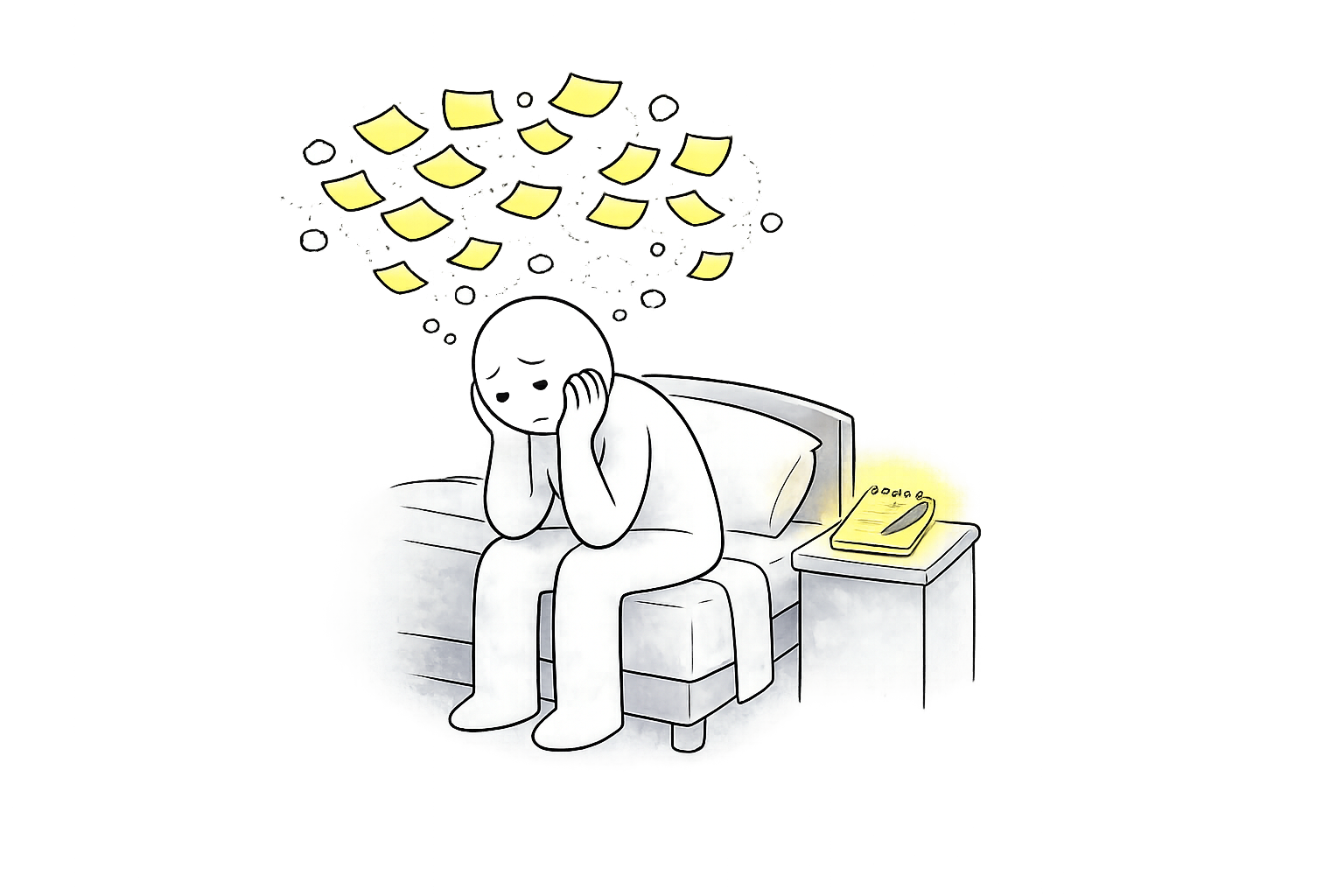
You know the feeling
You're tired. Genuinely, physically tired. You've been awake since 6am. Your eyes are heavy, your body is done.
And then you lie down. And your brain turns on.
Not gently, like a dim nightlight. More like a stadium flood lamp. Suddenly you're thinking about the email you forgot to send, the conversation you handled poorly, the appointment you might have scheduled for the wrong day. One thought drags in another. That drags in three more. Twenty minutes later you're wide awake, staring at the ceiling, somehow more alert than you were at noon.
Sound familiar? You're not alone. And you're not broken. What's happening in your head has a name, a known mechanism, and a surprisingly simple fix.
Why your brain won't shut up
In 2002, psychologist Allison Harvey at the University of Oxford proposed a model that changed how researchers think about insomnia. Her paper in Behaviour Research and Therapy laid out a feedback loop that most people with racing thoughts will recognize instantly.
It works like this. You lie down, and your brain starts reviewing unresolved things. Worries about tomorrow. Regrets about today. Tasks you haven't finished. This triggers a mild stress response. Your heart rate ticks up. Your body releases a small amount of cortisol. Now you're slightly more alert, which means you notice more thoughts, which triggers more arousal, which produces more thoughts.
The problem isn't that you have worries. It's that lying in the dark with nothing to do gives your brain a quiet stage to rehearse every single one of them.
So why do some people lie awake while others drift off easily? Harvey found that people with insomnia don't necessarily have more problems than good sleepers. They have the same problems. The difference is when those problems get their attention. Good sleepers process their worries earlier in the day, often without realizing it. Poor sleepers save them, unintentionally, for the moment they hit the pillow.
Here's what makes this worse: your brain treats unresolved tasks and worries as threats. Not the same category as a bear in the woods. But the same basic system. The amygdala flags incomplete items as things that need monitoring. And monitoring, your brain has decided, is more important than sleep.
The experiment that changed everything
In 2018, a neuroscientist named Michael Scullin at Baylor University ran a simple experiment. He brought 57 young adults into a sleep lab, hooked them up to polysomnography equipment (the kind that tracks exactly when you fall asleep, down to the minute), and gave them one task before bed.
Half the group spent five minutes writing a to-do list. Everything they needed to do in the next few days. The other half spent five minutes writing about things they'd already completed that day.
Nine minutes might not sound like much. But how many sleep aids can promise that without side effects or a prescription?
And there was a catch that made the finding even more interesting. The more specific the to-do list, the faster the person fell asleep. People who wrote vague items like "work on project" didn't get the same benefit as people who wrote "email Lisa the draft by 10am, then revise section 3 before the team meeting."
Why? Because your brain isn't just tracking what you need to do. It's tracking whether you have a plan for it. Vague intentions stay open. Specific plans close the loop.
The mechanism: closing open loops
This connects to something researchers have understood for over a decade. In 2011, E.J. Masicampo and Roy Baumeister published a study in the Journal of Personality and Social Psychology that tested a long-standing assumption about the Zeigarnik effect (the tendency for incomplete tasks to keep intruding on your thoughts).
The assumption was straightforward: unfinished tasks nag you until you finish them. But what if that's not quite right? Masicampo and Baumeister found something different. You don't actually have to finish the task. You just have to make a concrete plan for when and how you'll do it. Once you write that plan down, the intrusive thoughts stop.
Think about what this means for your brain at 3am. It's not keeping you awake because it's cruel. It's keeping you awake because it doesn't trust you to remember. It's running a background alarm system: don't forget, don't forget, don't forget. Writing a specific plan is the equivalent of telling your brain: I've got this. You can stand down now.
And this isn't limited to tasks. It works for worries too.
The worry version
Thomas Borkovec, a psychologist at Penn State, pioneered a technique in 1983 called "worry postponement." The idea sounds almost too simple: when you catch yourself worrying, write the worry down and assign it a specific time tomorrow when you'll deal with it.
What he found, published in Behaviour Research and Therapy, was that worries lose most of their intensity when revisited at the scheduled time. The thing that felt urgent and catastrophic at midnight often feels manageable at 10am. Not because the problem changed. Because your brain processes threats differently when it's rested, when the lights are on, when you're not lying in a dark room with nothing but your thoughts for company.
This evolved into what sleep researchers now call "constructive worry." It's now a core technique in Cognitive Behavioral Therapy for Insomnia (CBT-I), the gold standard treatment for chronic insomnia, outperforming medication in long-term studies. The practice looks like this:
1. Write the worry
Put it on paper exactly as it appears in your head. Don't filter or analyze. Just capture it.
2. Write one next step
Not a solution. Just the single next action you'd take to address it.
3. Assign it a time
When will you do that next step? Give it a day and a rough time.
That's it. The worry gets acknowledged, given a plan, and scheduled. Your brain can stop running the alarm.
Allison Harvey tested a variation of this in 2003. She had poor sleepers spend time writing about their worries before bed, with emphasis on expressing and processing the emotion behind them. The writing group reported falling asleep faster than the control group. Not because their problems were solved. Because their problems were contained.
Why this works better than "just relax"
Ever tried to "just relax" your way out of racing thoughts? Deep breathing, progressive muscle relaxation, counting sheep. Maybe those work for some people. But for a lot of people with racing thoughts, relaxation techniques feel like trying to put out a fire by ignoring it.
The reason is that your brain is doing something functional. It's flagging unresolved items. Telling it to relax without addressing those items is like telling a smoke detector to be quiet while the toast is still burning. Your brain knows something is unresolved. It will keep reminding you until you prove you've acknowledged it.
Writing is the proof. It externalizes the thought, assigns it a plan, and gives your brain evidence that the item won't be forgotten. That's why Scullin's to-do list worked and the completed-activities list didn't: your brain doesn't need help remembering what's already done. It needs help letting go of what isn't.
The five-minute version
You don't need a journal. You don't need a system. You need a piece of paper, five minutes, and willingness to write badly.
Here's what to do tonight, about 30 minutes before you want to fall asleep. Not in bed. At a desk, or a table, or the kitchen counter. (Keeping the writing separate from the sleeping space matters. You don't want your brain associating bed with problem-solving.)
Write down everything that's on your mind. Tasks, worries, random thoughts, things that bothered you today, things you're anxious about tomorrow. Don't organize. Don't prioritize. Just dump.
Then go through the list. For each item, write the next concrete action and when you'll do it. What about items that don't have a clear action, like "I'm worried about whether I made the right decision"? Write them down anyway. Often the act of naming the worry is enough. Your brain was keeping it in active memory because it was formless. Putting words around it makes it finite.
Fold the paper. Put it on your desk. Go to bed.
What's really going on
So what's really going on here? Something deeper than a productivity trick.
Racing thoughts at night are your brain trying to protect you. Every worry, every unfinished task, every replayed conversation is your mind saying: this matters, and I don't want you to lose it. The problem isn't that your brain is malfunctioning. It's that it doesn't have anywhere safe to put things down.
James Pennebaker, who spent decades studying expressive writing, found that the act of writing about stressful experiences changes how people process them. Writing forces specificity. You can loop on a vague worry forever, turning it over and over without progress. But you can't write about something without pinning it down, giving it edges, making it concrete. And concrete things are smaller than formless ones.
That's the real reason this works. Not because writing is magic. Because your brain needs to know that the things it's holding will be remembered. Give it that assurance, and it will let you sleep.
The unfinished tasks stop looping. The worries shrink. The 3am wake-ups get quieter. Not because your life got simpler. Because you finally gave your brain permission to stop carrying everything alone.
Get the next essay
One article per week on the psychology of thinking clearly. No spam, unsubscribe anytime.
References
- Harvey, A.G. (2002). "A Cognitive Model of Insomnia." Behaviour Research and Therapy, 40(8), 869–893.
- Scullin, M.K., Krueger, M.L., Ballard, H.K., Pruett, N., & Bliwise, D.L. (2018). "The Effects of Bedtime Writing on Difficulty Falling Asleep: A Polysomnographic Study Comparing To-Do Lists and Completed Activity Lists." Journal of Experimental Psychology: General, 147(1), 139–146.
- Masicampo, E.J. & Baumeister, R.F. (2011). "Consider It Done! Plan Making Can Eliminate the Cognitive Effects of Unfulfilled Goals." Journal of Personality and Social Psychology, 101(4), 667–683.
- Borkovec, T.D., Wilkinson, L., Folensbee, R., & Lerman, C. (1983). "Stimulus Control Applications to the Treatment of Worry." Behaviour Research and Therapy, 21(3), 247–251.
- Harvey, A.G. & Farrell, C. (2003). "The Efficacy of a Pennebaker-Like Writing Intervention for Poor Sleepers." Behavioral Sleep Medicine, 1(2), 115–124.
- Pennebaker, J.W. & Beall, S.K. (1986). "Confronting a Traumatic Event: Toward an Understanding of Inhibition and Disease." Journal of Abnormal Psychology, 95(3), 274–281.
Clarido is a quiet log for a loud mind. Speak or type what's on your mind. Clarido holds it for you so you can return when you have space. Join the beta →