Self-Reflection Prompts for When You Feel Stuck
You said yes when you wanted a quiet weekend. Or you spent dinner thinking about work. These self-reflection questions help you look at one moment, understand what mattered, and choose what to try next.
Start with something familiar.
Pick a situation. Think about your own version as you explore the questions, or open an example if you need a starting point.
Leah had kept Saturday free. When a friend asked for help moving, she said yes before checking how much time she had. Now she’s annoyed with both of them.
These are fictional examples. Your answer may be different.
What happened just before I said yes?
Go back to the request. What did you think would happen if you paused or said no?
I thought she’d think I was selfish. I agreed before I’d even looked at my calendar.
Question 1 of 3: What happened just before I said yes?
What makes a reflection useful?
Self-reflection means taking a closer look at your own thoughts, feelings, and choices. A prompt is a question that gives you somewhere to begin.
You might already know that you’re stretched thin. The useful part is finding the moment when you agreed to something you didn’t have room for, and asking what made it hard to pause.
That gives you something to work with. You may need to ask for help, change a plan, or have a conversation you’ve been avoiding. Sometimes you’ll realize that you need rest before making a decision.
The examples above offer possible answers. They aren’t the answers you’re supposed to reach. If the question doesn’t fit, choose another situation or use the exercise below with a moment from your own life.
Try three questions with your own situation
You can use these as journal prompts, answer them aloud, or just take a moment to think. Start with something recent enough to remember clearly.
Keep the first answer close to the event. “I’m terrible at boundaries” makes a claim about your whole character. “I offered to take the extra shift because I didn’t want to let the team down” describes a choice you can look at.
Then consider what was missing. Was it time, support, information, or a chance to say what you needed? Your next step should follow from that answer. If you already have too much work, that might mean asking your manager which task can wait.
Give the thought somewhere to go
Suppose you notice that you often answer requests before checking your own plans. “Give myself a moment before I say yes” could become your intention. The next time a message arrives, you could say, “Let me check and get back to you.”
An intention holds onto what you want to practice. An action is one way to practice it. You can keep the same intention while trying different actions as your situation changes.
Our guide to setting an intention can help you find your own words. If you’d rather browse first, look through these intention examples for work, family, and personal time.
When you’d like someone to guide the questions
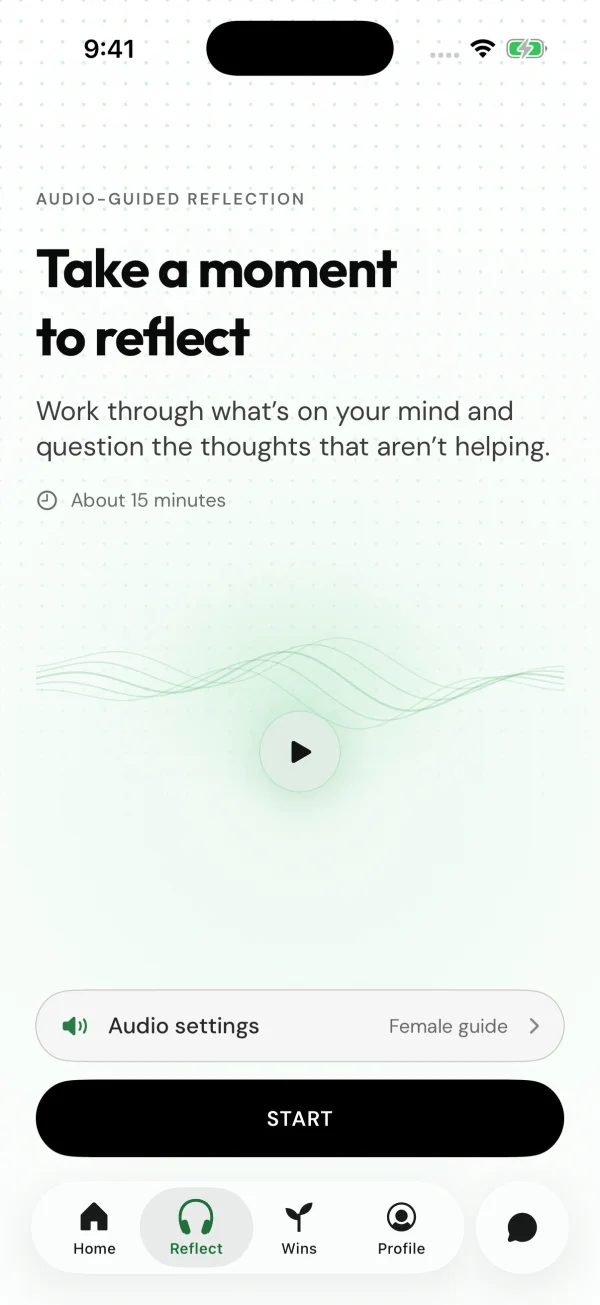
It can be hard to ask yourself a useful next question. Clarido’s guided audio reflections offer a way to talk through a situation. You listen and respond, then consider a concrete next step and a suggested intention. You can edit the words or keep the intention you already have.
Space to talk it through.
A guided session takes about 15 minutes. Carry an intention from the conversation onto your lock screen, then use a check-in to notice what happened.
App screen · Tap to enlarge.
Questions about self-reflection
What if I don’t know how to answer?
Try describing the scene first: where you were, who was there, and what someone said. “I felt off all day” may be hard to explore. “I felt annoyed after I agreed to stay late” gives you a moment to start with. You don’t need to decide why right away.
Do I need to reflect every day?
No. You can return when there’s something you want to understand, or check in after trying a different response. The point is to learn something useful about your life. You don’t need a new insight every evening.
What if I keep going over the same thing?
You can stop. If you’re repeating the same criticism without noticing anything new, more questions may not help right now. Leave it for another time, or try our guide to reflecting without getting stuck in the same thought.
Get the next essay
Occasional articles on choosing what matters and returning to it. Unsubscribe anytime.