Your Brain Has a Built-In Bad News Filter
One harsh comment can ruin a day full of wins. That's not weakness. It's a 200,000-year-old survival system that's still running in the background.
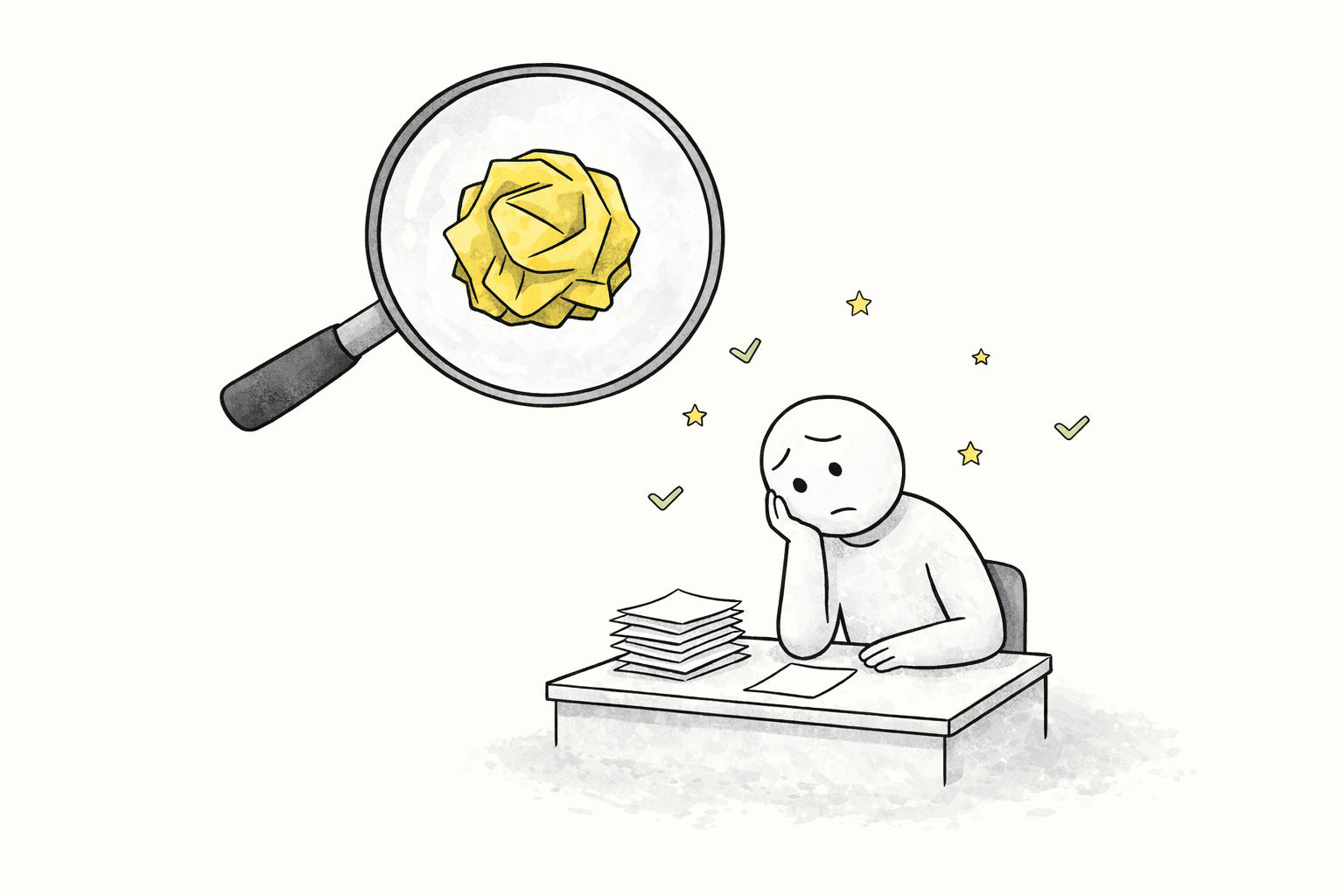
The comment that ruined the whole day
You get nine compliments and one criticism. Which one do you think about in the shower that night?
You already know the answer. Everyone does. The criticism. It sticks. It loops. It rewrites the entire day in its own image, until the nine good things feel like background noise and the one bad thing feels like the headline.
This isn't a personality flaw. It isn't low self-esteem or a negativity problem you need to fix with affirmations. It's a feature of the human brain that's been running continuously for about 200,000 years, and it has a name: the negativity bias.
What the negativity bias actually is
In 2001, Roy Baumeister and three colleagues published a paper with one of the most straightforward titles in the history of psychology: "Bad Is Stronger than Good." The review, which has since been cited over 10,000 times, examined evidence from across dozens of domains: emotions, relationships, learning, memory, impression formation, feedback processing. Their conclusion was blunt. In virtually every area they examined, negative events, emotions, and information carried more weight than positive ones. Not a little more. Substantially more.
That 2:1 ratio comes from Daniel Kahneman and Amos Tversky's prospect theory, one of the most influential papers in behavioral economics. But the asymmetry shows up everywhere, not just in money. Bad first impressions are harder to reverse than good ones. Negative feedback changes behavior more than positive feedback. A single act of betrayal destroys trust that took years of reliable behavior to build.
Why? Why would the brain be wired to overweight bad things?
The survival logic
Because the cost of missing a threat was death, and the cost of missing an opportunity was just a missed opportunity.
Think about it from an evolutionary standpoint. Your ancestors lived in environments where dangers were immediate and lethal. A rustle in the grass could be a snake. A stranger approaching the group could be hostile. The ones who treated ambiguous signals as potentially dangerous survived long enough to reproduce. The ones who shrugged and assumed the best did not, at least not as consistently.
Paul Rozin and Edward Royzman formalized this in their 2001 paper on negativity bias, identifying four distinct ways the brain privileges negative information. Negative events are more potent than equivalent positive ones. They grow in perceived severity faster as they approach. Combinations of good and bad tilt negative. And the brain generates more nuanced, detailed representations of bad things than good things.
That last one is worth pausing on. Your brain literally thinks harder about bad experiences. It builds more complex mental models of threats than of rewards. Which explains something you've probably noticed: you can describe in vivid detail the worst meal you've ever had, but you'd struggle to describe the best one with the same precision.
It starts before you can talk
Is this something you learn, or something you're born with?
Amrisha Vaish and colleagues tackled this question in a 2008 review published in Psychological Bulletin. They examined studies on infant social referencing, which is how babies use adult emotional reactions to evaluate new situations. The findings were clear: infants as young as three months old show a negativity bias. They pay more attention to fearful faces than happy ones. They learn faster from negative social cues. They're more cautious after seeing an adult react negatively to an object than they are encouraged after seeing a positive reaction.
This means the negativity bias isn't something your parents taught you or something you picked up from watching the news. It's factory-installed. Your brain arrived wired to treat negative information as more urgent, more important, and more worthy of your limited attention than positive information.
Your brain doesn't weigh good and bad equally. It never has. Bad gets priority processing, and it has since before you could walk.
Your brain lights up differently for bad news
In 1998, Tiffany Ito and her colleagues at Ohio State ran an experiment that made the negativity bias visible. They showed participants positive, negative, and neutral images while measuring their brain activity using event-related potentials (ERPs), electrical signals that reveal what the brain is doing in real time.
The results were striking. Negative images produced larger brain responses than positive images, even when both were equally extreme and equally arousing. The brain wasn't just reacting to intensity. It was specifically amplifying negative information. And this amplification happened at the earliest stage of processing, during the initial categorization of "what is this thing?" Not later, during deliberation. Not after reflection. Immediately.
This is why bad news feels like it hits harder. It literally does. Your brain allocates more neural resources to processing it. The criticism from your boss activates more cognitive machinery than the praise. The angry text gets more mental bandwidth than the kind one.
The 5:1 problem
John Gottman spent decades studying what makes relationships work and what makes them fail. He'd bring couples into his lab, record their interactions, and track which couples stayed together and which divorced. After observing thousands of couples, he identified a ratio that predicted relationship stability with remarkable accuracy.
Five positive interactions for every negative one. Not 1:1. Not 2:1. Five to one. That's how much work it takes to counterbalance the disproportionate weight of a single negative exchange.
Think about what that means for daily life. If you snap at your partner once in the morning, it takes five separate positive moments to restore equilibrium. Not because your partner is keeping score, but because their brain (like yours) is wired to register the snap more deeply than the kindness.
This ratio shows up beyond romantic relationships too. Research on high-performing teams found a similar pattern: the most effective teams had roughly 5.6 positive interactions for every negative one. The least effective had ratios below 1:1.
Why your inner monologue skews dark
Here's where this gets personal. The negativity bias doesn't just affect how you process external events. It shapes how you talk to yourself.
When you replay a conversation, which parts get the most airtime? The awkward thing you said, or the three insightful points you made? When you review your week, what stands out? The project you finished, or the email you forgot to send?
Your internal narrator has the same bias your brain does. It filters for threats, mistakes, and shortcomings because those are the categories the brain treats as high-priority. The result is a skewed internal picture where your failures feel prominent and your successes feel like they barely happened.
This connects directly to rumination. When you spiral on the same thought, it's often a negative one, because the negativity bias gives those thoughts stickier hooks. They grab your attention and resist being dismissed. A positive thought floats through. A negative thought anchors.
You can't delete the bias, but you can see it
The negativity bias is hardwired. You're not going to meditate it away or overcome it through sheer will. But knowing it exists changes the game, because once you see the pattern, you can start adjusting for it.
The first adjustment is simply noticing when the filter is active. When one bad thing is coloring your entire day, that's the bias talking. When you're ruminating on a mistake while ignoring three wins, that's the bias. When you feel like everything is falling apart and the evidence doesn't support that, the bias is distorting your read.
This is where naming what you feel becomes useful. Research on affect labeling shows that simply identifying an emotion ("I'm anxious about what she said") reduces its intensity by dampening amygdala activation. You're not suppressing the negativity bias. You're adding a layer of awareness between the automatic reaction and your response to it.
The second adjustment is getting things out of your head. The negativity bias is amplified by rumination, and rumination thrives when thoughts stay unexamined inside your mind. Writing forces you to articulate the negative thought concretely, which often reveals that it's smaller and more specific than the vague dread it was generating.
The third is exposure over time. Not everything needs to be resolved in the moment. Sometimes the most useful thing you can do is notice "my brain is doing the negativity thing again," and let the thought exist without treating it as the final word on reality.
The brain you have
The negativity bias isn't going anywhere. It's too deeply woven into how your brain processes information, from the neural level up. And honestly, you wouldn't want it gone entirely. It's the reason you pull your hand back from a hot stove faster than you reach for a cookie. It kept your ancestors alive. It keeps you alert to genuine dangers.
The problem is that it's running the same software in a radically different environment. The threats you face today are social, not physical. An unanswered text isn't a predator. A critical performance review isn't a famine. But your brain responds to them with the same urgency it evolved for actual survival threats.
So the goal isn't to eliminate the bias. It's to stop letting it narrate your life unchecked. To notice when it's amplifying a bad moment into a bad day. To remember that your brain's threat detector is sensitive by design, and that sensitivity doesn't mean its readings are accurate.
You're not wired for misery. You're wired for survival. Those are different things, and in the modern world, the gap between them is where most unnecessary suffering lives.
Get the next essay
One article per week on the psychology of thinking clearly. No spam, unsubscribe anytime.
References
- Baumeister, R.F., Bratslavsky, E., Finkenauer, C., & Vohs, K.D. (2001). "Bad Is Stronger than Good." Review of General Psychology, 5(4), 323-370.
- Rozin, P. & Royzman, E.B. (2001). "Negativity Bias, Negativity Dominance, and Contagion." Personality and Social Psychology Review, 5(4), 296-320.
- Kahneman, D. & Tversky, A. (1979). "Prospect Theory: An Analysis of Decision under Risk." Econometrica, 47(2), 263-291.
- Ito, T.A., Larsen, J.T., Smith, N.K., & Cacioppo, J.T. (1998). "Negative Information Weighs More Heavily on the Brain: The Negativity Bias in Evaluative Categorizations." Journal of Personality and Social Psychology, 75(4), 887-900.
- Gottman, J.M. (1994). What Predicts Divorce? The Relationship Between Marital Processes and Marital Outcomes. Lawrence Erlbaum Associates.
- Vaish, A., Grossmann, T., & Woodward, A. (2008). "Not All Emotions Are Created Equal: The Negativity Bias in Social-Emotional Development." Psychological Bulletin, 134(3), 383-403.
Clarido is a quiet log for a loud mind. Speak or type what's on your mind. Clarido holds it for you so you can return when you have space. Join the beta →